Sunday, October 6, 2013

My television debut


by Agnes the goat


Those of you who follow me on Twitter already know that on Friday we taped my first television appearance. The show will air tomorrow afternoon on Paula Sands Live in Davenport, Iowa and the Quad Cities area.  My daughter Marie and I went with my milk maid Deborah, who wrote a book about goats recently. The other goats and I taught her everything she knows, so of course, she had to bring us along to publicly thank me and the other does back home for all of our assistance.

First of all, I have to say that I was really disappointed in the travel accommodations. I was shocked and horrified to discover that we were expected to travel to the TV studio in dog crates! Oh, yes, we each got our own private crate, and they were big enough for us to stand up and turn around, and they were filled with fluffy straw, and we were even given some hay for snacking, but really -- dog crates! We are caprines not canines!


When we arrived at the studio, the farm apprentice Jane escorted us into the building. We were taken in the back entrance -- the one that only the most famous people use! First they took us into the studio, and Marie started to poop on the floor. They asked us to go into a room called the "garage," which I assume is their term for the green room. Being my first time on television, I've never seen a green room before, but I sure expected it to look a lot nicer than it did. It reminded me of the front of the barn at home where the goatherd stores his tools and stuff.


A couple of people walked through the green room and asked what we were doing in there. I suppose this is the most special green room that only gets used for the biggest celebrities, and they wanted to be sure that we were important enough to be in there. Then more people came through and asked if they could pet me and Marie. Before we knew it, there were people having their pictures taken with us, including Greg the weatherman. I overheard my milk maid say that she never received that kind of attention when she's been at TV stations in the past. Obviously, the people in Iowa know true greatness when they see it.


When we went into the studio for the promo shot -- that's when they videotape us as Paula is doing a voice-over saying that goats will be in the next segment -- they asked us to stand on a rug in front of some beautiful plants that didn't smell good enough to eat. In fact, I've never smelled plants like those before. They didn't make me the least bit hungry. How strange! Marie and I both squatted to pee on the pretty rug, and people started gasping. You would think they'd never seen a goat pee before! Come to think of it, I've never seen a human pee, so maybe it isn't something they're capable of doing, which is why there were so impressed. Then we stood up and started to poop, and I heard more gasps and cries of, "Oh, no!" I really did not see the big deal. No one ever cared when we peed or pooped before!

Then they started talking about having us stay on the pretty rug. Earlier they said we would be with Deborah on the main set during the interview. There was a lot of talk about cleaning carpets. What does that have to do with our interview? We're here to talk about the greatness of goats and our wonderful milk, which we share with the barn servants so they can make cheese and soap.

So, Paula sat down with my milk maid, and the cameras were rolling. They talked about the book and our awesome milk. Paula tasted the chévre and showed off the soap that the barn servants made with our milk. Then Paula asked my milk maid about us, and Deborah introduced us but completely forgot to tell everyone how we helped her write the book! I was disappointed, but I suppose I should not have been surprised. After all, humans think they are so smart. Silly people even think they are smarter than us caprines. The simple truth is that my milk maid could not have written that book without us!


As we were getting ready to leave, Paula said she wanted to get her picture taken with us, so of course we obliged.

When my milk maid and the apprentice put us back into the dog crates (ugh!) for the ride home, they told us we were good goats (well, duh!) and gave us something called corn "chips," which didn't look like any corn that I'd ever seen before, although it smelled similar. I tried to resist eating them, thinking they might have been poisonous, but the humans left a few in the crate with me, and after a little while, I finally nibbled on one, and it tasted okay, so I ate all of them. I heard the humans talking about another television appearance in a few weeks. I do hope I get a luxurious travel trailer next time.

Marie and I were exhausted by the time we got home, and we spent the rest of the day lounging under a hickory tree while the rest of the herd was browsing around the pond.

Thursday, October 3, 2013

Castration day


For the first time since 2008, I castrated lambs. It was in 2009 that I discovered that I could get just as much meat from an intact lamb at six months as I could with a castrated lamb at a year or more, which was after feeding him through the winter. So, why put the little guys through castration and buy hay for them when they can grow so much faster with the aid of their own testosterone?

I am not entirely sure what happened this year, but only about a third of the ram lambs are big enough to be worth the cost to butcher, so we decided to castrate the little guys and let them stick around a little longer. About a third of the boys were only a little smaller than normal sized, but the last third were tiny little things. Maybe they were inbred? It was a bit of a free for all last fall, so it would have been a miracle if there wasn't at least some inbreeding.

These are the three rams that have their date with destiny next week. I got a little carried away taking pictures of them. They are handsome boys!


The others will be spending the winter with us and be sent to the locker sometime next year, probably depending upon when the grass slows down.

Tuesday, October 1, 2013

Acorn harvest


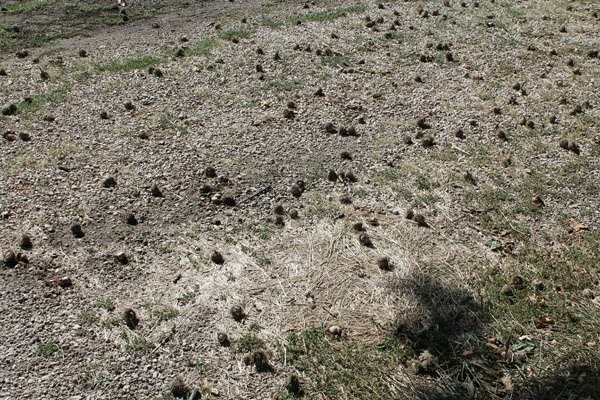
It's that time of year again -- the time that we used to hate, before we had the American Guinea Hogs. Acorns are falling from the trees. During our pre-hog years, it was a time of great danger, when simply walking across the driveway could result in a twisted ankle or bruised bum due to the "walking on marbles" situation provided by Mother Nature.


One of the reasons that I wanted Guinea Hogs is because they are friendly enough that we can easily lead them wherever we want them to go. We simply hold a bucket of whey or other yummy food in front of them, and they will follow us to the ends of the earth. In this case, they only had to follow us as far as the driveway. As soon as they realized they were surrounded by acorns, they went to work eating them. I didn't see a single hog laying down on the job the first day. The second day I did see some of them taking a nap mid-day.


The first year we just let them into the front yard and that was a mistake. When they got bored with the acorns, they went exploring and got into the barn to eat the chicken grain. They also destroyed a welded wire fence that separated them from the chicken yard.


So, now we use a single hot wire about eight inches off the ground charged by this nifty solar charger. Only eight inches off the ground, you say? Yep, pigs don't jump, so that works just fine to keep them inside the area under the big oak tree. That's right at nose level, and if they touch it, they let out a little squeal and run away. And it is really easy for us to step over the wire "fence" when walking through the yard.


Sunday, September 29, 2013

Farm to fork dinner

Last night, Mike, Jane, and I went to Joliet Junior College's annual fall scholarship dinner for the culinary department. In previous years it was an international buffet, but this year it was a farm-to-fork dinner, which of course, got yours truly really excited. I'm always excited about the culinary department scholarship dinners -- students have won the national culinary championship multiple times -- but add locally grown food to the menu, and it's a really big cause for excitement. I love knowing that future chefs are learning about the advantages of using local, in-season foods.


The event was held outside the cafeteria at the college. While the second-year culinary students were in charge of cooking, the first-year students were the servers for the evening. As everyone mingled during the arrival time, the first course was served by students walking around with platters of appetizers, such as smoked heirloom tomato bruschetta on freshly baked ciabatta and miniature house-made sausage sandwich with honey mustard sauce. To drink, we had cranberry cyser, which was a hard cider-mead hybrid from Wild Blossom Meadery and Winery in nearby Chicago. Unfortunately, I was too busy enjoying the food to remember to take any pictures. (You'll find that was a recurring problem through the evening!)


We were seated for the second course, which was a variety of entirely house-made charcuterie, salumi, and fresh cheeses. I find it really exciting that culinary schools are teaching their students how to make all of these things! Although the cheeses were all fresh varieties (as opposed to aged styles), I'm hoping the trend continues and a cheese cave will be a standard fixture at all culinary schools of the future.

Caesar salad

The third course was a choice of four salads, as well as a variety of breads, butters, pickled vegetables, and relishes. And I finally came out of my food-crazed daze long enough to snap a couple of pictures. The "Caesar salad" was not your fast-food garden variety -- of course! -- as it included early fall kale and endive, in addition to the traditional romaine. I have to admit I never would have considered using kale in a Caesar salad, but it was honestly one of my favorite parts of the meal, and I am looking forward to copying the medley in my own kitchen.

Grilled vegetable "slaw"

Everyone had a choice of four entrees, and since it was served family style, we could take a little of each, if we wanted. (or a lot!) Since I only eat meat that we grow ourselves or was grown by farmers we know, I decided to pass on the pork and beef entree, even though it came from a local farm. The chicken was an organic Bell and Evans chicken, and because the chef's description sounded divine, I gave it a try. I only had one bite, which was when it occurred to me that it was a Cornish cross. Although the sauce was delicious, the chicken itself didn't taste like much. So alas, I can say I've finally tried a commercially grown organic chicken, and I can see why so many people rave about how heritage chicken tastes like chicken. Heritage chicken definitely tastes better.


And then there was dessert. At this point, most everyone was entering a food-induced coma, so no one made a dash for the dessert tables when it was announced that we'd be going inside for the final course. There were eight choices, so I carefully surveyed the options before choosing three. My favorite was the salted caramel ice cream with spicy apples and toffee. The pumpkin cheesecake came in a close second place. I also had sweet corn ice cream, which would have been deemed excellent had it not been for the stiff competition.

Overall, we had a great time, and I'm hoping they will make this an annual event. I'd definitely attend again. And I've been thinking about the importance of educating chefs (and future chefs) about the value of using locally-grown ingredients, not simply because of the sustainability aspect but also because the food tastes so much better when it's really fresh, as well as the availability of heirloom vegetables and heritage meats from small farmers.

Friday, September 27, 2013

Where in the world is Deborah?


Today I'm home working on the farm and catching up on email and blog posts, but last weekend I was at the Mother Earth News Fair in Seven Springs, Pennsylvania, and yesterday, I spoke at the National Goat Expo in Bloomington, Illinois. On October 12-13, I'll be speaking at the Mother Earth News Fair in Lawrence, Kansas. (If you're there, be sure to introduce yourself!)


I also have some television appearances coming up to promote my new book, Raising Goats Naturally. I really didn't think that anyone would want me on a talk show promoting a goat book because few people actually have goats. However, last year after an interview on the Paula Sands Show in Iowa, the producer asked if I was working on another book, and as soon as I said it was about goats, he and Paula both said I had to come back to talk about it when it was released -- and one of them immediately asked, "Can you bring a goat?"

So, I am bringing a goat. It will be interesting. I've decided to take Agnes because she is the "resident goat expert" and has her own Twitter page. So far, she only has two engagements booked, but the first one is next Friday, October 4. I'm trying not to think about it too much. I have a really active imagination and tend to think that Mr. Murphy runs my life. (You know Murphy's Rule, right?)At least this segment will be taped, so I know I won't be the new star of a viral video about a goat gone wild in a television studio. If it goes okay, we might consider contacting a few more television stations.

Tuesday, September 24, 2013

The story of lunch

 by Jane Davis
Antiquity Oaks apprentice


I ate duck a l’orange for lunch the other day. It was delicious.


Friday morning the duck that I ate on Saturday was waddling around its enclosure.


Friday afternoon its head was being chopped off.


That night it was sitting in pieces in the fridge passing through the phases of rigor mortis.

Honestly, when I was watching the duck bleed out I wasn’t entirely sure that I would be able to eat it. It seemed gruesome. This was the duck that I had fed and watered every morning, and in just a second it went from very much alive to hanging headless, spilling it’s precious juices all over the ground. It was a little too real all of a sudden.

This might sound stupid, but I have never really been able connect the meat on my table to the animals it comes from. Think about the language that we use; it’s a cow when it’s alive, and at some point that we are not forced to bear witness to, it becomes beef. Poof, like magic. Nobody has to think about eating the big beautiful beast, because it’s not cow…. it’s beef.

The other day when I sat down in front of my plate I remembered that duck walking around the pen with his friends. I remembered chasing after his living, breathing body, and watching as spasms racked his headless body. To not eat this duck was to know that he had died for one less reason. So I ate consciously.

That duck tasted good because it was pasture raised and just about as fresh as it gets. It tasted good because I knew where it had come from and I had seen it grow and I was eating it deliberately. I was reminded of how much work went into that duck, and I was reminded to slow down and savor it. I was also reminded of how many slices of bacon, how many hamburgers, how many chicken wings, and how many turkeys I have eaten without reminding myself of the animal that made them. Watching that duck go, very literally, from farm to table prodded me to remember that all the meat I eat was once a living, breathing animal (as obvious as it sounds).

Sunday, September 22, 2013

Duck, duck, goose


Twice I've purchased 15 ducks for our farm. Initially we were going to use them for meat and eggs, but then I discovered that I wasn't a big fan of duck eggs, and Mike was not a big fan of butchering ducks. I found the eggs too yolk-y, and Mike found the feathers and down too challenging to pluck. So the ducks have mostly been pond ornaments and coyote food. Over the winter, we found ourselves with only two male ducks.

The bigger birds are the geese.

I really didn't want another 15 ducks, which is the minimum hatchery order, so when the feed store had ducklings available this spring, I bought five. The only down side to buying them at the feed store is that our only option was white Pekins, rather than some of the prettier ducks available through hatcheries.

Fast forward to last week.

A Cayuga drake splashing in the water

Mike butchered the last two male ducks, and the two female ducks were put out on the pond to join the two remaining boys from previous flocks. The boys immediately welcomed the girls by jumping on top of them to breed as soon as they met. The two drakes have been without females in their flock for more than a year, so I suppose I understand their enthusiasm.

The two new white Pekin ducks

The geese also seemed very happy to welcome the two new ladies to the pond. The geese are also boys, but they appear to understand they are not the right species for the new ladies. Why do we have so many males? Ever heard the term "sitting duck?" I think the original term was probably "setting duck" meaning that when a duck is setting, it is very easy for a predator to get them. That is definitely what happened to all of our geese.

The ducks, on the other hand, had a bad habit of leaving the secure fenced area around our house to visit the creek. Just as goats know that the grass is always greener on the other side of the fence, I suppose ducks think the water is bluer on the other side. They do have a nice pond for swimming, but that's apparently not good enough. I do hope these new ladies will stay put where it's safer.

And when we took them out of their little duck house to let them loose on the pond, we discovered that they had already laid their first three eggs. Jane used two of them to make a cake.

Our previous ducks just laid eggs around the pond, making it a real egg hunt every day. Because these were raised in a little house, I am hoping that they'll continue to go back there to lay eggs.

Saturday, September 21, 2013

Want to be a blog tour host?

My publisher wants me to do a blog tour to help promote Raising Goats Naturally: A Complete Guide to Milk, Meat, and More, so I'm in the process of finding blogs that are goat-related and willing to be a host.

Wait! What's a blog tour? What does a host do?

Great questions! A blog tour just means that I'll "visit" your blog one day in October. You can write up a bunch of questions for me to answer, or I can do a guest post, or you can do a review of the book. Yep, that means the publisher will send you a free copy of the book. If you want, I can plan to be available to answer questions that your readers might ask on the blog. My publisher is even willing to provide a limited number of books for giveaways on those blogs whose readers would be interested. If you're still wondering what I'm talking about, check out this post from 2009 when author Margaret Hathaway visited the Antiquity Oaks blog.

If you would like to participate, just send me a message on the contact form at this link.

Thursday, September 19, 2013

Breeding season!

A couple weeks ago, I was starting to complain about the fact that I had not seen a goat in heat since March. As luck would have it, the very next day when we let the goats outside in the morning, several of the does were butting heads, flagging, and mounting each other. The only problem with that sort of behavior is that it can be a challenge to figure out exactly who is in heat and who is just all worked up because they are surrounded by so many hormonal females.

This is the latest we have started breeding goats for as long as I can remember other than our very first year when all three of our goats were bred the first week of October. This means that I am not going to pass up a single doe that is in heat. Usually I try to maintain a bit of sanity in my kidding season by not having too many does due at the same time, but because I like to be done with kidding by March, I can't risk missing a doe coming back into heat later. Kidding during winter is one of our strategies for controlling internal parasites in the goats. If the does kid when the parasites are mostly dormant, we are able to avoid the use of chemical dewormers.


Pictured are two of the happy couples that were put together when the doe was in heat. Yes, Sadie the white goat above, is with a younger man. That's Calvin Klein, one of Coco's quintuplets born in March.


And here is handsome Austin with Nina Ricci behind him. I like to provide dinner for all of the goats when they're on their dates. And yes, he's a younger man too. I kept three bucklings this year, and they're all doing a great job with breeding this fall.

The first week of February is going to be crazy! There are nine does due on February 5 and 6. I'm looking forward to the babies but dreading the inevitable lack of sleep! If I make it through without a migraine, I'll be very happy.


Tuesday, September 17, 2013

Starting a Hamburg flock


I've been searching for a white egg laying bird that will do well on our farm, and the silver spangled Hamburg is the next candidate. They are a medium sized chicken and were historically considered a good egg layer in Holland.


When getting new layers, I prefer to have fall hatched because they will reach maturity around the time the days are getting longer, so you wind up with a lot more eggs the first year than you do when you get spring hatched chicks. It is also easier to keep the chicks warm in September than our cold spring months, and they feather out as the temperatures fall.


The chicks are already a week old in these pictures and starting to get their tiny feathers.


One of the fun things about getting chicks from McMurray Hatchery is that they always throw in a free mystery chick. This little one is a lot bigger than the Hamburgs. Any guesses?

LinkWithin

Related Posts with Thumbnails