Showing posts with label gardening. Show all posts
Monday, March 21, 2016
Our new greenhouse!
A greenhouse or potting shed has been on my to do list for at least a decade. And this year, it finally got done! However, Mike and I didn't do this ourselves.
Sarah, our new garden partner, and her brother Pat, did the framing, then they had some help from our current intern Stefanie with putting it all together.
Finally, Mike did help with putting on the front and back, as well as the door and windows, which were some of the more challenging aspects. Cutting corrugated plastic at an angle is tricky business.
We still need to put shelving inside, but otherwise it's done.
Sarah will be starting seedlings next week, so the greenhouse will be put to work very soon!
If you'd like to build your own greenhouse like this, here is the plan we used, although we put plywood and siding on the bottom, rather than metal. We had some left-over siding from when we built our house, so we wanted to use that. We were also happy to be able to repurpose the door.
Thursday, November 6, 2014
A new goal
As we are making the transition from homestead to full-fledged working farm with a strong emphasis on education, I am attending a variety of business seminars, and a couple of days ago, I attended one on managing multiple priorities -- and boy, do I have multiple priorities! It seems like I go through every day doing whatever is urgently demanding my attention, whether it is a goat in heat that needs to be bred or milk that needs to be turned into cheese, which leaves little time for things that need to be done but are not urgent, such as finishing the staircase or putting tile around our bathtub. (Yeah, we moved in 10 years ago.)
"Goals" was one of the many topics covered in the six hour seminar, and although I am no stranger to goals, sometimes we need to be reminded to actually apply what we know! Even though something may be important, it may not get done because you don't have a goal. So, I've decided to set a goal of posting on here at least once a week. I'd spent so many years just posting as soon as something happened that I never thought I needed to set a goal to post on here. But as other things have taken over my life, I find that blogging on here gets pushed to the back burner.
I have a goal of posting on my Thrifty Homesteader blog three times a week, and I usually meet it. Because that is a "how to" kind of blog, I feel a commitment to produce information to help people learn to homestead or live a greener life. But, I've always looked at this blog as my homesteading journal, and feeling that no one really "needs" to read this stuff, it gets put off day after day. I suppose I think of this as my fun blog and Thrifty Homesteader as my work blog. Even if that is the case, I should still make a habit of blogging here regularly because we all need to remember to incorporate fun into our lives, right?
So, rather than thinking that I'm going to write lots of individual blog posts on all of the little things happening around the homestead, here are a few highlights. You see that rose up there? That was really taken on our farm two weeks ago! And the same bush is still blooming, even though we've had two nights with below freezing temperatures. There are currently three blooms on that bush!
I planted lettuce in August, so we now have lots of big, beautiful heads of lettuce!
And that means we can have lots of salad! I especially love an entirely homegrown and homemade Cobb salad made with our chicken, bacon, jack cheese, boiled eggs, and lettuce!
Here is a picture of the butter I made with the milk from our new Jersey cow, which we got in early October. I am still hoping to tell you how we got her because it's a funny story, but for now, you get to see the butter. We've also made yogurt and gouda with her milk so far. No verdict on the gouda yet because it has to age, but the yogurt was a lot thinner than my goat milk yogurt, which would be fine for smoothies, but when it comes to fresh eating, I prefer the goat milk yogurt.
We currently have the goats grazing around our house, so here's Lizzie! We do rotational grazing, and now is the end of the grazing season, so we're letting the goats have every last bit of greenery, including everything in our yard.
Next weekend I'm heading down to Texas for the Livestock Conservancy conference. If any of you are there, say hi!
So, there you have it ... what I've been up to the last few weeks and where I'm heading. And I now have a goal to post on here at least once a week. It may not be perfect, but it'll be something.
Thursday, August 7, 2014
Virtual garden tour
Due to all the challenges that you've all been hearing about over the past few months, things happened later than usual this year, and the garden was no exception. However, we are doing better than I had expected. Here's what it looks like now ...
The perennials are done producing and just hanging out until next year. That's asparagus in the middle, rhubarb on the left and strawberries in the lower right corner...
The tomato plants are still really small ...
but we have tomatoes! They are still green but should be ripening soon. These are chocolate cherry tomatoes, and I can hardly wait. No, they do not taste like chocolate. They are chocolate colored, and they are as yummy as chocolate in their own way. They are definitely my favorite cherry tomato.
The zucchini and patty pan squash are doing great. The row on the left is zucchini, and the row on the right is patty pan squash. They were planted six feet apart, but they are so big, they have eclipsed the walkway. It seems like we can never plant them far enough apart. When you have nothing but seeds in your hands, it always seems like you are giving them more than enough room. I think I may have even posted on here in a previous year that I was going to start planting them eight feet apart.
And here are some awesome peppers that we are trying for the first time -- feher ozon paprika. They are supposed to ripen to a peachy-orange color. It's a sweet pepper, and yes, you can supposedly dry them and grind them up to make paprika.
A month ago, I planted some Swiss chard...
There are also onions and kale, but I didn't get pictures of them. Sunday I planted five types of lettuce in one of the raised beds: flame, Ella Kropf, speckled, Yugoslavian red butterhead, and bunte forellenschluss. Some of the raised beds have hoops on them so that we can cover them and continue to harvest through the winter! Soon we'll be planting more fall crops, such as arugula and more spinach and lettuce, also in the raised beds.
The perennials are done producing and just hanging out until next year. That's asparagus in the middle, rhubarb on the left and strawberries in the lower right corner...
The tomato plants are still really small ...
but we have tomatoes! They are still green but should be ripening soon. These are chocolate cherry tomatoes, and I can hardly wait. No, they do not taste like chocolate. They are chocolate colored, and they are as yummy as chocolate in their own way. They are definitely my favorite cherry tomato.
The zucchini and patty pan squash are doing great. The row on the left is zucchini, and the row on the right is patty pan squash. They were planted six feet apart, but they are so big, they have eclipsed the walkway. It seems like we can never plant them far enough apart. When you have nothing but seeds in your hands, it always seems like you are giving them more than enough room. I think I may have even posted on here in a previous year that I was going to start planting them eight feet apart.
And here are some awesome peppers that we are trying for the first time -- feher ozon paprika. They are supposed to ripen to a peachy-orange color. It's a sweet pepper, and yes, you can supposedly dry them and grind them up to make paprika.
A month ago, I planted some Swiss chard...
There are also onions and kale, but I didn't get pictures of them. Sunday I planted five types of lettuce in one of the raised beds: flame, Ella Kropf, speckled, Yugoslavian red butterhead, and bunte forellenschluss. Some of the raised beds have hoops on them so that we can cover them and continue to harvest through the winter! Soon we'll be planting more fall crops, such as arugula and more spinach and lettuce, also in the raised beds.
Thursday, December 26, 2013
From chicken tractor to hoop house
Earlier this summer as Mike was building a couple of new chicken tractors, it suddenly occurred to me that once they were no longer housing poultry this fall, they could be covered with greenhouse plastic and used as high tunnels for our winter garden. We first had a winter garden in 2010, using low tunnels, and I loved having fresh greens all winter long, but I did not love crawling around in the snow to harvest them. So, for three years, I've been saying that we need high tunnels, but it had not happened -- until now!
Summer seemed to last forever into the fall months, so we became a little too relaxed about the need to protect the plants in the garden. Floating row covers were working fine through October. But then the weather seemed to switch from summer to winter almost overnight with virtually no fall weather, which made it challenging to get the greenhouse plastic put on the frame. The large rectangles covering the top of the hoophouse are not ideal, but we were racing against time when we put this together, as a storm was brewing. We hope to do something a bit more aesthetically pleasing next year.
This is what the chicken tractor looked like after we removed the blue tarp, which had served as a roof for the ducks that had been living in there through October. The frame fit over the raised bed as if it had been made for it. There was not even an inch to spare.
Now we can walk into the hoop house, where it is warm and toasty during the day, and harvest lettuce. Right after the new year I'm going to start some cabbage and broccoli seeds that will be transplanted in there for an early harvest in the spring. In addition to the greenhouse plastic covering the hoophouse, we also have floating row covers keeping the lettuce warm.
Thursday, August 8, 2013
New chicken tractors
I am not a big fan of chicken tractors, but my husband loves them, and since he takes care of the poultry, I'm not going to argue the issue. Over the years, we have had four different designs ... PVC construction, all wood construction, wood frame and stainless steel sides and roof, and then this design. I personally thought this one would fly off like a big kite, but we've had this one for three years, and it's still here in one piece, and we have never (knock on wood) had it fly off or flip over in high winds. So, when we recently realized we needed a couple more chicken tractors, this was the one Mike wanted to repeat because it is light-weight and easy to move.
He wanted to build them in the barn so that they would be flat on concrete ... meaning they would be square. Building them outside on uneven ground might make for an uneven foundation, and that would be bad. Here are a couple of different views of construction, in case you might want to make one.
If you've ever searched for chicken tractors online, you've probably found similar models posted on other blogs and websites. One reason I'm kind of excited about this one is because I had an 'aha!' moment about this one recently. I'm hoping to turn one of them into a high tunnel this fall. We only use them for roosters and turkeys, which are destined to become meat by fall or earlier, and it occurred to me that we could replace the blue tarp with greenhouse plastic in the fall and ... voila! ... we'll have a high tunnel!
We've been using unheated low tunnels to grow food through the winter for three years now, and the only thing I don't like about them is crawling around in the snow to harvest lettuce and other greens. I've looked at commercial high tunnels, but they cost more than we can afford, so this seems like a great solution. With it being lightweight, the plan is to lift it up and sit it over one of our existing raised beds.
This post was shared at the Homestead Barn Hop!
Sunday, June 9, 2013
North to Alaska
In late May, as I was finishing up the edits on my manuscript for Raising Goats Naturally, which will be published this fall, I was racing against a different kind of deadline -- on May 25 we were supposed to board a cruise ship headed for Alaska -- and no one wants to take their work with them on vacation. As it turned out, I had a couple of final emails to handle as our vacation started, but it all worked out.
![]() |
| Mike and I at Mendenhall Glacier |
Then last summer my mother-in-law was diagnosed with stage four lung cancer and given six to twelve months to live, and I realized I needed to get moving on my Alaska goal! My in-laws had visited 44 countries, and I remember my mother-in-law telling me -- when she was about the age that I am now -- that she wanted to travel while she was still young enough and healthy enough to enjoy it. It didn't seem like that long ago, and yet here I am at the same age she was at when my husband and I got married. So, last August, we made reservations on a cruise to Alaska for this May.
![]() |
| Ice in the water as we cruised towards Sawyer Glacier |
![]() |
| Our tour guide Aaron at Jewell Gardens |
I've been feeling mentally stuck for a few years, wondering where to go with our homestead. I knew I wanted to do more, but I wasn't sure what to do that would be doable because all of my ideas seemed big and expensive. However, after seeing Jewell Gardens, I see that we can do something more that would not be overwhelming, and I am really excited to get started.
If you want to see a few more of my Alaska photos, click here.
Friday, November 16, 2012
Help wanted
You may remember that a few months ago, I said I was going to liquidate the Shetland sheep flock, and a couple months later, I admitted I had sold exactly one ewe lamb. I have since gone through a variety of decisions to sell different species ... and changed my mind more than once. The simple fact is that I don't want to get rid of any of them. But I can't deny that there are not enough hours in the day for us to continue doing everything that we did when our daughters were still living at home. So, if I don't cut back on something, that means I need help! But who to hire?
A few years ago, I read an article by Joel Salatin in which he talked about hiring help for your farm. He suggested that the first employee you hire be someone who does the job that is your least favorite. Because he disliked leaving his farm to deliver his food, his first employee was a delivery driver. If I think about my least favorite job on the farm, I'd have to say it's gardening. It is really hard for me to say that because I want to do it all! But I'm an animal person. I love the livestock. I don't exactly love gardening, but I love the fresh produce, which is why I garden. So, logically I should hire someone for the garden.
Why did it take me so long to figure this out? Because we don't really make money on the garden, so hiring someone to work in there didn't make much sense. But if I think back to my original goals, it was supposed to be a market garden. And with 32 acres, we have plenty of room for a very productive market garden. We just need someone who has the knowledge and desire to do the growing. We can provide the land, the seeds, and the equipment. They could also sell the produce at a farmer's market, which would provide a source of income that we could share.
I don't have all the details worked out yet, and I need to do a bit of research to figure out how to make this work. But it seems to be a much better idea -- and something that I really want to do -- rather than selling off the animals.
A few years ago, I read an article by Joel Salatin in which he talked about hiring help for your farm. He suggested that the first employee you hire be someone who does the job that is your least favorite. Because he disliked leaving his farm to deliver his food, his first employee was a delivery driver. If I think about my least favorite job on the farm, I'd have to say it's gardening. It is really hard for me to say that because I want to do it all! But I'm an animal person. I love the livestock. I don't exactly love gardening, but I love the fresh produce, which is why I garden. So, logically I should hire someone for the garden.
Why did it take me so long to figure this out? Because we don't really make money on the garden, so hiring someone to work in there didn't make much sense. But if I think back to my original goals, it was supposed to be a market garden. And with 32 acres, we have plenty of room for a very productive market garden. We just need someone who has the knowledge and desire to do the growing. We can provide the land, the seeds, and the equipment. They could also sell the produce at a farmer's market, which would provide a source of income that we could share.
I don't have all the details worked out yet, and I need to do a bit of research to figure out how to make this work. But it seems to be a much better idea -- and something that I really want to do -- rather than selling off the animals.
Sunday, March 18, 2012
What's wrong with these beautiful pictures?
![]() |
| Daffodils blooming |
![]() |
| Rose bush leafing out |
![]() |
| Pear tree ready to bloom |
![]() |
| Cherry blossoms |
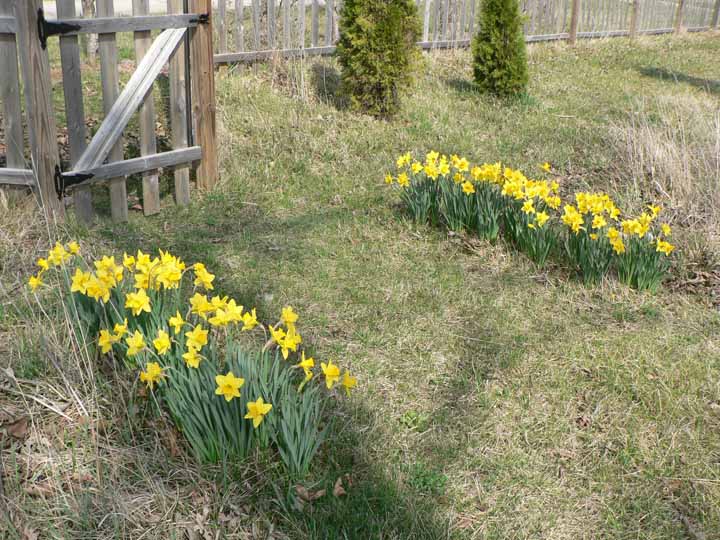
Everything is coming out of hibernation. The bees are buzzing around pollinating the blossoms. The dayliles are coming up, as well as the irises and the tulips. We have made a temporary pen in the front yard for the goats so that they can get out of the barn, which is too hot for them.
I don't see any positive end to this. If we go back to normal temperatures, all of the buds will freeze, so we won't have any fruit this year. If these record-breaking temperatures continue, I can hardly imagine what that will mean for us this summer. We've been having temperatures well above normal since October. And the temperatures have been in the 80s for several days now, and they're predicting they will continue for several more days before falling into the 70s. Normal high for March is 50s with freezing temperatures overnight. The low tonight is supposed to be 62.
Thursday, January 5, 2012
Rainbow Inca corn
We recently ground up the rainbow inca corn that we grew in the garden. We used some of it for cornbread, which was really delicious, and we used some of it for hominy grits, which was not so great. I think we probably should have soaked it before cooking because it didn't taste quite done, and we cooked it for half an hour. We also ate some as corn on the cob during the summer, and it was delicious fresh.
Friday, October 14, 2011
What's up?
Although the massive garden harvest of summer is long gone, we are starting to eat mustard greens and Swiss chard from the winter garden, and my arugula and mache have sprouted. I need to transplant broccoli plants that I started in the basement a month ago, and I'm still waiting for lettuce to germinate, but I know it will. My one-year-old broccoli plants in the garden have been reinvigorated by this cool weather and are growing like weeds! Broccoli is an annual, but I wonder how long it will continue to produce if we keep cutting the tops off. We'll get low tunnels and row covers on everything before it gets too cold, so
we'll be able to continue to harvest through the winter like last year.
And this is a picture of Milton (Shakespeare's brother). These are the only pictures I've taken in the past week. Someone wants to buy one of the boys, so I finally got a few photos to send her. She still couldn't decide which one she wants, so she's going to come see them in person in a couple of weeks. I'm keeping one for myself because Sherri is their mother, and if you've been around the blog long, you know I love Sherri. But I haven't been able to decide which one I want to keep, so I told the buyer that she can have her pick of the two.
I really hate the fact that I don't have time to post on here as much as I would like. Saturday (tomorrow) I have a book signing in Champaign, IL, and then I'm heading to Michigan for a week of speaking, book signings, and interviews, as well as the American Dairy Goat Association Conference. I'll post on the Homegrown and Handmade site about all of the exciting things I learn. Then I'll be heading to Wisconsin and Kansas and finally getting home again a week before Thanksgiving. Mike and the two-legged kids will be taking care of the farm and animals while I'm gone.
If you want to check out my complete schedule, click here. If you live in Michigan, Wisconsin, or Kansas, I hope you'll be able to make it to one of the events. I'd love to meet you! And if you're an XM or Sirius listener, I'm currently scheduled to be on Martha Stewart Radio Tuesday, Oct. 18, at 3 p.m. eastern time.
And this is a picture of Milton (Shakespeare's brother). These are the only pictures I've taken in the past week. Someone wants to buy one of the boys, so I finally got a few photos to send her. She still couldn't decide which one she wants, so she's going to come see them in person in a couple of weeks. I'm keeping one for myself because Sherri is their mother, and if you've been around the blog long, you know I love Sherri. But I haven't been able to decide which one I want to keep, so I told the buyer that she can have her pick of the two.
I really hate the fact that I don't have time to post on here as much as I would like. Saturday (tomorrow) I have a book signing in Champaign, IL, and then I'm heading to Michigan for a week of speaking, book signings, and interviews, as well as the American Dairy Goat Association Conference. I'll post on the Homegrown and Handmade site about all of the exciting things I learn. Then I'll be heading to Wisconsin and Kansas and finally getting home again a week before Thanksgiving. Mike and the two-legged kids will be taking care of the farm and animals while I'm gone.
If you want to check out my complete schedule, click here. If you live in Michigan, Wisconsin, or Kansas, I hope you'll be able to make it to one of the events. I'd love to meet you! And if you're an XM or Sirius listener, I'm currently scheduled to be on Martha Stewart Radio Tuesday, Oct. 18, at 3 p.m. eastern time.
Saturday, September 3, 2011
How does your garden grow?
Ours is growing quite well!
We have tequila sunrise peppers . . .
which are sweet, but every now and then you think it might be a little hot. Definitely different. I love to slice them in ringlets and put them on pizza. Beautiful!
and cayenne peppers . . .
which are hot! Duh! Most of these will be dried, but we do use them fresh while we have them. This is where the bottles of "red pepper" in the spice aisle come from.
and Amana orange tomatoes . . .
which is an heirloom variety that you can't find in any store. They're delicious, especially in tomato soup!
And the tomato plants that look like they're on steroids! (But it's just composted goat manure!)
We even have melons this year!
which is very unusual for Illinois because we have such a short growing season! That's Orangeglo Watermelon on the left, Charantais in the middle, and Banana Melon on the right.
How is your garden doing?
We have tequila sunrise peppers . . .
which are sweet, but every now and then you think it might be a little hot. Definitely different. I love to slice them in ringlets and put them on pizza. Beautiful!
and cayenne peppers . . .
which are hot! Duh! Most of these will be dried, but we do use them fresh while we have them. This is where the bottles of "red pepper" in the spice aisle come from.
and Amana orange tomatoes . . .
which is an heirloom variety that you can't find in any store. They're delicious, especially in tomato soup!
And the tomato plants that look like they're on steroids! (But it's just composted goat manure!)
We even have melons this year!
which is very unusual for Illinois because we have such a short growing season! That's Orangeglo Watermelon on the left, Charantais in the middle, and Banana Melon on the right.
How is your garden doing?
Monday, May 30, 2011
It's all about food
My husband just informed me it's been a week since I blogged, so what have I been doing? Mostly I've been busy with final edits on the book, tweaking sentences, writing captions for photos, and double-checking the bibliography.We've been getting a ridiculous amount of rain lately, so the yard, pastures, and garden are all soggy. Only about 20 percent of the garden is planted -- sweet potatoes, onions, beans, strawberries, rhubarb, and asparagus. I have 50 heirloom tomato and 60 pepper plants sitting around waiting to be transplanted. It is really not a big deal that they're a bit late getting into the garden because they won't start producing anyway until it gets hot enough, which means early August most years. One year I planted tomatoes at the end of June, and they produced fine. We are still harvesting more than enough lettuce, which was planted last fall in low tunnels. We removed the tunnels in April.
Because I've been so busy, we actually ran out of chevré! I can't remember the last time we had no chevré in the house in May -- maybe 2002? Anyway, I'm making chevré today!
Lately we've been talking about how excited we used to be when we had a single meal that was homegrown, but now almost all of our meals are homegrown, even through the winter. It's a pretty surprising accomplishment for someone who was a vegetarian with a brown thumb nine years ago. Tonight's dinner will be salad, grilled lamb chops, corn on the cob, and ice cream. Last night's dinner was queso blanco with pasta and marinara sauce. Saturday's lunch was quiche. We've actually been having a lot of quiches lately. Today's lunch was an odd one -- corn fritters and smoothies -- because no one thought about cooking until we were all starving, and it was after noon.
We're about to open our last jar of canned pears, and we're running low on frozen raspberries. There are only two packages of frozen green beans left, although we still have a lot of corn in the freezer. The chickens are laying a few dozen eggs a day, and if we milk all the goats, we can get seven gallons of milk a day for making buttermilk, yogurt, and cheese, as well as ice cream and cream soups and other good stuff.
And with the garden, the cycle starts again. As we are running out of fruits and vegetables, it's time to plant and nurture and harvest to put up food to last for the next winter. Why do we keep doing this? As my daughter said this morning, "Once you get used to homegrown, you just can't find anything in the store that tastes as good."
Friday, May 20, 2011
What's up?
It might sound impossible, but I've been busier than normal lately. In addition to cleaning the milking parlor, planting the garden, and milking goats twice a day four days a week while my daughter is taking summer classes, I'm also working on final edits for the book manuscript. Part of that process is deciding what can be cut because I ran out of space. So, earlier today on the Homegrown and Handmade site, I posted a bread recipe that was cut.
We recently received another batch of turkey poults, which I want to blog about. Today and tomorrow morning, we are in the midst of doing our monthly milk test with the goats, and on Sunday, we are having about a dozen of our goats classified with AGS. An AGS judge will be coming to the farm and basically giving our goats a report card to score them on the various parts of their conformation. We only have about a fourth of the garden planted, so we need to continue with that while also working on other projects that I'm looking forward to sharing with you -- like the area we're creating in the basement for making soap, storing wool roving, and shipping orders.
I go through this every summer -- when I have dozens of things to write about, I have no time to blog!
We recently received another batch of turkey poults, which I want to blog about. Today and tomorrow morning, we are in the midst of doing our monthly milk test with the goats, and on Sunday, we are having about a dozen of our goats classified with AGS. An AGS judge will be coming to the farm and basically giving our goats a report card to score them on the various parts of their conformation. We only have about a fourth of the garden planted, so we need to continue with that while also working on other projects that I'm looking forward to sharing with you -- like the area we're creating in the basement for making soap, storing wool roving, and shipping orders.
I go through this every summer -- when I have dozens of things to write about, I have no time to blog!
Wednesday, May 11, 2011
Slipping through the cracks
![]() |
| We use an old water trough as a brooder for the first two weeks. |
Of all the seed potatoes sold by Seed Saver, there were only three varieties not sold out by the time I placed my order. So, I decided to try Nicola, a new one for us that looks a lot like a Burbank russet, but hopefully it won't be plagued by some of the issues that cause russets to not do very well in organic situations. And we'll plant some of our own potatoes that we saved from last year's crop.
The turkey situation was not much better. I called several hatcheries, and the earliest I could get a turkey delivery was the first week of May. Some were already sold out for the year. Good news for heritage turkey enthusiasts, but not so good for us. I decided to try Narragansetts this year. They are the only breed of turkey recognized by the American Poultry Association that we have never had for dinner. We tried to raise them five or six years ago, and they all disappeared one day. It was a very discouraging experience, although I don't blame the breed. I'm sure it was not a predator, because there were no feathers anywhere. And it would have taken a pretty big pack of coyotes to eat twenty young turkeys. So apparently they just all took a hike and probably got lost in the woods, never to be seen by human eyes again.
We like to get turkey poults in early April because we get the largest live turkeys by Thanksgiving. Get them any earlier, and the males start to reach sexual maturity and begin killing each other. Although two or three additional weeks of growth on the turkeys before Thanksgiving would have been nice, I can't beat myself up about it, because it's not going to do any good. The poults arrived last week in the best condition I've ever seen, and so far (knock on wood), they're all still alive, which is unusual for poults, because they don't usually handle the trip that well.
And if you're wondering why we don't hatch our own turkeys, it's because they don't hatch early enough in Illinois to be a good size by Thanksgiving. Our turkeys hens do hatch poults, but not usually until June or July. And if we collect eggs and incubate them, we don't usually get them hatched much earlier than that. We don't mind small turkeys, but customers do. However, I usually save that topic for a November post.
For today, I'm just trying to accept the fact that although I can do a lot of stuff, it may not all be perfect, and that's okay.
Monday, May 2, 2011
Who can you trust?
A fear and frustration of anyone who does any public speaking or writing is that your words will be taken out of context. It has been on my mind for the past week as I contemplated whether or not to write this post. But I finally decided to do it because this topic is too important to not write about it. What is so important and controversial?
Anyone remember back in 2007 when Tyson started advertising antibiotic-free chicken? Did you notice how those ads disappeared? That's because Tyson was lying, and they got called on the carpet by Perdue and then consumers. Like many advertisers, Tyson was splitting hairs with their advertising claim because their chickens were being fed medication on a daily basis -- just like Perdue and other commercial chickens -- but technically the drug is an ionophore, not an antibiotic. Although Tyson admitted no wrongdoing, they quietly settled the lawsuit with Perdue in 2008. The consumer lawsuits were ultimately lumped into a class-action suit, which was settled last year. I'm sorry to say that if you bought Tyson chicken from 2007 to 2009 thinking it was drug-free, the time has passed for you to get your coupons and cash. So, why am I telling you this?
Because it's just another painful example of how corporate America will say anything to get us to fork over our hard-earned cash for their products. And they'll do anything to increase their profits, because that is the only thing they care about. But, as they are quick to point out, it's not their fault because legally corporations only answer to their stock holders, and they are responsible for turning as big a profit as possible.
Food giant Dean Foods, which has gobbled up dozens of smaller dairy companies, has been caught conveniently avoiding the truth and stretching the truth. When Dean bought Silk Soy products, they quietly stopped using organic soybeans without changing the labels, other than to omit the word "organic," and it was months before consumers noticed that they had been duped. In their organic dairies, they've been caught buying conventionally raised, drug-fed heifers as future milkers, even though it's prohibited by organic standards. And now they're fortifying their "organic" milk with DHA Omega-3, which is synthetic and illegal under the organic standards. And what really fries my bacon with this story is that if they kept their cows on a grass-fed diet, their milk would be naturally high in omega-3s.
And it goes beyond organics. Does anyone remember the McDonald's class action lawsuit in the 1990s when McD said they were now frying their french fries in vegetable oil rather than lard. Vegetarians started eating the fries before learning that the new "secret ingredient" in the fries was tallow, which is beef fat. We were vegetarians at the time and starting eating the fries. The only thing I've purchased from McDonald's in at least ten years was a cup of coffee a few years ago when I was desperate to find a WiFi connection, and a sign outside a McD's boasted WiFi, so I figured I could buy a cup of coffee and check my email. Wrong! After I bought the coffee, I asked how to get connected, and I was told I'd have to pay for it. Want to guess when I'll set foot in a McD's again?
And it goes beyond food. When we moved into our house six years ago, all of the appliances were brand new except for the dryer, which we bought in 1993. As of today, all of the appliances have been replaced -- some twice -- except for the stove and the 1993 dryer. And in the last two years, the cost of a refrigerator has gone up $400 -- yes, the exact same refrigerator that only lasted 20 months!
I am so fed up with Big Biz, I could rant all day with one story after another. And although I don't have an answer about what to do with appliances, I do have answers for food. We can't rely on labels, government inspectors, or lawyers and lawsuits to protect us from anything, whether it is ingredients we would prefer to avoid or deadly pathogens. We have to take responsibility and do what we can. Madison Avenue has done a splendid job convincing us that our time is too valuable to be spent gardening or cooking. We should relax in front of the television (so they can convince us to buy more stuff that we don't need). Of course, we can't all grow everything, but farmer's markets are becoming more popular, making it easier than ever to know your farmer.
Yes, a person could lie to you about how they grow their crops, but in my experience most of them adamantly believe that they're doing what needs to be done, and rather than lie to you, they'll try to convince you that you don't really need organic spinach or pork. And if you're a savvy shopper, it is easy to spot the fakers. A couple of years ago, I asked at a farmer's market stand if they sprayed their vegetables, and rather than answering my question, the man said, "Pesticides kill bees," and gave me an explanation that would mean no one could use pesticides. I just walked away, feeling insulted and thinking that I should have started questioning him. But if you frequent a farmer's market, you can get to know the people and learn who you can trust.
I've been thinking about writing this post for a long time, but the last thing I want is for people to take away the idea that it's hopeless, and you should just keep buying the cheapest food possible, because you don't really know if organic is organic or not. I want this post (and the blog and my book) to motivate and empower you -- to help you believe that you really can take control of your food choices. You don't have to be a master gardener. I'm not. You don't even need a yard. When we lived in the Chicago burbs, we rented a community garden plot. According to the National Gardening Association, 5% of those who garden -- two million people -- have a garden at a friend's house. And it doesn't take a ton of time. The average amount of time spent gardening every week is less than five hours, which is not even an hour a day -- far less than most people spend watching television.
But if you have a legitimate reason for not gardening or shopping at farmer's market, you can at least start cooking something from scratch. I started baking bread 23 years ago, back when I was drinking two liters of soda a day. Little things add up, and if you keep adding little things, at some point you might find yourself on 32 acres in the middle of nowhere growing the majority of your own food organically.
And if anyone has ideas on how we can get back to appliances that last twenty years, please share!
Anyone remember back in 2007 when Tyson started advertising antibiotic-free chicken? Did you notice how those ads disappeared? That's because Tyson was lying, and they got called on the carpet by Perdue and then consumers. Like many advertisers, Tyson was splitting hairs with their advertising claim because their chickens were being fed medication on a daily basis -- just like Perdue and other commercial chickens -- but technically the drug is an ionophore, not an antibiotic. Although Tyson admitted no wrongdoing, they quietly settled the lawsuit with Perdue in 2008. The consumer lawsuits were ultimately lumped into a class-action suit, which was settled last year. I'm sorry to say that if you bought Tyson chicken from 2007 to 2009 thinking it was drug-free, the time has passed for you to get your coupons and cash. So, why am I telling you this?
Because it's just another painful example of how corporate America will say anything to get us to fork over our hard-earned cash for their products. And they'll do anything to increase their profits, because that is the only thing they care about. But, as they are quick to point out, it's not their fault because legally corporations only answer to their stock holders, and they are responsible for turning as big a profit as possible.
Food giant Dean Foods, which has gobbled up dozens of smaller dairy companies, has been caught conveniently avoiding the truth and stretching the truth. When Dean bought Silk Soy products, they quietly stopped using organic soybeans without changing the labels, other than to omit the word "organic," and it was months before consumers noticed that they had been duped. In their organic dairies, they've been caught buying conventionally raised, drug-fed heifers as future milkers, even though it's prohibited by organic standards. And now they're fortifying their "organic" milk with DHA Omega-3, which is synthetic and illegal under the organic standards. And what really fries my bacon with this story is that if they kept their cows on a grass-fed diet, their milk would be naturally high in omega-3s.
And it goes beyond organics. Does anyone remember the McDonald's class action lawsuit in the 1990s when McD said they were now frying their french fries in vegetable oil rather than lard. Vegetarians started eating the fries before learning that the new "secret ingredient" in the fries was tallow, which is beef fat. We were vegetarians at the time and starting eating the fries. The only thing I've purchased from McDonald's in at least ten years was a cup of coffee a few years ago when I was desperate to find a WiFi connection, and a sign outside a McD's boasted WiFi, so I figured I could buy a cup of coffee and check my email. Wrong! After I bought the coffee, I asked how to get connected, and I was told I'd have to pay for it. Want to guess when I'll set foot in a McD's again?
And it goes beyond food. When we moved into our house six years ago, all of the appliances were brand new except for the dryer, which we bought in 1993. As of today, all of the appliances have been replaced -- some twice -- except for the stove and the 1993 dryer. And in the last two years, the cost of a refrigerator has gone up $400 -- yes, the exact same refrigerator that only lasted 20 months!
I am so fed up with Big Biz, I could rant all day with one story after another. And although I don't have an answer about what to do with appliances, I do have answers for food. We can't rely on labels, government inspectors, or lawyers and lawsuits to protect us from anything, whether it is ingredients we would prefer to avoid or deadly pathogens. We have to take responsibility and do what we can. Madison Avenue has done a splendid job convincing us that our time is too valuable to be spent gardening or cooking. We should relax in front of the television (so they can convince us to buy more stuff that we don't need). Of course, we can't all grow everything, but farmer's markets are becoming more popular, making it easier than ever to know your farmer.
Yes, a person could lie to you about how they grow their crops, but in my experience most of them adamantly believe that they're doing what needs to be done, and rather than lie to you, they'll try to convince you that you don't really need organic spinach or pork. And if you're a savvy shopper, it is easy to spot the fakers. A couple of years ago, I asked at a farmer's market stand if they sprayed their vegetables, and rather than answering my question, the man said, "Pesticides kill bees," and gave me an explanation that would mean no one could use pesticides. I just walked away, feeling insulted and thinking that I should have started questioning him. But if you frequent a farmer's market, you can get to know the people and learn who you can trust.
I've been thinking about writing this post for a long time, but the last thing I want is for people to take away the idea that it's hopeless, and you should just keep buying the cheapest food possible, because you don't really know if organic is organic or not. I want this post (and the blog and my book) to motivate and empower you -- to help you believe that you really can take control of your food choices. You don't have to be a master gardener. I'm not. You don't even need a yard. When we lived in the Chicago burbs, we rented a community garden plot. According to the National Gardening Association, 5% of those who garden -- two million people -- have a garden at a friend's house. And it doesn't take a ton of time. The average amount of time spent gardening every week is less than five hours, which is not even an hour a day -- far less than most people spend watching television.
But if you have a legitimate reason for not gardening or shopping at farmer's market, you can at least start cooking something from scratch. I started baking bread 23 years ago, back when I was drinking two liters of soda a day. Little things add up, and if you keep adding little things, at some point you might find yourself on 32 acres in the middle of nowhere growing the majority of your own food organically.
And if anyone has ideas on how we can get back to appliances that last twenty years, please share!
Monday, April 25, 2011
Spring
![]() |
| Flower garden at front gate |
Mike also put together four new raised beds, and he has the lumber to build four more, which will give us a total of twelve raised beds. They're eight-feet by four-feet, and we've discovered that there are many advantages to them. For one thing, you can work in them when it's just rained buckets, because you are standing on grass next to the raised beds. I am thinking of putting gravel between them though, because we are not great about mowing between them in the summer. The four existing raised beds were turned into low tunnels for winter gardening, which is why we have lots of lettuce right now. Five of the new raised beds will be used for perennials -- strawberries, rhubarb, and purple asparagus, which are sitting in the house losing vitality, waiting to be put into soil.
As for the animals, the goats are only going outside about every other day. We're doing this balancing act, trying to figure out whether the goats are better off outside with mud and parasites on wet pasture or in the barn eating alfalfa all day and increasing risk of coccidiosis for kids. It feels like a no-win situation, so I just keep piling on more clean straw in the barn for the inside days. Katherine was at least able to get all the goat stalls clean on Saturday. Still, I worry.
Even the pigs are not happy with all the mud in their pen. I keep piling on more straw in their shelter and right outside the shelter so they don't drag too much mud inside. As soon as I put fresh straw in there, they immediately lay down on it.
This is starting to remind me of the spring of 2009. It rained and rained, and just when you thought it was finally going to dry out, it rained again. Farmers couldn't get their heavy equipment into the fields until about a month later than normal, which then meant they were still harvesting at Thanksgiving, which even the oldest among them had never experienced before. The really frustrating thing about the spring of '09 is that when it stopped raining, it stopped for weeks. But the good thing about backyard agriculture is that we don't use heavy equipment. Yeah, mud is nasty, but if we put on a pair of waterproof boots, we can still get a lot done. And if we have a drought, we can water the garden.
So, I just have to learn to relax.
Sunday, March 20, 2011
Winter gardening success

In previous years, I would have only been starting seeds in my basement in March, but this year, I'm already weeding, watering, and harvesting!
Back in December, I first told you about our winter garden. We continued to enjoy fresh salad for a few more weeks after I wrote that post, but towards the end of December, I realized that I had not planted enough to last us all winter. However, because I wanted to know how this worked, I decided that I should leave everything in the garden rather than continuing to harvest. And I am excited to report that it worked great! The low tunnels even survived the Blizzard of 2011.
Earlier this week, I opened up the low tunnels to see how everything had survived. Salads greens were thriving.
But the most exciting thing was that the cole crops, which were only tiny transplants in September, were now quite large, and there was actually broccoli ready to harvest! My favorite thing about winter gardening is that there no pests! I've tried putting cole crops in the garden in spring and in fall, and the bugs just eats the poor things until the outer leaves look like lace. The broccoli, Brussels sprouts, and cabbages are absolutely pristine.
We are already making plans for next winter's low tunnels. We will definitely have more, but rather than mixing up lettuces and cole crops in each tunnel, I will plant each tunnel based upon when the crop will be harvested. This year, I mixed up three of the low tunnels, although I did plant the northernmost tunnel with cole crops and lettuce seeds that I didn't plan to harvest until now, so I never opened that one all winter. The cole crops in that one are huge compared to the cole crops in the tunnels from which I harvested through December. Coincidence? Perhaps, but it also makes it easier to harvest from the beds during the winter if I don't have to work around the cole crops. I am also hoping that we can put up a high tunnel so that I won't be on my hands and knees in the snow harvesting in the middle of winter.
Subscribe to:
Posts (Atom)