Showing posts with label goats. Show all posts

Friday, May 27, 2016

Goat retirement plan


Now that we've been on the homestead for 14 years, every now and then someone will ask what we do with does that are too old to give birth. Some assume they're butchered, which is what eventually happens to all dairy animals in large commercial operations. But with only a couple dozen does, all of our goats have names rather than ID numbers, and we know the individual personality of each one.

In general, the last time that a goat gives birth on our farm is when she's ten years old. After her final kidding, we continue to milk her as long as she'll produce, which has been somewhere between a year and eighteen months for various goats. Then they are simply left to enjoy their remaining years in the pasture. My first goat died at the age of 14. The retired does now consist of Sherri at age 13, Carmen at age 12, Lizzie at age 11 (Carmen's daughter), and Giselle at age 9. And then there's Lil, who is 7 years old and never been bred because she never grew up. She's the size of a 6-month-old, and I never sold her because I was worried that someone would get the hair-brained idea to try to develop teacup goats. So Lil lives here. I should do a blog post about her someday, as she does have a special place.

Giselle was retired after her c-section at age seven. Although goats can give birth again after having a c-section, it was the fourth time that Giselle had had kidding problems. Normally I have a two strikes rule, meaning that the second time a doe needs help during kidding, she's retired. I made excuse after excuse for Giselle through the years because she has long teats and was wonderfully easy to milk. But I'd be a fool to get her pregnant again.

The photo above was taken a few days ago when we moved them to new pasture across the farm where they can enjoy plenty of green grass this summer.


Sunday, May 22, 2016

Alex's final kidding


Before I tell you this story, I have to tell you that we've had twelve does give birth so far this year, and ten of them were textbook perfect. Now I'm really wishing I had been able to find the time to write about those joyful, beautiful births.

On April 18, I happened to look out the window by my desk, and I saw Alex laying on the ground in an unmistakable position. Her legs were outstretched, her neck was craned, and her ears were pointed back. She was in labor and pushing. I jumped up, grabbed a stack of goat towels that just happened to be next to the front door and ran to the pasture. It seemed like a beautiful spring day to have a goat give birth in the pasture.

As soon as I opened the gate, Lucy the Great Pyrenees ran towards me, and as I approached Alex, the dog's exuberance caused the goat to stand up and start walking away. I put Lucy into another pasture and went back to Alex. Of course, I was wearing a pair of my town jeans, which means that they didn't have any farm stains on them, such as manure, dirt, or blood.

Beauty the Jersey cow also happened to be in the pasture, and she decided to come say hi. She has recently decided that I'm her new scratching post, and she started to rub her head against me. I called Sarah who was in the barn working on a building project, and she came out and moved Beauty to the next pasture. Then she brought a flake of straw so that I could scatter it on the ground because Alex had chosen to lie down in a spot with more dirt than grass.

The first kid was very slow to come out, partly because Alex wasn't pushing very hard, and partly because he was quite large. I'd later discover that he was 4 pounds, 7 ounces, which is big for a Nigerian, where 3 pounds is more average. Because her contractions seemed to be really wimpy and the kid was making little to no progress from one contraction to the next, I pulled on his legs to help bring him into the world.

I could see that the second kid was even bigger when the first hoof emerged. I kept comparing it to the hoof of the kid that had already been born and was worried. As the nose and white head began to come out, it was easy to see that there was an unusual amount of blood. (I took the picture at right after I'd toweled him off and removed as much blood as I could.) Turns out he weighed 5 pounds, 2 ounces, setting a new record for largest Nigerian kid born on the farm. Because he was also progressing excruciatingly slowly, I wound up pulling him also, and it was such a tight squeeze that Alex was even pulled across the grass a little.

After the kids were born, I started to worry even more, as Alex completely ignored them. She's an experienced mom and has always been wonderful with her kids. We took her and the bucklings into the barn, and not only would she not let them nurse, but she wouldn't let me milk her. This is a doe who just finished a three-year lactation two months ago, so she's also a very experienced milker! She just wanted to lay in the stall with her ears back, looking angry.

I was supposed to pick up two bee nucs (starter hives of live bees) right about the time that Alex went into labor, but I messaged the bee person and told him why I was running late. I felt very conflicted, as I really needed to pick up the bees and bring them home, but I was also worried about Alex. I checked her temperature, and it was only 101.5, which is a little on the low side, but probably not low enough to assume she had milk fever. She wasn't eating until we gave her Power Punch, which is an electrolyte and molasses concoction. I couldn't check her for ketones because that would require catching her urine, and she wasn't standing up, so I'd have no idea when or if she peed.

She hadn't passed her placenta, and there was not much hanging out in terms of membranes, so I was not completely convinced that she didn't have another kid inside because she was still pushing ever few minutes. I've never seen a doe really "push" if the only thing left was the placenta. I decided to do an internal exam to check for a retained kid, but there wasn't one.

Because she wouldn't stand up and let the kids nurse, I eventually was able to milk out her colostrum and give it to the bucklings in a bottle. At least they were doing well.

I called the U of I vet hospital and spoke to a vet who said that it sounded like Alex might just be in pain because the kids were so unusually large. So, I jumped in my car and went to pick up the bees and bring them home. There was a farm supply store on my route, so I stopped and picked up some CMPK to treat for possible milk fever, which is caused by a calcium deficiency.

The next morning I knew something was wrong. Her temperature was down to 99, which either meant that it was definitely milk fever or her body was shutting down and she was dying. I put her in the car and headed for the university vet hospital.

Within a couple of hours, an ultrasound and blood tests, we learned that she had metritis and was acidotic. Thankfully she didn't have ketosis or hypocalcemia (milk fever). They thought that they might see a very small mummified fetus in her uterus, but they weren't sure because you can only make educated guesses on an ultrasound. They said she probably had the metritis before she even went into labor, which would explain why she had such wimpy contractions and why I had to pull the kids and why she still hadn't passed her placenta 24 hours later. They still didn't have all the answers though, and Alex was in terrible condition, so I left her a the vet hospital and headed home.

After I left they had a couple of reproductive specialists do another ultrasound, and they don't think there was a retained mummified kid. They thought it looked more like a uterine tear. But they are all in agreement that she had an infection before she even went into labor. The vet said she's gotten worse since I left, so they're actually giving her morphine on top of the banamine. They also started her on an oxytocin drip, hoping that would help her expel the placenta.

I think the reason her temp was so low that morning is because she was shutting down. She really looked like she was just ready to die, so it was hard for me to imagine that she looked worse after I left. They said that if she had a uterine tear, the day after the birth was always the worst, and that if she was going to make it, she should improve a lot by the following day.

The next day they had a reproductive specialist do an ultrasound and a vaginal exam, and he said that she has an interior vaginal tear, which went all the way through into her abdomen, and that could ultimately cause more problems than a uterine tear. The vet said "Goat uteruses love to tear. It's just what they do. But they're also really good at healing themselves." Vaginal tears can wind up with a lot of scar tissue that would cause kidding problems in the future. If we wanted to breed her again, they suggested bringing her back in 30 days for another exam to see if scar tissue is building up and looks problematic. That was another first for me! I'd never heard of an interior vaginal tear, but that's probably why the 5-pound, 2-ounce kid had so much blood on his head when he was being born.

Alex continued to improve, and I was able to bring her home after five days in the vet hospital. On the phone, the vet told me how much better she looked, but when I arrived, I thought she looked dreadful. After I brought her home and put her in the barn with her kids, she just laid there all the time with her ears back, and she'd still push every few minutes. They said that was because of the internal tear. Every time I looked at her, I kept thinking that she might still die. I'd never seen a goat look so miserable, and I just kept reminding myself that we'd done everything possible.

I put her in the kidding stall with her bucklings, which we'd been bottle-feeding. I simply hoped she'd tolerate them, but it seemed that she remembered them as she would lick them when they came near her. Three days after she came home, she finally started standing up to eat. As I was giving one of her boys a bottle one evening, the other one was bopping my leg, hoping to find a new spigot for milk. Since Alex had been tolerating them quite well, I decided to give it a try and see if she'd let the kid nurse.

I sat down in the straw and put the kid under her. I put the teat in his mouth while squeezing out a bit of milk onto his tongue. He immediately began to suckle! I supported his head for a minute or so, then I let go, and he continued to nurse, and Alex just stood there like a perfect mama! The other kid, who had already had a bottle, wasn't interested, so I decided to let him try nursing in the morning before giving him a bottle.

The next morning I was so excited about the possibility of the second kid starting to nurse but reminded myself that it might not work. Don't get your hopes up too much, I told myself. When I walked into the kidding pen, I checked the tummy on the kid who had nursed the night before, and it was quite full. I felt Alex's udder, and it was loose. We had been milking her, so I knew it would have been much more full if the kid had not been nursing.

I sat down and put the other buckling in front of Alex's udder and opened his mouth, just as I'd done for his brother. He also began suckling immediately! I was over the moon excited, and the song "Miracle's Happen" from Princess Diaries immediately began playing in my head. Indeed, if anyone had asked me if this was possible, I would have said that I never say never, but I wouldn't get my hopes up about kids starting to nurse at eight or nine days of age.

Alex has continued to improve, and we recently moved her and her bucklings into a nursery pen with two other does and their kids, and Alex immediately decided she should be the queen of this little herd. She took on the other two does in quite the head butting match and won.

We have no  plans to ever breed her again, as I'm not going to trust a visual exam to determine whether or not she'd be able to give birth vaginally in the future. Her last lactation lasted three years, and she is six years old now, so we will just continue to milk her and see how long she can go.

Wednesday, March 30, 2016

Farewell, Sadie

Sadie in 2013 with her triplet does
The vet called today shortly before noon to say that she had consulted with a couple of reproductive specialists, and they said that if Sadie has not responded to the first two shots of prostaglandin, there is really no point in making her miserable with a third. If her cervix is not dilating, it's because of scar tissue or adhesions, and it's not going to dilate.

Sadie and her sister as kids in 2012
They did not recommend draining the uterus surgically because if it was full of pus, they would not be able to keep it from the abdominal cavity, so it would cause more problems. They did not recommend draining it through the cervix with a trochar because it would leave her with less than a five percent chance of ever carrying a pregnancy to term, and the odds are high that the uterus would simply fill with fluid again.

Sadie in 2013
They said that if her uterus continued to fill with fluid, it would eventually cause her to be unable to poop, and she was already straining to have a bowel movement. The uterus could eventually rupture, if she lived long enough. She's had a catheter in her for as long as she's been there, so that her bladder won't overfill again, but they couldn't send her home with a catheter.

In the end, our options came down to euthanasia or a hysterectomy, which would cost $1000, assuming nothing went wrong, which could drive up the price even more. Apparently doing a hysterectomy on a goat is more complicated than on dogs and cats. When I left her there on Thursday, the estimate was $700-800, and the bill is already $1100.

Sadie's udder as a 2 year old
It's been a horrible few hours, thinking about what to do. Hearing the estimate for a hysterectomy came as quite a shock. Last week, they had said it probably would be a few hundred dollars. A thousand dollars is about three times as much as what I'd been preparing myself for. I just can't justify spending $1000 to keep her alive, knowing that she would "only" be a pet afterwards. I already have four retired does, as well as an 8-year-old that has never been bred because she never grew big enough. Still, I hate the idea of essentially putting a price tag on her life. If I had all the money in the world, I would have easily said to do the hysterectomy. But I can't live my life as if I have money I don't have. And what would I do if next week another animal were to get injured or become ill? I have to try to maintain some sort of fiscal responsibility. Still, I hate it.

It makes it even worse for me that she's spent the last six days of her life alone in a strange place with strangers who've been poking her with needles and a catheter. I justified leaving her there because I thought they could make her well, and she'd be able to come home and be with her babies again. Sadie was such a shy kid, but after she freshened, she warmed up to me and the rest of the humans. I always told her that she could trust us, and as I was leaving her at the vet hospital last week, I couldn't help but think that she felt betrayed. If only I could have explained to her what was happening ...

Sadie in labor last month
So, I called the vet a little while ago and told her to euthanize Sadie. It was one of those horrible moments in life. I hated it. But I also hated that she had endured six more days of suffering because we were hoping to save her. They said the prostaglandin injections might not work, but in my head, I was thinking that they had to work. She would go into heat. Her cervix would open, and her uterus would drain. It sounded so simple. Surely, Sadie would be coming home again.

But then I think that I understand why farmers tend to be such spiritual people. Maybe it's to protect our sanity, but we have to believe that everything works out for the best. Perhaps Sadie was only with us for four years because that's what was meant to be. She's given me all that I was meant to have from her. I just realized that I have her son from last year. It sounds silly, but I kept forgetting to advertise him. Maybe there was a reason for that. This year, the person who had wanted two of Sadie's doelings wound up having to cancel after I had already marked them as sold on the website, and Sadie got sick before I had a chance to update the website stating that they were available.

One of Sadie's daughters born last month that we'll be keeping
Still, it's always hard to lose a good goat, and Sadie was great. She was very generous about giving me plenty of doe kids, starting with triplet does when she was only a year old. In four years, she gave us 14 kids, which included a remarkable 11 does! She also had outstanding parasite resistance, having never had a dewormer in her life. And until this year, she never had any birthing problems, even spitting out a couple of breech kids without help as a first freshening yearling. I'm so grateful to have three of her kids here, especially since I never had the foresight to consciously keep any of them, thinking that I had plenty of time since she was only four years old. Although we won't see her sweet face again, she left behind a great legacy in her kids. Perhaps that's the best thing that any of us -- human or goat -- can ever hope for, regardless of how many years we live.

Some decisions just suck

As much as I love my homesteading lifestyle, there are times when it just sucks. Now is one of those times.

Last week, our intern told me that Sadie was crying out when she was peeing. I went to the barn and watched her, and within a couple of minutes, she was squatting and screaming, and only a few drops of pee came out. I was puzzled as I have never heard of a doe having a urinary stone. Then life interrupted, and I forgot about her until the next day.

I called the University of Illinois veterinary clinic, and of course they suggested I bring her in, which I did. They ran a lot of urine and blood tests, which all came back normal, which meant she did not have an infection. She also did not have a fever. The interesting thing is that whenever anyone put pressure on her bladder -- whether under her belly or on her sides -- pee would squirt out of her like a water hose on high! They did an ultrasound, which showed an abnormal uterus, and Sadie had given birth five weeks earlier. They hypothesized about the contents of the uterus, and I learned a lot listening to their brainstorming. But they said we could learn more about the contents of the uterus by doing a CT scan. It would be about $450, and our bill was already up to a couple hundred. Even though the solution might lie in a hysterectomy, which would mean she could never have kids again, I agreed to do the test.

It showed that Sadie's uterus was filled with fluid. They're fairly sure that it's not pus because of the color, so it's probably blood or some other type of fluid. There are only two ways to get the fluid out. One is to give her a shot of prostaglandin, which should hopefully cause her to go into heat, which would open her cervix so it could drain. The other way to drain her uterus is surgically -- make a small incision and suction it out. However, will it fill up again?

I opted for the prostaglandin, and they gave her an injection on Saturday. As of Monday, she had not come into heat, so they gave her another injection at a higher dose. As of Tuesday afternoon, she had not come into heat, so they're planning to give her another injection today on Wednesday. But they said we should probably start thinking about surgical options. Other than draining her uterus, which may not work long term, a complete hysterectomy is the best way to eliminate the problem.

But then I'll have a dairy goat who can never get pregnant again. So, we could milk her until she dried up from this lactation, and then she would be worthless as a dairy goat. The bill is already up to $1100. Surgery would be another few hundred.

This is when you realize that being a grown up is not as awesome as you thought it was going to be when you were 12. This is when you wish that you had enough money that a couple thousand dollars didn't mean anything to you. This is when life sucks.

I want Sadie to be able to pee on her own, and to come home, and to continue nursing her three beautiful doelings that have already grown so big and strong during their first five weeks on their mama's milk. We've been trying to feed them milk from the other does with a bottle, and some feedings go better than others. Sometimes they seem to get it, and sometimes they have no clue. They're only getting about 50 percent as much as they should every day. Even though they're eating hay and grain, their immune systems are still very immature, and with the stress of losing their mama, I'm very concerned that I'll soon be seeing poopy butts caused by coccidiosis.

What if we pay for the surgery, but when Sadie comes home, she no longer remembers her kids and won't let them nurse? What if the stress of all this causes her milk to dry up? Or, what if she dies in spite of the surgery -- or because of it?

I suck as a business person. A good business person would have said to euthanize last week as soon as this became complicated. A good business person doesn't lose site of the bottom line. But I am clearly not a good business person. The bill is sitting at $1100 now, and I still can't give up on her, at least not today. She is still at the vet hospital, and I'm still hopeful that another shot of prostaglandin will do the trick. But what will I do if the prostaglandin doesn't work? I know what a good business person would do. I know what my heart wants me to do. But I honestly don't know what I will do.

Thursday, February 18, 2016

Quick and simple triplets

Blanche with her doelings at one day old
Usually I have yoga on Tuesdays, but I had received a call Monday saying that our instructor was ill, so class was canceled. I was somewhat relieved to hear that because at that point, intern Stef had not seen a birth yet. Little did I know at that moment, but before the day had ended, she would see the most complicated birth we'd ever had on the farm. (See yesterday's post for details.)

Tuesday morning, when I would have normally been at my yoga class, I heard the unmistakable sound of a goat pushing. The sound was coming from the television in our bedroom upstairs, and I was at my desk. I ran upstairs and saw that Blanche was lying on her side with her legs stretched out in front of her. Yep, she's pushing. Having no idea how long I'd be outside, I figured I should go to the bathroom before putting on my insulated overalls, coat, and boots.

When I was in the bathroom, I could tell that the sound of her bleats were becoming more and more serious. I ran down the stairs, pulled on my outerwear as quickly as I could while also calling Mike's cell to tell him that Blanche was pushing. He and Stef were across the creek tapping maple trees. I hustled across the yard to the barn, reminding myself to pay attention so that I wouldn't slip on the ice and hurt myself.

When I walked into the barn, Blanche was licking a little black kid. Because the temperature was in the 30s, I grabbed a towel to help get most of the birth goo off the kid so it wouldn't get hypothermia. Stef walked in, and I realized I didn't know if the kid was a buck or a doe, so I checked. It was a doe!

A few minutes later Blanche pushed again, and we saw a nose and two hooves -- perfect presentation! And a few seconds later, the kid was born. A beautiful red doe! (pictured at right)

Only a couple minutes later, Blanche pushed again, and it was another perfect nose and two hooves presentation. The kid was born quickly and easily. It was another doe!

The first kid weighed 2 pounds, 8 ounces, while the second one was the largest at 4 pounds, 3 ounces, and the third one was in the middle at 3 pounds, 6 ounces. We seem to be having larger than average kids this year.

I told Stef that in only two births, she had seen the two most extreme situations -- one that required serious intervention and one that only required us to dry off the kids and make sure they started nursing, which they also did quite well.

We will have four more births within the next week and then we'll have a break from kidding for a month.

Wednesday, February 17, 2016

Our most challenging birth ... with a happy ending

Sadie and her triplet doelings at one day of age

After a week of being on kid watch and thinking that Cicada or Sophie would give birth, Monday afternoon Sadie went into labor. I was supposed to be teaching a class at the local community college on how to get your writing published. My husband Mike and intern Stefanie were here, and although part of me thought that it would be fine to leave them in charge, there was another part of me that thought something wasn't quite right.

Sadie started pushing shortly after 4:00. She wasn't pushing particularly hard and didn't seem distressed, but she kept changing positions -- sitting like a dog, standing and arching her back up like a camel, or squatting to push. Everything in my head said that the kid was not in a great position, and she was changing positions to try to move it along. Most goats give birth lying on their side, and those that do give birth standing are not making their back look like the classic Halloween cat.

At 4:30 I was thinking that I should be going into the house to shower and have dinner, but surely the first kid will be born any minute now, and I can show Stef how to dry it off so that she can handle the rest as they're born. This is her first birth.

By 5:00 I'm thinking that I didn't really need that much time to shower and eat, and that first kid is going to be here really soon, especially after I see a bubble of water appear and break. I slip one finger into Sadie and feel something hard, pointy, and boney. It's probably a butt. It's definitely not a nose. Breech kids take a little longer to push out because the butt is more blunt than the nose, which is torpedo-shaped. But the kid should be born soon.

As the minutes tick past, I start to think that I can get away without showering. As more time passes, I tell Stef that I don't need dinner. I can just eat a banana in the car as I'm driving to class. I'll eat dinner when I get home at 9:30. When I check Sadie again, I immediately realize the kid has not budged at all in the last half hour. Something is definitely not right. I realize I have to stay with Sadie. Mike has never dealt with any labor complications, and his hands are much bigger than mine.

I call the college and apologize profusely for canceling at the last minute. "I have a goat in labor who is having complications, and I can't leave."

Sadie is pushing so hard that her rectum is prolapsing. Basically she's pushing it inside out. It's not something I've seen before, and I hope to never see it again. Thankfully, when she stops pushing, everything goes back inside where it belongs. It happens a few more times over the next hour or two, but it all goes back inside whenever she stops pushing.

I ultimately figured out that the kid was indeed breech, but unlike every other breech kid ever born on this farm whose legs were straight up against its stomach and chest, this little darling had its legs folded as if it were lying in the pasture enjoying a sunny day. So, in your typical breech, there is only the circumference of the kid's butt and a single set of bones from it's hind legs that are pressed straight against its body. But in this case, there was the circumference of the kid's butt PLUS three sets of bones from the hind legs that were folded up like a Z against its body.

Summarizing the whole thing in a paragraph like that makes it sound far more simple that it was. I spent a lot of time trying to figure out exactly what I was feeling when I examined Sadie, and I was talking out loud to Mike and Stef about it, trying to help myself visualize it all. I knew I needed to find the hind feet and pull them out, but I couldn't find them. Finally, I decided to phone a friend who has a lot more goats than me, so has seen a lot more unusual presentations. As I was walking towards the house, my brain seemed to connect the dots of what I had been feeling inside Sadie, so I was able to explain it to her far better than I could have a few minutes earlier.

She said I needed to push the kid back inside so that I could straighten out the back legs and pull them out of the doe to deliver the kid. "Do you have a cattle sleeve," she asked, referring to the plastic gloves that go up to your shoulder. "Yes," I replied.

"If you're wearing a shirt, take it off because it's just going to get in your way -- unless you can push your shirt sleeve up to your shoulder." I didn't bother telling her that it was 30 degrees here or that I was actually wearing a shirt, a sweater, and a coat. None of that changed what needed to be done.

Sadie and her first doeling
After I got back to the barn, I was explaining to Mike and Stef what I needed to do. I took off my coat, trying to ignore the cold, and managed to push my shirt and sweater up above my elbow. Stef asked me a question about the kid's presentation and how I would be rearranging it, and as I responded to her question, it actually helped me clarify to myself what I was doing. Although the concept was simple, the task itself was not easy, and it was punctuated with me saying, "I hate this," and "I'm so sorry, Sadie," over and over again.

Once I had both legs out, it really was not hard at all to pull the kid out. It was a doe! And she didn't seem to be the least bit troubled by the ordeal that her mother and I had endured to get her into this world.

As we were cleaning her up, Sadie pushed out the second kid, which was another doe, also in excellent condition.

Then a big bubble of fluid appeared under Sadie's tail. I saw something small and black in the bubble, and I said, "That looks like an ear." Then in a moment of wishful thinking, I said, "It's probably a tail," even though my brain was saying that a tail would be shorter and thicker. It was indeed an ear, which unfortunately for Sadie meant that I would have to push the kid back inside of her, where there would be more room, so that I could flip up the chin so that it could come out nose first. After having just rearranged the first kid, I was not feeling nearly as nervous about helping this one.

We ultimately learned that the third kid was the largest of the three -- also a doeling -- at 4 pounds, 2 ounces. The first one weighed 3 pounds, 8 ounces, and the second one was 3 pounds, 6 ounces. After getting all of the kids to nurse, it was 9:00, which is when my class at the community college would have ended. I was glad that I had canceled because I probably would have been called home early, if I had gone in. Or, if no one had called me, we probably would not have had three live, healthy doelings.

Wednesday, January 6, 2016

A difficult decision -- but the right one


On December 23, I sold Charlotte the goat. If you know who Charlotte is, you'll probably be shocked, but I know it was the right decision for her. Because she was a top milker in her prime, buyers have waited as long as a year or two to get a kid from her at $600 each, and since she always has three or four kids, she's been a very profitable goat. But I learned a long time ago that I should never make a decision based on money alone.

I asked the buyer to pick her up after my daughter Katherine was home for Christmas so that she could say good bye to Charlotte. The above photo was taken with Katherine just before Charlotte left. I've heard from her new owner already, and she is enjoying her new home, and her new owner is loving her. I wrote the following post on December 10, but never got around to posting it ...
I made a decision today that seemed difficult, although I know in my heart it's the right decision. About ten years ago, a young teenage girl bought four goats from me. Those goats have had the best life that anyone could ever hope for their goats to have. They've been well cared for and loved. One of them recently died, and the owner, who is now a young adult, called me and said she'd like to get another older goat to join the herd, so today she came over to pick out one of my retired does. I showed her three that I was willing to part with, but none of them were really striking a cord with her. 
Then Charlotte walked up to her and just stood there. As she started to pet her, you could see the magic happening. I never thought I would ever sell Charlotte. She spent the first month of her life living in my daughter's bedroom, and she was #1 on AGS's top ten list for one-day milk tests in her prime. But she's going to be 9 next year, and her last two kiddings have really taken a toll on her. I worry about her a lot. So, it makes sense to let her retire early and go to a farm that is basically the human equivalent of retiring at a lovely resort.


Tuesday, June 30, 2015

The next chapter

This blog post has been percolating in my head for months. It's a blog post I never wanted to write. It includes facts I don't want to be true. Many of you know I grew up as a "sickly" child, according to my mother and doctor. There was "nothing" that could be done to keep me healthy, again according to them. But in my 20s, I discovered that by adopting a diet rich in real foods, I no longer suffered from the all-too-common colds and flus and other ills that had plagued me for the first two decades of my life. I would go as long as five years without a cold and ten years without the flu.

For the past year and a half, I've become the sickly child again. At least that's how I feel as I've dealt with one health issue after another, some of which I've written about here. All along in the back of my head, I had a nagging feeling that I might have a problem with food sensitivities.  But my brain would quickly respond that's not possible! But then the other side of my brain would say, "remember back when you were a vegan, your problems with constipation went away, and every time you'd have a little piece of cheese or other dairy product, it'd come back." But the rest of my brain would just ignore that. It could NOT be true! I LOVE cheese! I write about cheesemaking. I talk about cheesemaking. I TEACH cheesemaking!

Last year when I got diagnosed with Hashimoto's, I read that the majority of people with thyroid disease have a sensitivity to wheat and gluten, and that some people have actually reversed the disease by removing gluten from their diet. I was sick and tired and desperate, so I quit eating wheat, which meant no more bread baking, which we had been doing for the past 26 years, almost daily for more than a decade. (See that pic on the right.) I LOVED bread! There are bread recipes in my books. I've taught bread baking from Washington State to Pennsylvania and Virginia, and I always felt bad when someone would ask me if I had any tips for gluten-free bread. I even said, "I don't know what I'd do if I couldn't eat bread!" It seemed a horrible fate. But after eliminating wheat from my diet, it became obvious that my body didn't like it. I'd occasionally wind up eating something with wheat in it when traveling, and the only thing that happened is that my digestive system would just shut down. Not pooping when you're traveling is not such a bad thing ... until you've gone five days!

Many aspects of my health have improved since eliminating wheat. I haven't had a cold or flu in more than a year now, I no longer have migraines, my asthma is gone, and my Hashimoto's is in remission. My antibodies were cut in half, and my hormones have remained at an ideal level. I no longer take any prescription meds. My vitamin D and vitamin B12 deficiencies have been completely corrected, and those levels are now optimal. But things weren't perfect. I still had nagging digestive issues, including constipation, motion sickness, and random nausea in the middle of the night. After seeing how my body reacted to wheat, I knew that I probably had other food sensitivities, which were wreaking havoc on my digestive system. But what?

The gold standard for figuring out food allergies is an elimination diet. I started talking about it last year and said that after the holidays I'd start. The holidays came and went, and it didn't happen. I gave a half-hearted shot at it in January, but I had one excuse after another why it wasn't a good time. Finally, in March after reading yet another book about auto-immune diseases and how food sensitivities play a major role, I started one day cold turkey. I eliminated corn, soy, dairy, eggs, peanuts, and tree nuts. After three weeks of not having any of those foods, I started to add them back into diet one by one with several days in between so that there would be no confusing which food was causing a reaction.

Of all the foods I eliminated, the only one that I've been able to add back into my diet with no problems has been peanuts. Everything else caused a reaction of some sort. Eggs was one of the worst as it caused chaos in my digestive tract, starting with nausea. I was also sleepy and dizzy and generally feeling like I'd come down with a stomach bug. It occurred to me that my motion sickness and random nausea had probably been caused by eggs all along. In fact, as I was flying into Denver last month in a rather bumpy flight, it suddenly occurred to me that I was feeling absolutely no motion sickness at all!

I could write pages and pages about this, but since March I've been keeping a food journal and writing down everything I eat and everything that happens to my body. I've tried to re-introduce most foods more than once because honestly, there isn't anything that I want to give up. Above all else, the number one thing I did NOT want to give up was dairy products. I've only tried cow milk once, and it was in the form of yogurt. It was our wonderful grassfed Jersey's milk made into yogurt, which is supposed to be easier to digest because of the probiotics, and yet it was not good. I had a smoothie made with the yogurt and didn't poop for three days. Not fun!

The goat milk did slow down my digestive system some, but not nearly as bad as the cow. This has made me very unhappy. It's not like I can just stop buying this stuff at the store! I have 14 goats out there making milk as I type. So far, this spring, all of the milk has been used to feed kids, but at some point, the kids won't need the milk any longer, and how am I going to feel about continuing to go out there and milk them every day? At the moment, my husband is actually doing almost all of the milking, but when he starts teaching again in the fall, the job will be mine again. I love my goats, but I originally got them because I loved their milk and cheese and yogurt. What will I do if those reasons no longer exist? I honestly don't know.

At this point, I've told myself that I should just continue for the next year before making any decisions. I've spent the last 13 years building a wonderful herd of milkers, and it would be tough to give that up. I am hopeful that as my body continues to heal, I will once again be able to consume their milk. Many people have been able to do that, but not everyone. I am not a patient person. I wish I knew what the future would hold for me, but I must learn patience.

That leads me to the next thing that causes health problems -- stress! Stress plays a major role in almost every disease. And we are all under stress. I constantly hear people say that they can't do anything about the stress in their lives. And I've said the same thing myself. But I've spent a good chunk of the past year reading books to help me regain my health, and it has finally sunk in ... we will all have stressful situations come into our lives every day, and we can't help that. We can, however, control how we respond to those situations. And it isn't just a matter of saying that you won't get upset when something negative happens. That just does not work.

I've learned that we have to make a conscious effort to regularly force our minds into a state of relaxation. Okay, "force" is not the right word, but it feels like that in the beginning. I've starting practicing yoga and meditation on a regular basis. I'd love to say daily, and that's the goal, but I'm not there yet. I have noticed that when I meditate daily, my response to stressful situations is much more calm -- and that's exciting!

I've also learned to take time every day to be grateful for the beauty in my life. Even when things are not going well, there are things to be grateful for. When I had car trouble last month, I sat there and thought of all the things for which to be grateful -- a tow truck was coming, I had peanuts in my purse, and so on.

I knew I'd be entering a new chapter in my life when my children left home. I also knew menopause would create some changes. But I always thought they'd be outward things, such as a new career. I never anticipated the changes within my body and mind that would have to happen. Yes, I have had my pity party, as I did not want any of these changes to happen. I thought life was perfectly wonderful over the past decade. But we have to play the hand we're dealt, and I intend to figure out how to make this next chapter the best yet.

Tuesday, March 17, 2015

Just Kidding ebook available

For those of you who like reading the goat birthing stories on here, I've created a collection of 17 kidding stories. In addition to the original birth stories, I also added commentary to each one. What went well? What would I have done differently? What would not have made a difference?

And if you ever wondered what happened when Coco gave birth two years ago, I finally tell the story in the book. If you've been reading my blog for that long, you might recall that she died of a ruptured uterus after giving birth to five kids. Actually we had to take her to the University vet hospital, and they pulled the last four kids there because they were quite tangled up. Although all five kids survived, Coco did not, and I was so upset, I was unable to write her birth story at the time. The book also includes the complete story of another goat that had birthing difficulties a few years ago.

I wrote the ebook because there are so many questions from new goat owners about what to expect when their goats give birth. The book includes several normal births, including those that are not textbook perfect but still not problematic. Those are the births that seem to confuse new people the most. And because everyone worries about the possibility of a caesarean section, I included stories of our two experiences.

The ebook is available in all formats, from a simple PDF to those that will work with a variety of ereaders from Kindle to Kobo. If you don't have an ereader, you can download a PDF or get the free Kindle reading app for your computer or iPad. The ebook is only $4.99 and is about 40 pages long. Click here to learn more and to order your copy.

Sunday, March 15, 2015

Catching up ...

Since my last kidding post, six more goats gave birth and I hurt my back twice. I can't possibly provide all of the details on everything, so here is a short summary ...

 Emily's doe 
This year's goat births have been going extremely well! Of the ten goats that have given birth, no one has had any problems that required assistance, even though they had some challenging presentations, such as an ear first, a posterior, and a couple of breech kids. We had two sets of quintuplets, three sets of quads, three sets of triplets, and two sets of twins. That's an average of 3.5 kids per doe, which is unbelievably excellent! Even better, we've had 22 does and 13 bucks. Since these are dairy goats, the does are the most coveted because obviously boys don't produce milk. Of course, I should not get too excited because we still have eight does left to kid, and they could have lots of bucks and flip that ratio on its head.

 Scandal's doe 
Two weeks ago I stepped in a hole, which threw my back out, and I spent two days in the recliner on the first floor of our house because I couldn't walk upstairs. After a week I was doing pretty well, other than feeling like someone was following me around and randomly stabbing me in my lower back. Then on Tuesday I was doing chores, and the mud was just too much for my back. I was able to make it back to the house under my own steam, but then I spent the next 48 hours incapacitated, either in the recliner or in the guest bed on the first floor. Who knew that walking in mud could throw your back out? The chiropractor said I have a bulging disc, so tying my shoes could throw my back out. I am really hoping it won't get that bad.

In the meantime, Mike and I are talking about adding a first floor master bedroom because between my knees and my back, going upstairs is getting harder and harder. After 10 years, the house is still not entirely finished, so adding on sounds a little funny, but I need a first floor bedroom more than trim on the windows, so an addition sounds pretty important right now.

If you missed Friday's post about our upcoming farm dinner, click here for more details and to make reservations.


Wednesday, March 4, 2015

Victoria's twins

 February 9, 2015 
The day before Victoria kidded, I realized that I had not appreciated my senior does enough. You see, when a goat has given birth before, they are usually very stoic until the last minute or two before the kid is actually born. Victoria was a first freshener and completely freaked out by every little contraction. Sunday night after Cicada gave birth, Victoria was screaming her head off, sounding quite unhappy. I went running out to the barn a few times only to find her standing there screaming as if to simply express her displeasure. She was standing like a normal goat and just screaming. She wasn't pushing or laying down or pawing the ground or anything that a goat normally does when in labor. Even though she is not a friendly goat, she was very unhappy and would scream more whenever I left her. So I wound up staying with her for three hours! And then she was quiet. I came inside, and we went to bed and went to sleep.

Monday morning shortly after Mike left for work, she started screaming again. I decided to take a book out to the barn office and read because it was obvious that she was not going to stop screaming anytime soon. Even though it was a really dreadful scream, her body language just looked like she was mad about something, so I wasn't taking it very seriously.

An hour and a half after I went out there, she finally got serious, and it was obvious she was actually pushing. She's lay down, throw her head back, curl her tail over her back, and stretch her legs out in front of her as she screamed. She also quit eating. And then things got interesting.


A hoof was sticking out, but it was upside down. That meant that the kid was either posterior or breech. Breech would not have been such a bad thing, especially if it was feet first. It would actually be pretty easy for Victoria. However, after ten minutes of pushing the foot was sticking out about three inches, and there was no sign of progress. I ran my finger along the leg and bumped into a nose and mouth. That meant it was a posterior kid. The books tell you that in those situations, you should reach in and flip the kid over. Since I was home alone, the odds of Victoria standing there while I did that were somewhere between zero and never. The idea of doing that also worried me because of the risk of tearing the uterus. I went looking for some disposable gloves and some iodine, but I wasn't entirely sure what I'd do when I actually had them. In the meantime, Victoria kept pushing. About fifteen minutes later, the kid was born. The head actually came out sideways, which I don't recall ever seeing before, and the body came out with the kid's belly facing Victoria's tail, which is basically upside-down. The little doeling was in great shape, and as Victoria and I started to clean her up, I noticed another upside down hoof sticking out of Victoria's back end.

"Seriously?" I asked Victoria. "Another one?" I ran my finger along the leg, and when I came to a joint, I bent it. Since it bent in the direction of the top of hoof, that meant it was a hind leg, and I knew the kid was breech, which should be much easier than the posterior kid that she just delivered. And a couple minutes later, the breech doeling was born.

Victoria has been an excellent mom from the very beginning. I think she heard that I'm planning to seriously reduce our goat herd this year, and she wants to be sure that she makes the cut and gets to stay here. After all it was pretty impressive for her to give birth to doelings that weighed 3 pounds, 4 ounces and 3 pounds, 9 ounces, especially since one of them was posterior, which is never easy, even with smaller kids.


Sunday, February 22, 2015

Cicada's quads

Six days after Vera kidded, it was Cicada's turn. Unfortunately, she was not as thoughtful as Vera, who gave birth in the late afternoon. Around 4 a.m. February 8, I woke up to see Mike getting dressed. I wondered if it was morning already and asked why he was up. He said, "Listen." The video monitor was on because we thought Cicada might give birth during the night, but I had not heard any screams. I listened carefully and heard a faint moan coming from the television. Mike headed outside while I got dressed. I took my time because it didn't seem like Cicada was in the middle of actually pushing out a kid. 

I arrived in the barn a few minutes before she gave birth to the first kid -- a buckling that weighed 4 pounds, 10 ounces! Yeah, that's big for a Nigerian! She took about a fifteen minute break and helped us clean off the kid. Then she plopped down and three kids -- all doelings -- shot out only about a minute apart. Two of them weighed 3 pounds 12 ounces, and one weighed 3 pounds, 7 ounces, which are all excellent sized kids -- and pretty unbelievable sizes for quads! Cicada had been as big as Vera and Agnes, which both had quintuplets, but their kids didn't weigh as much as Cicada's. When you add up the weights, they were all actually carrying about the same number of pounds of kids.

Cicada is one of our top milkers and has successfully raised quads in the past, so we were not worried about leaving all four of the kids with her. Since they were all big and healthy, I wasn't worried about everyone getting their fair share, and they are all doing really well.

We will be keeping one of the doelings because Cicada is 8 years old, and I've never kept a doeling from her, which has been a terrible oversight, especially considering what an excellent milker she is. Time flies! It's hard to believe that she is already 8, and she is a third-generation Antiquity Oaks goat. 

Unfortunately I don't have any other photos for you because I upgraded my computer with the newest operating system and now Photoshop doesn't work. Hopefully I can get that fixed before more kids are born. I'll be telling you about Victoria's kids within the next couple of days -- they were born the day after Cicada's. 

Now we are waiting for four more does to kid -- yep, right now. I don't think anyone will kid within the next few hours, but they are due now, so we'll have more kids within the next few days. From the looks of it, there will be some more multiples. We're hoping that four is the most anyone has, and I'd be happy with triplets, but I'm not holding my breath.

Friday, February 6, 2015

A second set of quintuplets!

I'd been thinking that Vera was carrying quintuplets for the past three months. I can now still say with total accuracy that whenever a goat looks pregnant at two months, she is carrying five kids because it's happened five times now. And when I say that a goat looks pregnant at two months, I'm not saying that you look at her and think that maybe she is pregnant. Nope, I mean that they look like they could actually give birth tomorrow! The picture on the right was taken on November 10. I have goats that are due in two weeks that look like that.

Agnes looked just as big as Vera at two months, but I was dismissing the possibility of her carrying quints because no one else in her line has done that. However, I had not looked far enough back in her pedigree. Her great-great grandmother is Vera's great grandmother -- a goat that had quads several times and then had six once!

On February 2, Vera gave birth about 38 hours after Agnes, and she also had quints. I am really enjoying our video monitor because I got to the barn about ten minutes before Vera actually gave birth, which was especially nice since it was 14 degrees out! I am grateful for every minute that I do not have to spend out there. I'm also grateful that my camera recorded the times the photos were taken because it verifies the fact that Vera torpedoed those kids into the world at light speed ...

At 5:03 p.m. she was pushing ...

By 5:14, two had already been born ...

I had no time to take pictures of the third and fourth ones as they were born because by 5:18, five had been born ...

And then she scared the daylights of me because she gave another big push only a minute after the fifth one was born. I screamed, "Oh, no!" as a big bubble emerged. "You are NOT having six!" Nope, she wasn't. It was just a big bubble of water, and I was so relieved when I discovered that there was nothing in that bag other than water.

Final tally was three bucks and two does.


We brought two inside to bottle-feed -- the little doe that weighed only 1 pound, 12.4 ounces and the buckling that was 2 pounds, 1.2 ounces. The three that we left with mom weighed 3 pounds, 5.2 ounces; 2 pounds, 15.1 ounce; and 2 pounds, 8.2 ounces. That was a lot of babies for Vera to be carrying around!

Here is a picture of the four bottle babies today. The two on the left are Agnes's, and the two on the right are Vera's ...

And now we're waiting for Cicada to give birth. She is as big as Vera and Agnes were, but I don't recall thinking that she looked pregnant at two months, so I'm hoping she only has four in there.


Sunday, February 1, 2015

Agnes had FIVE!

Yesterday I had a speaking engagement about an hour from home, and there was a snow storm in the forecast. It started raining as I was heading home at 3:30, and I watched nervously as the thermometer on my car went from 37 to 34 degrees. I was very happy to pull into the driveway before the roads started to freeze. Mike told me that Agnes had been in early labor for a good chunk of the day, so I came into the house and changed into my farm clothes and went out and checked on her. Yep, early labor. 

Agnes is a Sherri granddaughter, and all of the Sherri does are very stoic until the first kid is actually being born, so there have been many mad dashes to the barn in the middle of the night when we heard a scream over the monitor. We've had a video monitor for the past couple of years, but that doesn't help you when your eyes are closed. I decided to go to bed last night at 9:30, assuming I'd be awaked at midnight or so. When I woke up at 2 a.m. from a hot flash, I started to worry that Agnes had not kidded yet.

I sat on the bed and watched her on the monitor. I could see her stretching her legs out in front of her body as she was silently pushing. Then she'd stand, turn around, lay down, and push her legs out in front of herself again. Yep, she's pushing. But after 30 minutes, I started to wonder if maybe she was just uncomfortable. It really didn't seem that she'd be silently pushing for that long simply because the Sherri does usually have pretty short labors. So, then my brain switched back to worry mode. But then I reminded myself of my mantra -- if the doe's happy, I'm happy. And Agnes was clearly not unhappy. If I had just walked in on the situation, I wouldn't be worried in the least. Then she stood up, turned around, and stuck her nose into the straw. Ah, ha! She's licking up fluid! Her water broke! About that time, Mike woke up, and I told him I was headed out to the barn.

As soon as I walked into the kidding pen, I could see a bubble sticking out from under Agnes's tail. Agnes bleated when she saw me. A minute later, I could see a black nose in that bubble! I grabbed the towels, and within five minutes of arriving in the barn, I was drying off the first kid! I placed it on a towel in front of Agnes, and she started licking it while softly bleating.


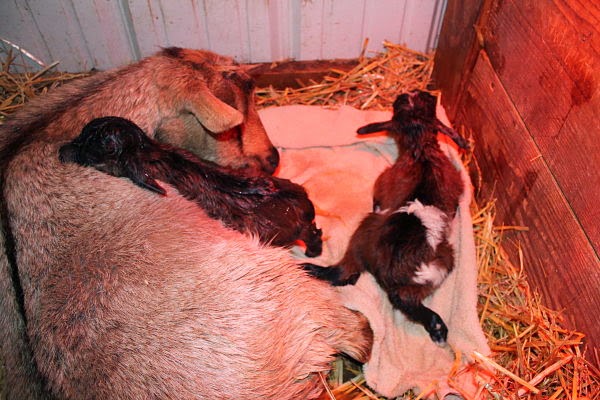
Just as I snapped this picture, she gave a little push, and I saw another bubble sticking out from under her tail. Less than one minute after the first kid was born, kid number two made its entrance into the world! The shiny black blob that Agnes is licking in the picture below is the second kid. Sorry the picture quality is so terrible, but I only managed to snap two pictures before I realized that kid number three was about to make her appearance!


I covered the three kids because it was happening so fast that I couldn't adequately dry each one before the next one was presenting. I didn't know it at the time, but after downloading my pictures on my computer I could see that the first picture was taken at 3:01, and the one with three kids (below) was taken at 3:04!


And then a fourth kid.


And then a fifth kid! As soon as the fifth kid was born, Agnes stood up to continue licking the kids. 


That was when I realized I was going to need some help. There was no way I could get five kids nursing on my own. I had been having enough trouble simply getting the kids dried off. In past years, I was out there crawling around on my hands and knees drying off kids as they were born, but my right knee, which was injured last March and has grade four arthritis, was not willing to let me do that. It doesn't bend completely any longer, and simply trying to make it bend that far is quite painful. I quickly realized I was limited to either sitting in the straw or laying on my stomach. So, I called over the monitor to Mike, asking him to come help.

We eventually ended up milking Agnes and giving each kid 3 ccs of colostrum in a syringe to try and get them interested in nursing. The two smallest ones -- a buck at 1 pound, 15.6 ounces and a doe at 1 pound, 15.1 ounces -- just wanted to go to sleep. The three larger does, between 2 pounds, 9 ounces and 2 pounds, 13 ounces, were alert but not showing any interest in nursing, so I told Mike that I was going to take the two smaller ones into the house and bottle-feed them. I don't usually make the decision that quickly, but the two smaller ones were clearly having more trouble than the larger ones, probably because their smaller body mass made them more susceptible to hypothermia. So, I took the two little ones in the house with some colostrum from Agnes. Mike stayed in the barn trying to get the other three to nurse.

Once the kids got warmed up in the house, they took to the bottle like ducks to water. I put the nipple in the little buck's mouth, and he immediately started to suck. When he finally let go of the nipple, I looked at the markings on the side of the bottle to see that he had consumed 2 ounces. Then the little doeling did the same thing, only faster!

I still had two ounces of colostrum left, so I went back to the barn. One of the doelings still had not nursed, so I gave her the last two ounces, so that Mike and I could come back into the house and go to bed. By then it was almost 6 a.m.

Here are a couple of pictures of the two kids taking their bottles this morning ...


Did I mention that the snow storm did hit. And now it has turned into a real blizzard. And Vera is at day 148. Mike went out to the barn an hour ago and said that he couldn't find Vera's ligaments. I really hope that's because of his inexperience. The temperature is falling into the single digits tonight, so I'd really prefer to stay in my bed all night! 

And Vera looks like she has four or five kids in there again this year, so it's going to be a production when she does kid.

Sunday, December 7, 2014

Vet visit

We don't have a full-time large animal vet anywhere near us, which is why I always wind up driving the two hours to the University of Illinois vet clinic in emergencies. However, there is a traveling vet that comes through here, and although it would be $140 to have her drive here just for us, if I can coordinate her visit with another nearby farm (or two or three), we can reduce that cost considerably. And that's what happened a couple of weeks ago. A farmer friend of mine was having the vet come to her place to trim her boar's tusks, and I thought it would be a good opportunity to get an ultrasound on a goat that was being sold to Texas to make sure she was pregnant.


So, here's Marie on the milk stand, enjoying some grain, with no idea that the vet is about to put that cold ultrasound probe on her belly. It went totally fine though -- after Marie's initial shock -- and we learned that she was pregnant with at least two bouncy kids! So, Marie is now in her new home down in Texas.


Since the vet was going to be here, I also decided to get an ultrasound on Vera. She was two months pregnant and already huge. I have only ever had three goats look pregnant at two months -- Vera when she had quintuplets last year, and her mother Coco, the two times she had quints!


If memory serves, this is just a picture of amniotic fluid, but that means the goat is pregnant! Unfortunately, with Vera being two months into her pregnancy already, the vet couldn't get a good view of all the kids at once. She could see three at one time, but she was hesitant to say that there were more than that because it's tough to know when you're seeing the same kid or a different one each time you move the probe a little. So, I guess we'll just have to be surprised at the end of January when Vera kids. If she does have five in there again, I just hope that they come shooting out as easily as they did this last kidding season. Mike was home alone and said he could hardly get them dried off fast enough.

LinkWithin

Related Posts with Thumbnails