Friday, September 27, 2013
Where in the world is Deborah?
Today I'm home working on the farm and catching up on email and blog posts, but last weekend I was at the Mother Earth News Fair in Seven Springs, Pennsylvania, and yesterday, I spoke at the National Goat Expo in Bloomington, Illinois. On October 12-13, I'll be speaking at the Mother Earth News Fair in Lawrence, Kansas. (If you're there, be sure to introduce yourself!)
I also have some television appearances coming up to promote my new book, Raising Goats Naturally. I really didn't think that anyone would want me on a talk show promoting a goat book because few people actually have goats. However, last year after an interview on the Paula Sands Show in Iowa, the producer asked if I was working on another book, and as soon as I said it was about goats, he and Paula both said I had to come back to talk about it when it was released -- and one of them immediately asked, "Can you bring a goat?"
So, I am bringing a goat. It will be interesting. I've decided to take Agnes because she is the "resident goat expert" and has her own Twitter page. So far, she only has two engagements booked, but the first one is next Friday, October 4. I'm trying not to think about it too much. I have a really active imagination and tend to think that Mr. Murphy runs my life. (You know Murphy's Rule, right?)At least this segment will be taped, so I know I won't be the new star of a viral video about a goat gone wild in a television studio. If it goes okay, we might consider contacting a few more television stations.
Tuesday, September 24, 2013
The story of lunch
by Jane Davis
Antiquity Oaks apprentice
I ate duck a l’orange for lunch the other day. It was delicious.
Friday morning the duck that I ate on Saturday was waddling around its enclosure.
Friday afternoon its head was being chopped off.
That night it was sitting in pieces in the fridge passing through the phases of rigor mortis.
Honestly, when I was watching the duck bleed out I wasn’t entirely sure that I would be able to eat it. It seemed gruesome. This was the duck that I had fed and watered every morning, and in just a second it went from very much alive to hanging headless, spilling it’s precious juices all over the ground. It was a little too real all of a sudden.
This might sound stupid, but I have never really been able connect the meat on my table to the animals it comes from. Think about the language that we use; it’s a cow when it’s alive, and at some point that we are not forced to bear witness to, it becomes beef. Poof, like magic. Nobody has to think about eating the big beautiful beast, because it’s not cow…. it’s beef.
The other day when I sat down in front of my plate I remembered that duck walking around the pen with his friends. I remembered chasing after his living, breathing body, and watching as spasms racked his headless body. To not eat this duck was to know that he had died for one less reason. So I ate consciously.
That duck tasted good because it was pasture raised and just about as fresh as it gets. It tasted good because I knew where it had come from and I had seen it grow and I was eating it deliberately. I was reminded of how much work went into that duck, and I was reminded to slow down and savor it. I was also reminded of how many slices of bacon, how many hamburgers, how many chicken wings, and how many turkeys I have eaten without reminding myself of the animal that made them. Watching that duck go, very literally, from farm to table prodded me to remember that all the meat I eat was once a living, breathing animal (as obvious as it sounds).
Antiquity Oaks apprentice
I ate duck a l’orange for lunch the other day. It was delicious.
Friday morning the duck that I ate on Saturday was waddling around its enclosure.
Friday afternoon its head was being chopped off.
That night it was sitting in pieces in the fridge passing through the phases of rigor mortis.
Honestly, when I was watching the duck bleed out I wasn’t entirely sure that I would be able to eat it. It seemed gruesome. This was the duck that I had fed and watered every morning, and in just a second it went from very much alive to hanging headless, spilling it’s precious juices all over the ground. It was a little too real all of a sudden.
This might sound stupid, but I have never really been able connect the meat on my table to the animals it comes from. Think about the language that we use; it’s a cow when it’s alive, and at some point that we are not forced to bear witness to, it becomes beef. Poof, like magic. Nobody has to think about eating the big beautiful beast, because it’s not cow…. it’s beef.
The other day when I sat down in front of my plate I remembered that duck walking around the pen with his friends. I remembered chasing after his living, breathing body, and watching as spasms racked his headless body. To not eat this duck was to know that he had died for one less reason. So I ate consciously.
That duck tasted good because it was pasture raised and just about as fresh as it gets. It tasted good because I knew where it had come from and I had seen it grow and I was eating it deliberately. I was reminded of how much work went into that duck, and I was reminded to slow down and savor it. I was also reminded of how many slices of bacon, how many hamburgers, how many chicken wings, and how many turkeys I have eaten without reminding myself of the animal that made them. Watching that duck go, very literally, from farm to table prodded me to remember that all the meat I eat was once a living, breathing animal (as obvious as it sounds).
Sunday, September 22, 2013
Duck, duck, goose
Twice I've purchased 15 ducks for our farm. Initially we were going to use them for meat and eggs, but then I discovered that I wasn't a big fan of duck eggs, and Mike was not a big fan of butchering ducks. I found the eggs too yolk-y, and Mike found the feathers and down too challenging to pluck. So the ducks have mostly been pond ornaments and coyote food. Over the winter, we found ourselves with only two male ducks.
![]() |
| The bigger birds are the geese. |
I really didn't want another 15 ducks, which is the minimum hatchery order, so when the feed store had ducklings available this spring, I bought five. The only down side to buying them at the feed store is that our only option was white Pekins, rather than some of the prettier ducks available through hatcheries.
Fast forward to last week.
![]() |
| A Cayuga drake splashing in the water |
Mike butchered the last two male ducks, and the two female ducks were put out on the pond to join the two remaining boys from previous flocks. The boys immediately welcomed the girls by jumping on top of them to breed as soon as they met. The two drakes have been without females in their flock for more than a year, so I suppose I understand their enthusiasm.
![]() |
| The two new white Pekin ducks |
The geese also seemed very happy to welcome the two new ladies to the pond. The geese are also boys, but they appear to understand they are not the right species for the new ladies. Why do we have so many males? Ever heard the term "sitting duck?" I think the original term was probably "setting duck" meaning that when a duck is setting, it is very easy for a predator to get them. That is definitely what happened to all of our geese.
The ducks, on the other hand, had a bad habit of leaving the secure fenced area around our house to visit the creek. Just as goats know that the grass is always greener on the other side of the fence, I suppose ducks think the water is bluer on the other side. They do have a nice pond for swimming, but that's apparently not good enough. I do hope these new ladies will stay put where it's safer.
And when we took them out of their little duck house to let them loose on the pond, we discovered that they had already laid their first three eggs. Jane used two of them to make a cake.
Our previous ducks just laid eggs around the pond, making it a real egg hunt every day. Because these were raised in a little house, I am hoping that they'll continue to go back there to lay eggs.
Saturday, September 21, 2013
Want to be a blog tour host?
My publisher wants me to do a blog tour to help promote Raising Goats Naturally: A Complete Guide to Milk, Meat, and More, so I'm in the process of finding blogs that are goat-related and willing to be a host.
Wait! What's a blog tour? What does a host do?
Great questions! A blog tour just means that I'll "visit" your blog one day in October. You can write up a bunch of questions for me to answer, or I can do a guest post, or you can do a review of the book. Yep, that means the publisher will send you a free copy of the book. If you want, I can plan to be available to answer questions that your readers might ask on the blog. My publisher is even willing to provide a limited number of books for giveaways on those blogs whose readers would be interested. If you're still wondering what I'm talking about, check out this post from 2009 when author Margaret Hathaway visited the Antiquity Oaks blog.
If you would like to participate, just send me a message on the contact form at this link.
Wait! What's a blog tour? What does a host do?
Great questions! A blog tour just means that I'll "visit" your blog one day in October. You can write up a bunch of questions for me to answer, or I can do a guest post, or you can do a review of the book. Yep, that means the publisher will send you a free copy of the book. If you want, I can plan to be available to answer questions that your readers might ask on the blog. My publisher is even willing to provide a limited number of books for giveaways on those blogs whose readers would be interested. If you're still wondering what I'm talking about, check out this post from 2009 when author Margaret Hathaway visited the Antiquity Oaks blog.
If you would like to participate, just send me a message on the contact form at this link.
Thursday, September 19, 2013
Breeding season!
This is the latest we have started breeding goats for as long as I can remember other than our very first year when all three of our goats were bred the first week of October. This means that I am not going to pass up a single doe that is in heat. Usually I try to maintain a bit of sanity in my kidding season by not having too many does due at the same time, but because I like to be done with kidding by March, I can't risk missing a doe coming back into heat later. Kidding during winter is one of our strategies for controlling internal parasites in the goats. If the does kid when the parasites are mostly dormant, we are able to avoid the use of chemical dewormers.
Pictured are two of the happy couples that were put together when the doe was in heat. Yes, Sadie the white goat above, is with a younger man. That's Calvin Klein, one of Coco's quintuplets born in March.
And here is handsome Austin with Nina Ricci behind him. I like to provide dinner for all of the goats when they're on their dates. And yes, he's a younger man too. I kept three bucklings this year, and they're all doing a great job with breeding this fall.
The first week of February is going to be crazy! There are nine does due on February 5 and 6. I'm looking forward to the babies but dreading the inevitable lack of sleep! If I make it through without a migraine, I'll be very happy.
Tuesday, September 17, 2013
Starting a Hamburg flock
I've been searching for a white egg laying bird that will do well on our farm, and the silver spangled Hamburg is the next candidate. They are a medium sized chicken and were historically considered a good egg layer in Holland.
When getting new layers, I prefer to have fall hatched because they will reach maturity around the time the days are getting longer, so you wind up with a lot more eggs the first year than you do when you get spring hatched chicks. It is also easier to keep the chicks warm in September than our cold spring months, and they feather out as the temperatures fall.
The chicks are already a week old in these pictures and starting to get their tiny feathers.
One of the fun things about getting chicks from McMurray Hatchery is that they always throw in a free mystery chick. This little one is a lot bigger than the Hamburgs. Any guesses?
Sunday, September 15, 2013
Welcome, Jane!
Last week you had the pleasure of reading Jane's post about our honey harvest, which means I am way overdue in introducing her to you. She is our new apprentice and will be here until December.Jane is from Baltimore and just graduated from high school. Although she's been accepted at a college already, she asked for deferred enrollment so that she could spend a year exploring her place in the world, as she said in her apprenticeship application.
She jumped right into farm life and has been helping with chores, including animal care and goat milking, as well as learning to make a variety of cheeses. She also helped with honey harvesting and processing the beeswax. As you've already discovered she is a talented writer and photographer, even taking her own self-portrait above with Bella the goat!
Thursday, September 12, 2013
The book has landed!
Monday I had a phone meeting with my publicist from my publisher, and she told me that my latest book, Raising Goats Naturally, had just come off the press on Friday. Copies were being drop-shipped to me so that I will have them available when I speak at the National Goat Expo in a couple of weeks. However, she said that it could take up to ten days for the books to reach me.
Imagine my surprise when we got a phone call Tuesday morning from a trucking company asking if we would be home to accept delivery that afternoon!
It was a semi truck, so he had to park on the road. My son had the excellent idea to drive our truck out there and back it up to the semi so we could get the books closer to the house before we had to actually carry them. We are into working hard out here, but no one wants to do any extra labor when it's 97 degrees out!
I immediately ripped open one of the boxes and pulled out a book!
It is truly amazing when you actually get to hold your book in your hand for the very first time. I flipped through the pages, looking at pictures, reading passages, and even getting all choked up and teary eyed when reading the "Final Thoughts" again.
The book sat on my desk just to the right of my computer for the rest of Tuesday, and I did a double-take every time I saw it. After so many months of planning and writing and sweating, it's hard to believe it's finally here!
It will take two or three weeks to get to stores, but for those of you who really want a copy now, I have a special price with free shipping until the end of this month. Click here for details! For those of you who prefer ebooks, it will be available on Nook, Kindle, etc within a few weeks.
Tuesday, September 10, 2013
Beautiful baffling bee barf
by Jane Davis
Antiquity Oaks apprentice
I thought I had bees all figured out. I knew a little bit about their social structure, their lifecycle, and their care. I had gotten dressed up in a bee suit and taken peeks into their home. For some reason I assumed I was familiar with everything I cared to know about bees; I was happy just enjoying the fruits of their labors and appreciating them from afar.
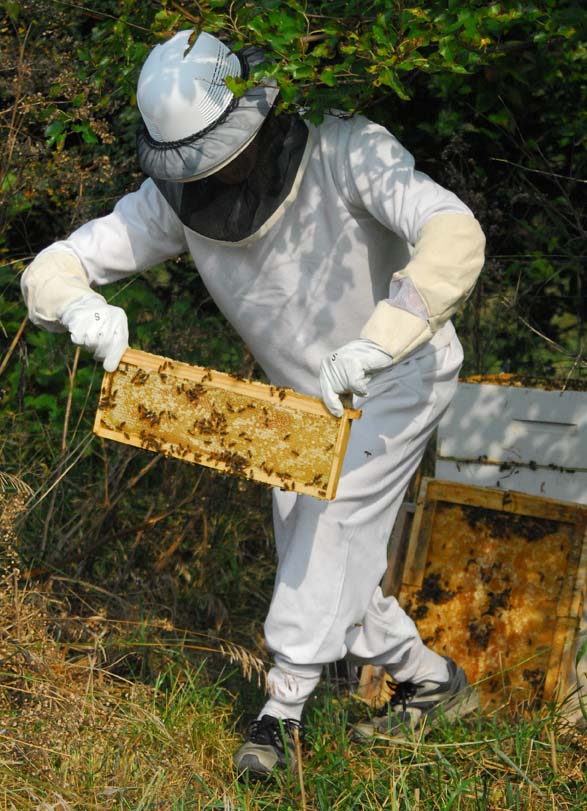
When Mike announced that it was time to harvest the honey, I was intrigued but not overly zealous. Deborah seemed the most excited, which made sense considering she had stood by for a year and a half while the bees did their work. However, after much patience, the wait was finally over. Mike donned his bee-keeping outfit, slid on his helmet and gloves, and lit his smoker. We headed out, unsure what to expect. The two hives sit nestled back into a thicket of brush. Bees buzz lazily in and out of the hive and crawl around the entrance. With immense patience and placidity (and a little help from the smoker) Mike disassembled the first hive with little incident. To our great disappointment as soon as he lifted the lid we saw ants swarming and mingling with a few other mysterious bugs. We let the first hive be; simply hoping they will make it through the winter. While it was not a great start to the investigation, we were not disheartened knowing we still had a whole second hive to investigate.As soon as Mike pulled the first frame out of the super we knew we had struck gold. Even the frames closest to the edges (the last to get filled) were bursting to the brim with honey. Happily, he continued to pull frames out, smoking and brushing bees off as he went. As Mike pulled frames out I became more and more captivated by the project. I was in awe that those little bees had created something so big. I was entirely fascinated by the process and would only become more so as the day wore on.
When Mike was done, he had pulled nine frames out of the top super –he left the last because it was not yet full. The hardest part was over, and Mike had braved only three stings. I was surprised by how tranquil the bees were considering we were taking the hard earned fruits of their labor. When we got everything inside (carefully checking for stragglers and hitchhikers first) we could only wait long enough for Mike to change before we dove into the next steps.
The first phase of the process was to remove the caps from the comb. Using a tool that was something along the lines of a cross between a spatula and a double sided, serrated knife and a little comb we separated as many caps as possible.
The frame was then put into a metal drum with a crank on the side that spins two frames at a time. This machine is great for two reasons. First, it saves the comb for the bees, creating less of an impact on their hive. Second, it does an astonishing job cleaning every last drop of honey out of the comb. When all the frames had been cleaned they were ready to be returned to the hive and filled again. As we were processing the honey I couldn’t help but become progressively more excited about bees. I was astonished. These teeny tiny creatures had built thousands of perfect little cells and filled it with their magical barf. How could insects make something that works as a disinfectant, a preservative, a sweetener, and an allergy aid? Nobody really understands everything about bees, which is part of the reason they are so intriguing.
The next step took a little more patience. The honey is poured through a set of three, progressively smaller strainers to trap all the little pieces of wax and any other impurities. We ended up having to let it sit overnight to allow all the honey to drain through. The honey was collected in a five gallon bucket and I was astonished by how much we had. With just a little work on our part and a lot of work on the bee’s part, we collected almost two and a half gallons of honey! This is especially astounding when you consider that each worker bee creates just 1/10th of a teaspoon of honey in her lifetime. For a first harvest I was very impressed by the results.
Sunday, September 8, 2013
Happy retirement, Carmen!
When do you retire a doe? Although I can give some benchmarks that are easy to measure -- like, when she can't maintain her body condition after kidding -- I've discovered this year that I have a much more instinctual method for deciding when to retire does. I'm not saying it's good or that I'm always making the best business decision, but it feels right, so I'm going to go with it. Maybe it's more emotional than instinctual?
I've decided that I won't be breeding ARMCH Antiquity Oaks Carmen *D 1*M again. In the back of my head, I can't help but think that it has something to do with the death of Coco following kidding last spring. Coco is the doeling in the background of this picture with Carmen from 2004 when they were born -- and then both promptly tried to die on me. They were the first goats that ever tried to to die on my farm, and I was beyond thrilled when I was able to beat death, in spite of my inexperience and ignorance.
Carmen was a tiny triplet that was born when no one was in the barn, and when we found her, she looked dead. Her two big brothers were both up and nursing, but this tiny little gold and white doe laid seemingly lifeless in the straw. Even though I had never seen a kid with hypothermia, I realized immediately that it was her main problem, and I told my children to bring me a bucket of warm water. I didn't want to take her away from her mother, naively thinking that this tiny, weak doeling would be able to compete with two big healthy bucklings for her dam's two teats. I called my mentor who told me to milk the dam and feed her colostrum to the tiny kid with a stomach tube. I felt like I had two left hands, and I was terrified of accidentally putting the colostrum into her lungs, but somehow I managed to do it correctly.
And so Carmen became our first house goat. She was not able to stand for a couple of days, but it didn't take us long to realize that she was a lovely little doe. In the back of my head, I thought that I must be incredibly biased. After all, what are the odds that one of our first kids would actually be a really beautiful goat? When my daughters started showing, no one was more surprised than me when Carmen took her first grand champion ribbon. And then she won again and again and became a finished champion.
It was not all smooth sailing though. We had recently gone on milk test when my daughters took the goats to a show where they all contracted pinkeye, but none had it worse than Carmen. Within a few days she was completely blind and just stood in the corner of the barn, not eating, and losing weight, as her milk supply plummeted. I saw my dream of my first homegrown doe earning a milk star vanishing. But after two weeks, the pinkeye was finally nothing more than a bad memory as Carmen regained her vision completely. And amazingly enough, her supply was able to rebound enough that she squeaked by to earn her milk star that year!

Carmen has always had her mother's ease with birthing, completely surprising us as a first freshener, kidding with a single doeling in the pasture when no one was around. That kid, Lizzie, is still with us and has been our second-best milker for three years. I realized last year that I had not kept any other Carmen daughters, so decided to keep Rosie, her doeling from last year.
One of my favorite things about Carmen is that she is an easy keeper. She has great parasite resistance and so does Lizzie, so I'm hoping Rosie follows in her Mama's and Auntie's hoofsteps. She was born last August and so far has never needed a dewormer, so I'm very hopeful.
As I write all of this, a tiny voice asks, "Why aren't you going to breed her again?" She'll be ten years old next spring, and although she is in excellent health and would most likely give birth easily again, it just feels right to retire her. She gave me hundreds of gallons of milk over the years, as well as Lizzie and Rosie, and to ask for more just seems like it would be greedy. So Carmen will be spending her golden years out in the pasture with her daughters, granddaughters, and great granddaughters, enjoying the fresh air and sunshine.
I've decided that I won't be breeding ARMCH Antiquity Oaks Carmen *D 1*M again. In the back of my head, I can't help but think that it has something to do with the death of Coco following kidding last spring. Coco is the doeling in the background of this picture with Carmen from 2004 when they were born -- and then both promptly tried to die on me. They were the first goats that ever tried to to die on my farm, and I was beyond thrilled when I was able to beat death, in spite of my inexperience and ignorance.
Carmen was a tiny triplet that was born when no one was in the barn, and when we found her, she looked dead. Her two big brothers were both up and nursing, but this tiny little gold and white doe laid seemingly lifeless in the straw. Even though I had never seen a kid with hypothermia, I realized immediately that it was her main problem, and I told my children to bring me a bucket of warm water. I didn't want to take her away from her mother, naively thinking that this tiny, weak doeling would be able to compete with two big healthy bucklings for her dam's two teats. I called my mentor who told me to milk the dam and feed her colostrum to the tiny kid with a stomach tube. I felt like I had two left hands, and I was terrified of accidentally putting the colostrum into her lungs, but somehow I managed to do it correctly.
And so Carmen became our first house goat. She was not able to stand for a couple of days, but it didn't take us long to realize that she was a lovely little doe. In the back of my head, I thought that I must be incredibly biased. After all, what are the odds that one of our first kids would actually be a really beautiful goat? When my daughters started showing, no one was more surprised than me when Carmen took her first grand champion ribbon. And then she won again and again and became a finished champion.
It was not all smooth sailing though. We had recently gone on milk test when my daughters took the goats to a show where they all contracted pinkeye, but none had it worse than Carmen. Within a few days she was completely blind and just stood in the corner of the barn, not eating, and losing weight, as her milk supply plummeted. I saw my dream of my first homegrown doe earning a milk star vanishing. But after two weeks, the pinkeye was finally nothing more than a bad memory as Carmen regained her vision completely. And amazingly enough, her supply was able to rebound enough that she squeaked by to earn her milk star that year!

Carmen has always had her mother's ease with birthing, completely surprising us as a first freshener, kidding with a single doeling in the pasture when no one was around. That kid, Lizzie, is still with us and has been our second-best milker for three years. I realized last year that I had not kept any other Carmen daughters, so decided to keep Rosie, her doeling from last year.
One of my favorite things about Carmen is that she is an easy keeper. She has great parasite resistance and so does Lizzie, so I'm hoping Rosie follows in her Mama's and Auntie's hoofsteps. She was born last August and so far has never needed a dewormer, so I'm very hopeful.
As I write all of this, a tiny voice asks, "Why aren't you going to breed her again?" She'll be ten years old next spring, and although she is in excellent health and would most likely give birth easily again, it just feels right to retire her. She gave me hundreds of gallons of milk over the years, as well as Lizzie and Rosie, and to ask for more just seems like it would be greedy. So Carmen will be spending her golden years out in the pasture with her daughters, granddaughters, and great granddaughters, enjoying the fresh air and sunshine.
Subscribe to:
Posts (Atom)