Monday, June 19, 2006

Wilderness in my backyard


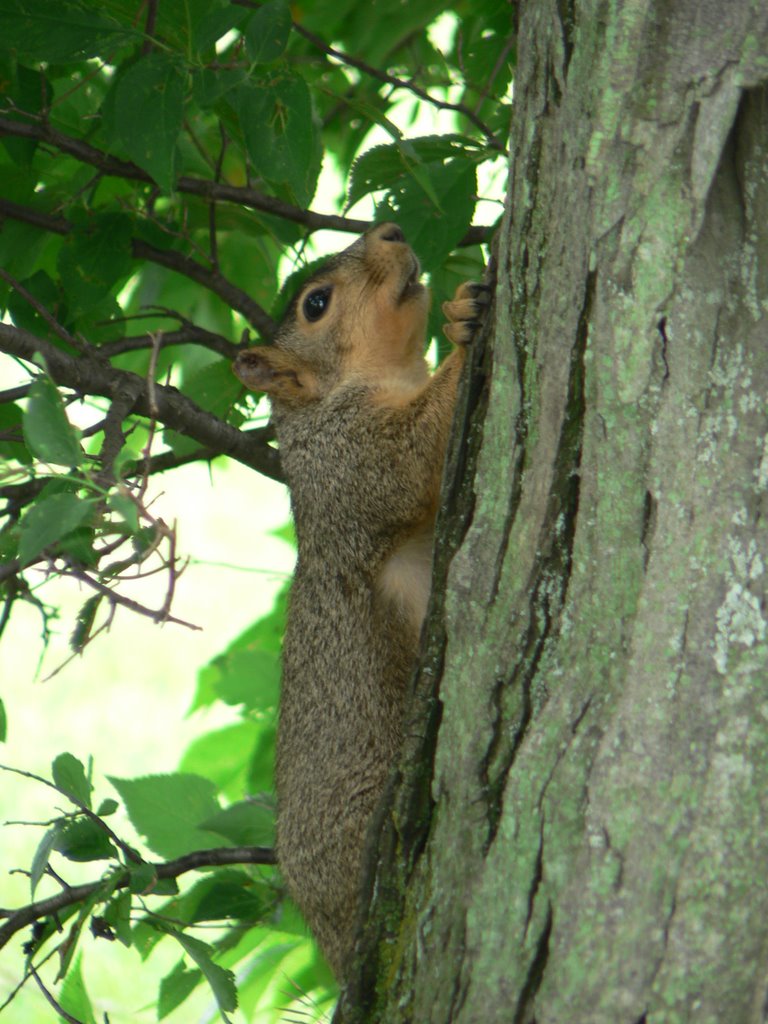
When we first moved here four years ago, it was desolate in spite of the grass and centuries-old trees. There were frogs croaking in the pond, but nothing else. There were squirrels scampering about, but few other wild animals. I guess we must be doing something right, because in the past year, I have seen more wild animals than I ever knew existed in Illinois.

A few days ago, I spotted a turquoise bird clinging to a cattail by the pond. I've seen so many different colored birds recently. We are now frequently visited by Canada geese, egrets and wild ducks. I've seen blue jays, robins, cardinals, woodpeckers of different varieties and black birds with yellow wings and red wings. I saw a yellow bird not very long ago.

This evening as I was eating dinner, I looked out onto the pond and thought to myself, if I were suddenly paralyzed and unable to walk, I'd want to spend all my time in front of those big glass doors. I'd want a sketchpad or canvas and paints to record what I saw. The scene on the pond changes from one minute to the next, but it is always beautiful and always entertaining. There just aren't many places where you could always be guaranteed a view like that.

Wednesday, June 14, 2006

Simply delicious!

Sorry I didn't get a picture of my dinner ... it wasn't a gourmet meal, but it was satisfying beyond the taste and appearance. The salad came from our garden: lettuce and radishes. The dressing was homemade ranch made with our own buttermilk and my mayonnaise, which was made with our fresh eggs. The quiche was made with our fresh spinach, milk and eggs. This evening I need to mix up sausage for tomorrow's breakfast. I'll add some garlic, sage and salt to our ground pork, and in the morning, Mike will make breakfast for us. It'll include our own sausage, eggs, biscuits made with out buttermilk and gravy made with the sausage pan drippings and our milk.

Tonight's dinner came at a great time ... just when I was feeling that we couldn't do anything right.

Tuesday, June 13, 2006

Challenges of small farms

Last Thursday, we took 28 young roosters to the processing plant in Arthur, IL. That sounds more elaborate than it is -- it's a little white building that looks like a house from the outside. It's run by the Amish and inspected by the USDA. Inside, it looks like a commercial kitchen. We drop off crowing roosters in the morning and pick up chicken in plastic, shrink-wrapped packages in the afternoon.

My oldest daughter and I took the chickens down there last week. While there, we had to fill the truck with gas. Suddenly it dawned on us that it had cost us $1.50 for each chicken to drive them down there! That's a huge chunk of profit out of chickens that are being sold for $3.25 a pound for whole or $3.50 per pound for cut-up. Heritage chickens don't weigh as much as commercial breeds. These averaged 2.5 to 3 pounds each. The purchase cost of the roosters as day-old chicks was $1.39 + processing cost of $2.50 per chicken + the gasoline = more than $7 per chicken before the cost of feed! (And no, that does not even include anything for labor, so we worked for free all these months raising the chickens.) Since these chickens ate a lot over the four months it took to grow this big, we were really depressed for the whole drive home. It wasn't this bad a few years ago. We weren't buying specific breeds. If you are willing to take whatever heritage breed the hatchery has left over, they can be as cheap as 40 cents each. The cost of gasoline has doubled in the past four years, and the cost of processing has increased by $1 per bird.

Commercial chickens grow to this size in only six to seven weeks, so how can we possibly compete? Forget competing! How can we possibly make a profit with slow-growing chickens? We obviously cannot take them to the processor unless we have at least 100 at a time. That would cut the cost per bird to around 50 cents per bird for transportation. If we could process the birds on the farm, we could eliminate the entire transportation cost and the processing cost. If we didn't buy chicks from a hatchery, that would save even more. Right now we only have a few new chickens raised on the farm each year because our hens don't set that much. We'd have to use an incubator for hatching eggs if we wanted to raise a lot. Then half the chicks would be hens, so we couldn't hatch 500 chicks unless we wanted 250 new laying hens every year. (Hens are even smaller than roosters, so aren't really practical for butchering when they're young.) Processing chickens on the farm is not practical since it takes us 45 minutes to butcher a single chicken. It would have taken us days to process 28. Plucking is what takes so much time, and a mechanical plucker costs close to a thousand dollars, which we can't afford.

I can understand why our customers say they can't find products like ours anywhere else -- no one can stay in business doing what we're doing. So, what do we do? Obviously, we need capital to buy a commercial incubator and a mechnical plucker. We'd also need a commercial kitchen to process the chickens. We're researching incorporating as an S-corporation, an LLC or a not-for-profit. I was surprised to learn that agricultural business in Illinois can be not-for-profit. I guess they know how little small farms can make. If we incorporate, we can sell stock. If we become a not-for-profit, people can buy memberships. There is a lot to research and a lot to consider, but one thing we're discovering is that the farm of the 1800s cannot survive in the 21st century.

Monday, June 12, 2006

Frustrations of free-range geese

Before I started keeping a blog, I didn't think we did much around here. People would express surprise at how dedicated we were or how much we worked, but I pooh-poohed their comments, thinking that if they really knew how little we did, they'd be disappointed. Now that I'm keeping track of "stuff" by writing, I am realizing that we are really busy around here -- and I don't even write about half of it. I usually just write about a particular theme for each entry, something that kind of stuck out in my mind about what we did that day.

Saturday was a typical farm day in so many ways. First, we weren't able to do all the outside chores we wanted due to rain. It poured all day long. So, we did mostly inside stuff, continuing to work on our house. We also had company -- a couple of friends from Chicago who wanted to help with farm work. The rain outside changed it into a social day for us. Then around six in the evening, Mike came inside, and I knew from the look on his face that something bad had happened. Someone had run over two of our young geese. One of the buff geese and one of the white embden geese had been killed while crossing the road. We live on a gravel road. No one should be driving faster than about 30 miles per hour, and most people drive much slower past our place because they enjoy watching the animals. Many people slow to a crawl or even stop so they can get a closer look at the animals. It's rare to have an animal killed by a passing car. Over the past four years, we've lost two chickens to passing traffic, so it was a shock to loose two geese at once.

Knowing that they would have been worth $100 each at maturity, it was depressing on two levels to see them dead. Knowing that these geese had not been dead very long, it was not hard to decide that we needed to butcher them. At least we'd get something out of it. We realized quickly that the buff was not fit for human consumption because the body had been destroyed, so Mike just cut off some breast meat for the dogs. The other goose did not look like it was too badly damaged. There was a tire track across one wing, but it otherwise didn't appear too messy. As Mike worked on plucking, however, he realized one of the thighs was broken. He also learned that it's true what they say about plucking waterfowl -- it's hard! He spent three to four hours plucking. Then when he cut open the body to remove the intestines, he came upon the sad realization that the internal organs were destroyed. So after all those hours of plucking, he realized we could not use more than the breast meat and legs.

I've never cooked goose before, so I looked up goose recipes on the Internet. Currently, the legs are marinating in red wine, and the breast meat is marinating in buttermilk. Tomorrow, we'll cook them.

Friday, June 9, 2006

Make hay when the sun shines!

There are so many meaningless cliches in our language, but after moving to a farm, I am starting to appreciate what they really mean. We've had so much rain this year that the pastures and the hay field are growing like crazy. Many of the pastures have grass that's knee high.

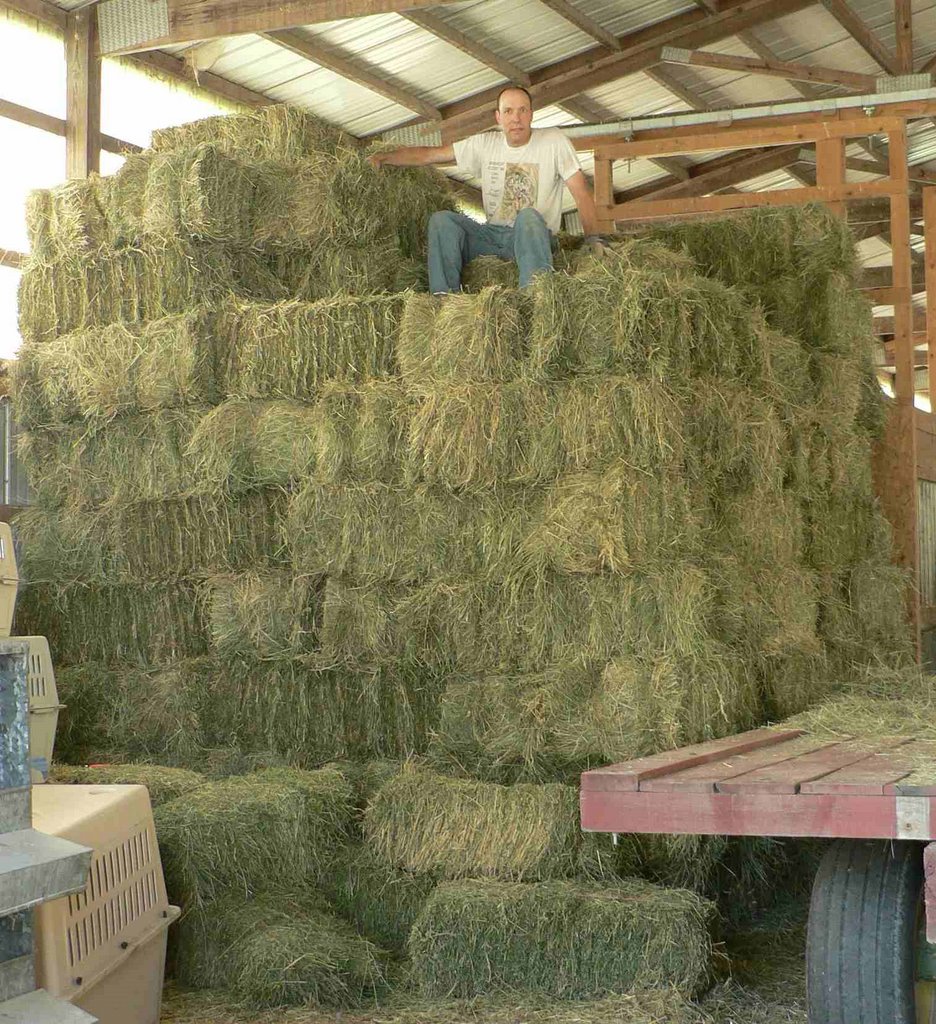
The challenge then becomes getting the hay cut and baled when it is not raining. If you cut hay and it rains, the hay can mold, making it unsuitable for animal feed. We have another farmer cut the hay because we don't have the equipment. He was going to cut it two Mondays ago, but it started raining then, and it rained for six days! Sunday was finally sunny, and the forecast showed sun, so that's when he cut it. Today he baled it, and that's when our work begins! We had to clear a space in the barn to hold all 177 bales! Mike and the girls did the stacking, which is the messiest, sweatiest, dirtiest job on the farm. Stacking grass hay (which this is) is much better than stacking alfalfa hay, because alfalfa has little leaves that can fall off and stick to your sweat ... and itch.

The baby ducklings are doing well. They don't like staying in a cage. They want to follow just about every animal they see, including a barn cat! It reminds us of the children's book, "Are You My Mother?" They have no idea who their mother is!

Today was very busy before the hay was even cut. We moved the bucks back from across the creek. With the grass being so tall on this side of the creek, there is no reason to keep the grass trimmed around the electric fences across the creek. (Tall grass on electric fence will make it short out -- not work.) It's enough of a time-consuming job to keep the fencelines clean on this side of the creek.

After moving the bucks into one of the pens in the barn pasture, we moved all 24 sheep to a new pasture. That was easier than we expected, but Monet was very intimidating. Katherine and I have both been rammed by him, and at one point I foolishly turned my back. Margaret and Katherine both screamed, "Mom!" when they saw him put his head down and start running towards me. I screamed and jumped and turned around and stared him down. I don't think he really likes to ram people when they're looking. He's always done sneak attacks.

Wednesday, June 7, 2006

Your mama is a ... ?


Earlier today I signed on to post a story about a chicken hen who'd adopted baby ducks, but Blogger was down. Now, I'm posting about baby ducks that we've adopted! There was a duck setting in the barn, and apparently her eggs hatched within the last 24 hours. Today, Katherine discovered a speckled sussex chicken hen being mama to the seven ducklings. This afternoon she went to check on them, and all seven babies were wandering through the grass of the near pasture with no mama in sight. She picked them up and put them in a box for the moment. She is now working on creating a brooder for them.

Brooder sounds so high tech. It's nothing more than a safe place for the babies to stay, and there is a heat lamp to keep them warm. I swore I would never again raise baby ducks in a brooder, because they were the messiest birds we ever raised. We bought 15 ducklings four years ago, and within a few days, I was counting the minutes until one month had expired. Brooder-raised ducklings can't go into the water before they're a month old. They are not producing their own oil prior to that time. If they are being raised by a mama, her oil rubs off on them, and they can swim safely without getting hypothermia.

Monday, May 29, 2006

Making mulch

Don't have the energy to type much tonight. We spent most of today mulching the smaller branches of the big hickory that went down in the storm last Wednesday. Temperature was in the 90s. Mike, his parents and Jonathan did the mulching, and I put the mulch in the various flower beds, which was more work than it sounds like. I imagine it would have been much more enjoyable if the temperature were about 20 degrees lower. They went through a pile that was six feet high, 15 feet wide by 20 feet wide!

After his parents left with the mulcher, another storm came through and knocked a few more branches out of trees. I wish we could afford a mulcher.

Never got around to making mozarella today, but we did make peppermint ice cream. This was just an ice cream kind of day.

More storms are in the forecast .... as well as lower temperatures, which are quite welcome!

Sunday, May 28, 2006

This and that


We've been so busy. Yesterday, I planted several packets of squash and zucchini. Mike planted more potatoes. He spent most of the past two days either staining or applying polyurethane to our windows. Yes, that should have been done when the windows were installed a year and a half ago. Some are definitely showing signs of being unprotected all this time, but hopefully there won't be any true, lasting damage that will affect their usefulness over the next few decades.

Remember those turkey hens I mentioned a few weeks ago? The two that had nests on top of the storeroom in the barn? Well, they have exactly one poult left between them. A couple of chicken hens hatched a brood around the same time, and they still have all nine chicks left. Chickens definitely win the prize for being the best mothers, but I've known that for quite some time already.

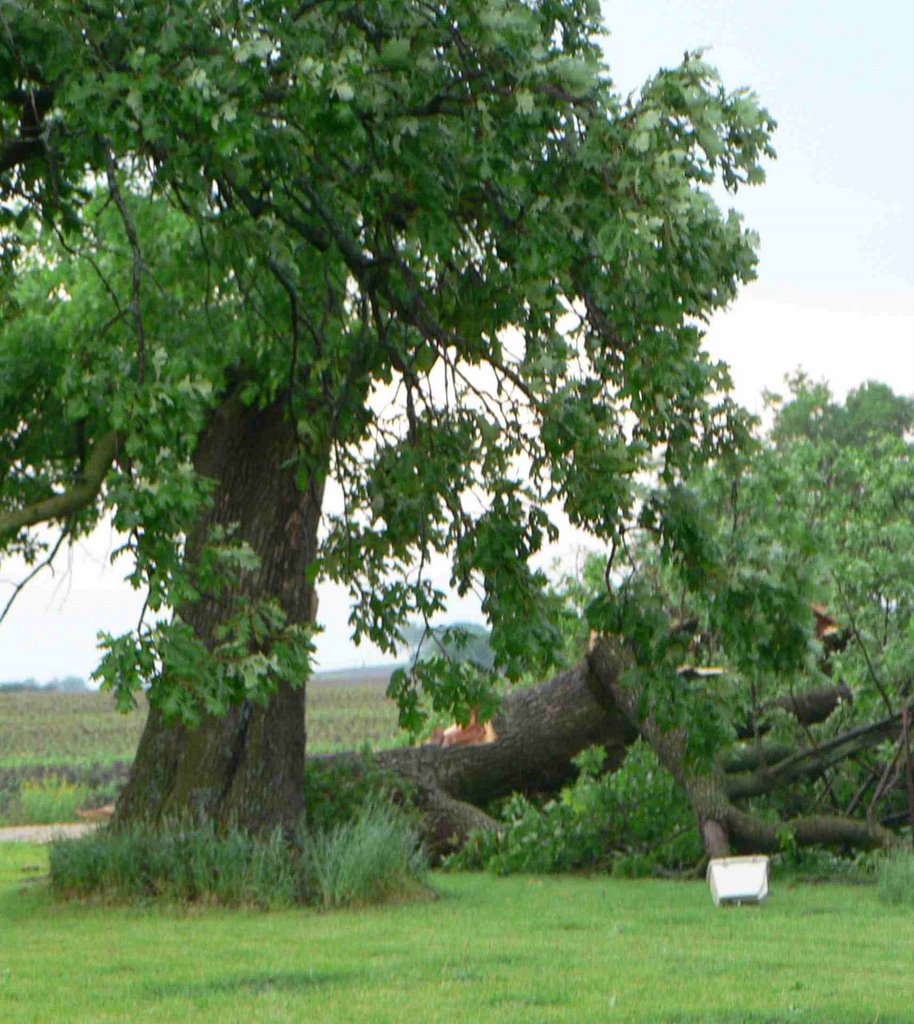
Mike has also spent quite a bit of time in the past two days cutting up the 200-year-old hickory tree that was knocked down by the storm on Wednesday. He has most of the smaller branches cut off now. His father will be bringing over the mulcher on Monday, so we can mulch them. The large parts will become firewood, and that will require a chainsaw and more time.

Last Sunday I completely sold out of soap made with fragrance oils. I should have remembered that the people who go to Garfield Farm like the fragrance oils more than the essential oils. So, I've started making more soap. I made a batch of sandalwood two days ago. I also made cheese a couple days ago -- fromage blanc this time. My buttermilk making has slowed to once every few days because I decided to start making a half gallon at a time, rather than just a quart. I make either buttermilk pancakes or buttermilk biscuits at least five mornings a week, and a couple times a week for dinner, I've starting making cornbread with buttermilk, which is the most delicious I've ever tasted.

Margaret and I will be making mozarella tomorrow. My history with mozarella is a long, sad one. The first time I made it, it turned out perfectly. It went downhill after that. It has never been quite right since then. There are several different methods used to make mozarella, so we have decided to attempt the citric acid method tomorrow. I hope it works, because if we are to ever reach our goal of self-sufficiency, we have to be able to make our own mozarella -- because we love pizza and lasagna.

Here's another little tidbit about an experiment we've been trying ... living without paper towels. I realized that we were spending about $20 a month on paper towels, which is a tad ridiculous. So, when we ran out, I announced to the family that I wouldn't be buying any more. You can imagine the response I received. "You can't live without paper towels!" Well, you can. It's been a few weeks, and we've managed to do just fine. If something gets spilled on the floor, I use a dish cloth, then throw it in the laundry right away. For draining fried foods, I use a clean dish towel. One of my daughters asked, "You aren't going to stop buying toilet paper are you?" No, toilet paper has a permanent place in our home.

The temperature climbed into the 90s yesterday, which is quite unseasonably warm for us. The forecast is more of the same today. We are planning to work in the basement this afternoon when the temps get too high. (We didn't put A/C in our house because there isn't an energy efficient A/C unit available. They're all power guzzlers, and our ultimate goal is to have a solar-powered house.) Normally, our plan for hot weather is to have the whole house fan on at night to pull the cold air in from outside -- normally, it gets down into the 70s or even 60s at night all summer long, so we're usually freezing at night. Then in the morning, when the temperature gets above 70, we close all the windows. With our super-insulated house, this works really well for all but the hottest days -- meaning 100 degrees. We do have ceiling fans, which make it seem cooler than it would otherwise. For days that will go above 90 outside, we have the smallest available window unit for each floor -- it's the type of unit that is supposed to cool a 10X10 room, but it is enough to maintain temps in the 70-80 degree range in the 1,000-square feet on each level, and we don't use the upstairs unit during the day, because there are only bedrooms up there. At the moment, our normal plan doesn't work because we don't have windows in all the windows. Mike removed the glass parts of several windows to make it easier to stain and finish. So, this afternoon we are going to retreat to the coolness of the basement where we'll work on organizing it in preparation for putting up more walls down there. (In other words, we have to get the junk out of the way so we can work down there.)

Today's picture was taken by Katherine a few days ago when it was raining. When we first moved here, there was no wildlife around the pond. I guess we're doing something right because now we get frequent visits from blue herons, egrets and Canada geese, as well as a variety of wild ducks that we always scramble to identify with our birdwatching book.
Thursday, May 25, 2006

Storm


As I'm writing this, I hear the hum of a Shopvac and a hair dryer in the basement. We had a dreadful storm yesterday. It looks like a tornado probably came very close to touching down. For 1/3 of a mile, trees and telephone poles are snapped, and electrical wires are broken. This very old and large tree in our front yard broke off above the first branch. Clean-up will not be quick or easy.

We realized none of the electric fences were working last night, so we brought all the goats into the barn and hoped the coyotes would leave the sheep alone.

I borrowed a generator from a friend, but they didn't have gasoline for it, and we couldn't find a gas station open that had the right kind of gasoline for it. The sump pit was a couple inches from the top when we went to bed, hoping it wouldn't rise any more. Apparently, another storm came through during the night because we found another branch down in the front yard, and the basement had standing water in it this morning. Mike has been in the basement all morning cleaning up the mess. We buy food in bulk, such as beans, and I have about 20 pounds of lentils sitting on the table drying out now. At least, I hope they'll dry out. I have a huge pot cooking on the stove, so at least we'll be able to use those if the rest of them rot.

I am feeling exhausted, more mentally than physically. I keep reminding myself that we're all okay, and that's what's important, but I'm feeling beaten. There is so much work to be done.

Friday, May 19, 2006

Good morning!

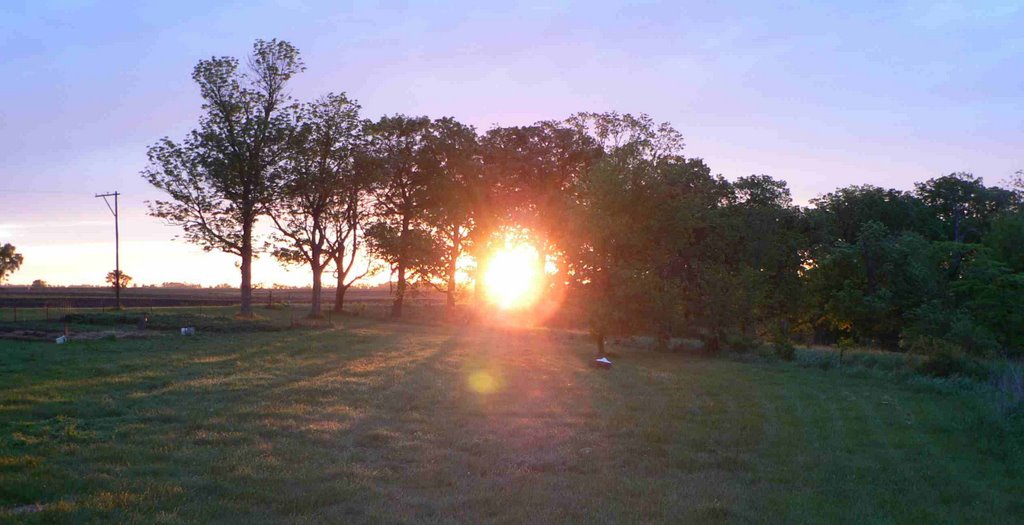
I woke up at 3:45 this morning and couldn't fall back asleep. As I noticed the sky start to lighten shortly before 5 a.m., I actually started to get excited about the prospect of today. The sky was a beautiful streaked pink and yellow. Unfortunately, by the time I got downstairs and got the camera, it didn't look nearly as nice. I took a few pictures of the sunrise from the kitchen door anyway, hoping some would be as beautiful as what I had seen earlier.

Many of our city friends think that since we now live on the farm, we always get up at the crack of dawn, and I can't help but chuckle when they say so. It is the American icon of the farmer walking out to the barn with the sun barely peaking over the horizon, but we haven't figured out a reason that we need to get up that early every day. I can understand why dairy farmers did that 100 years ago. Their milk was delivered fresh to homes every morning in time for breakfast, so the cows had to be milked early in the morning. The important thing about milking though, is that you do it every 12 hours. Our goats don't care if we milk them at 6 a.m. and 6 p.m. or 8 a.m. and 8 p.m. -- as long as they don't have to wait more than 12 hours between milkings. If we are running late in the evening, they walk up to the fence and start yelling at us to hurry up.

I couldn't fall back asleep this morning, because we have a very busy weekend coming up. This afternoon we leave for a goat show that is being held two hours away on Saturday and Sunday. Last year, we left home at 5 a.m., meaning we did get up at 4 a.m. that morning, so we wouldn't be late checking in for the show. This year, we've been saying that we're going to go on Friday so that we can sleep late. I have my doubts about sleeping though, because we would be sleeping in the barn with the goats, and the nightly lows have been in the 40s. I know I can't sleep when it's that cold, so we need to discuss a Plan B!

On Sunday, my daughter will stay at the goat show and continue to show the goats, while my husband and I will go to the Garfield Farm Rare Breed Show in LaFox, Illinois. It is always a lot of fun, and it reminds me of where I first got the crazy idea of moving out to the country to raise rare breeds of livestock. I was a reporter at the Kane County Chronicle when I first attended the show in 1999. I was completely enamored with the livestock I saw there, and I wanted to do something to make sure these very useful animals continued to live on this planet. Since factory farms use only one breed of animal for a particular purpose -- the white leghorn chicken for egg production, for example (because they produce the most eggs on the least feed), or a Cornish-Rock cross for meat production (because they grow the fastest) -- it leaves hundreds of other breeds to slowly die out. The beauty of heritage chickens is that they grow at a moderate rate, and they are good egg layers. I could write about this all day, but if you want to know more, check out Garfield's Web site and especially the page on the Rare Breed Show.

I've already made chocolate chip muffins and the timer just went off for the bran muffins. Now it's time to wake up the kids and get to the regular chores on the homestead today. Yesterday, Margaret clipped 10 goats for the upcoming show. She has another 11 to go!

LinkWithin

Related Posts with Thumbnails