by Sarah
Antiquity Oaks apprentice
When Gerti the blind goat was just a week old she was fairly easy to feed, had to take lots of breaks, but she still sucked well enough. After she was brought into the house she got a little harder to feed, almost always having to pry her mouth open in order to get the nipple in, but she still sucked. A few weeks later she got harder to feed, she was barely sucking, chewing on the nipple, and couldn’t get much into her. Then she got better again, and was taking down 9 oz in a feeding easily. Then she began to get worse again, barely sucking, barely getting 6 oz into her if we were lucky. But we thought there was hope for her eventually eating solids because although she was not chewing on or eating the hay, she was often chewing on the straw whenever we put new bedding down.
For a while after we moved her back outside (because she was really stinking up the house) she wasn’t liking the straw and would not lay down. She spent her nights in a dog crate in the heated office so she could rest and not get too cold. After a while she began to lay down in the straw so we left her with the other babies. She seemed to be getting better with interacting because she didn’t run away when the boys would mount her, and she would even go stand in the pile of goats sometimes to help her keep warm.
We could see a future for her, the path there was still unclear, but there seemed to be so much hope.
The weekend of April 16th and 17th I was gone from the farm. I had something for work in Lake Forest on Saturday and so had spent some time away. Before I left Friday night Gerti barely got 3 oz of her bottle, so I told Mike she would likely be very hungry in the morning. I arrived back on the farm around 1 pm with J (my current boyfriend) who had come to visit me before, and was going to help tattoo the babies. Mike was not home yet from church and so we knew we would have some time before that process began. We went in the house and said hello to Deborah. She then said, “I have some bad news about Gerti.” While I was gone they had barely been able to get anything into Gerti, usually just an ounce or two at a time. Then that morning she had started gurgling. Sometime in the last hour or so she had started crying (screaming). Deborah also said she thought her body temperature had begun to go down so she had her on the heating pad.
I quickly threw my stuff down, put on my shoes and went out to the barn. Half way across the yard I could hear her. She had NEVER been a loud goat. Never woken me up in the middle of the night to feed her. Never cried. The only sounds she made was her warbled “I am so happy you are here” when I would first go in my room or out to the barn and when I would call her to come over when she was living in my room. This was different. This was pain. I had heard animals cry out before, goats in labor, babies who had gotten their head stuck in the hay feeder, babies who wanted their Mom’s, Mom’s who were just unhappy being milked. That sound trumped them all as the worst sound I had ever heard. It was pain, pure and simple. It was sad, horrible, pain. I run the rest of the way to the barn, trying not to slip in any of the mud that is everywhere because of the rain.
There she was. My darling baby girl Gerti, laying on the heating pad, mouth foaming with milk, screaming. I sat down next to her and began to pet her, trying to get her to calm down. I talked to her a lot. Said I was sorry. She tried to stand up but was wobbly on her legs. So I picked her up and held her for a while. But she struggled so I tried to get her to lie down again. She did thank goodness. But she continued to scream. I cried. I wept. I sobbed. J cried. I held her head. I told her I was sorry I couldn’t do anything, I told her to stop fighting, that it wasn’t worth it anymore. J held me throughout the whole thing. Held her too. Tried to comfort both of us. We sat there for a long time with her. She would calm down for a little while, nap for a few minutes, then wake up and scream again. J and I realized that there were tears streaming down her face. Neither of us realized goats could cry. But they were tears alright. I felt terrible knowing there was nothing I could do and I didn’t want to leave her side, but I knew I couldn’t sit there any longer, I couldn’t cry anymore.
J and I went inside for a while, then Mike got back and we began the tattoo process. The tattooing went fairly smoothly, although I did end up with a nice bruise on my stomach. Mike said we weren’t going to do Gerti, she didn’t need that right now. She began struggling so much she was moving herself off the heating pad, and Deborah said if she continued to do that to just go ahead and unplug the heating pad.
After the tatoos were done, J and I went back to be with Gerti. I brought one of my sweaters with me to use as a pillow for her, hoping it would help her calm down. J sat, leaned against the side of the pen, and I laid down and cuddled Gerti to my chest. I told her again it was okay, she didn’t need to fight, that this wasn’t worth it, that she would be in a better place and out of pain. She fell asleep next to me for a while. Just like she had the first two days she was in the house, within my first week of being on the farm. But she woke up again and started screaming. I had to go back inside. I loved her and didn’t want to leave her, but I couldn’t handle it.
Deborah and I talked about who needed to be moved around so that a doe and a buck could be pen bred in the stall that Kitty and Nina were currently sharing. Two stalls needed cleaning, including the one Gerti was in. Deborah said to put her in the crate in the office, that maybe the familiarity of that space would help her calm down. I hoped it would. I gently picked her up and put her in the crate with my sweater. While J and I were cleaning stalls I could still hear her through the walls. I wished there was something I could do.
J had to leave, and I had to milk. I tried to not think about her over in the office, all alone. In pain. I suddenly realized I had never told my Mom I had gotten to the farm safe HOURS ago. I came inside after milking and Mike told me “I brought your sweater in. Gerti won’t be needing it anymore.” I ran upstairs to call my Mom, apologize, and tell her what happened. I began to weep again. Even though I wanted her to let go all day, I didn’t really want her to leave me.
I cried a lot that night. I have cried a lot of times since. I cry when I think about her screaming, her crying, her being unable to stand at the end. I cry because I wasn’t there when she died. I feel guilty sometimes. Like there was something I should have been able to do, anything, to have made the end not come, or the end better. She taught me so much about how different animals are from another. She liked being held tight, most babies do not. She couldn’t be fed if her back legs could touch the ground (or anything else that could be pushed off of). She needed a slow introduction to being with other goats, and being on straw, unlike other goats who are fine right away. Sometimes animals just need time and to not be forced, and they will eat and lay as they should. Most of all though she taught me just how much I can love an animal. I didn’t truly realize until the end how much she meant to me. I knew she was the one I was most attached to, but didn’t realize she was the one I looked forward to feeding the most. I KNEW the other goats needed me, especially for food, but I felt like she needed me more than anyone. I felt like she needed me for a lot more than just food. I loved her. Still love her. I just hope I made her short time here as wonderful as it could have been, and that she was not too scared at the end of it all.
If you missed Sarah's first post about Gerti the blind goat, you can find it here.
Tuesday, May 7, 2013


Sunday, April 21, 2013
One happy ending
 |
| Yearling mama and the chosen one |
After ten years with sheep, we had our first Shetland ewe to ever reject a lamb. It was a yearling, and I'm thinking that maybe there is a reason why most yearlings only have a single lamb. Maybe they can only count to one, or maybe the idea of mothering two lambs is simply too overwhelming. Whatever the reason, last Wednesday a yearling lamb had twins, and she would only let one nurse. She was tap dancing around the pasture refusing to let the other one nurse. After watching this sad story for about half an hour -- and watching the lamb trying to nurse on every other critter in the pasture, including the llama, we finally decided to call it quits. The saddest thing was when the little ram tried to nurse off Kewanee, an adult wether, and Kewanee butted him, flipping him onto his back so hard that he completely rolled over like a dog. And mind you, this little lamb was at least a couple of hours old. He was mostly dry, although filthy, so mama had done nothing to clean him up after he was born. When picking up him and his brother, it was painfully obvious that his tummy was empty while his brother's tummy was quite full.
I was not terribly happy about having a bottlefed ram for multiple reasons. First off, rams should not be bottlefed, and if they must be, then they need to be castrated because intact rams that have been bottlefed tend to be extremely dangerous. They think that you're one of them, and they treat you the same way they'd treat another sheep -- ramming you whenever the urge arises. What's wrong with a bottlefed wether? Well, I can't see myself butchering a bottlefed animal of any species. I just get too attached to them. And I don't need more sheep. I'm trying to cut back. Remember?
 |
| Sarah and the rejected lamb |
Saturday afternoon, a lovely family with two young children came to pick up a couple of goat wethers that would be family pets, and while they were here, I showed them the lambs in the barn. Without even thinking about it until the words were already out of my mouth, I said, "I've got a bottle lamb that you could have." The mom's only question was whether it would need a bottle in the middle of the night, and as soon as I said no, they were sold on the idea. The children were ecstatic about having their very own little cuddly lamb. We talked about lamb care, and they said they'd bring him back in a couple of months for castration.
Part of me was very sad to see the little guy leave, but it's a little easier when I know he's going to such a great home where he is going to get lots of love and attention. And seriously, I have to admit that I'm already over-extended, especially with our apprentice leaving. Speaking of Sarah, even though she left yesterday, I'm hoping to provide you with a couple more posts from her!
Clean-up from the flood continues. Mike is out in the pasture working on the fence as I type. One good thing about the rain is that it did cause the grass to go through a big growth spurt!
Thursday, April 18, 2013
Flooding woes
 |
| That's the top of a fence post in the lower right-hand corner. |
I woke up this morning at 6:30 after less than six hours of sleep. I told Mike he needed to get going because there was likely a lot of damage control that needed to be done before he went to work. In my mind, I was thinking about how much I wanted to catch another hour of sleep, but as soon as I looked out our bathroom window I was shocked into reality. There was water everywhere. I immediately knew there was no way I was going to fall back asleep as the adrenaline kicked in.
We put a pot of steel-cut oats on the stove and started coffee, and Mike and Sarah went out to do chores and whatever else needed to be done. I saw the horse in the pasture, blocked by the flood from getting to a shelter, so I went to the barn, grabbed a lead rope, and led him through the front yard to another pasture where he could get out of the rain. Then Jonathan came outside and told me that our turkey poults were at the post office.
I jumped in the car and headed towards town. The road next to the bridge to the west of our house was flooded, so I turned around to take a different route. I passed by Mike fixing a fence in the sheep pasture. I could see where the road had been flooded overnight in four places on my alternate route. Driving past other intersections I saw debris covered roads and a "Road Closed" sign. The intersection at the post office was completely flooded. I parked and went inside. As soon as the postmaster saw me, she knew I was there to pick up my poults, and I asked her if that intersection usually floods. She shook her head and said, "Not like that!" I told her that our road was flooded west of our farm, and she yelled back to our mail carrier who was sorting the day's mail. And then she said, "The worst is yet to come," which I had seen on weather.com, but it still make my throat feel tight to hear it.
Driving home with chirping turkey poults on the seat next to me, I alternated between crying and chuckling like a mad woman. I knew there wasn't anything that we could do other than simply deal with whatever happened to get thrown our way. I remembered my mother saying "if the good Lord is willing and the creek don't rise" sometimes, and it suddenly made sense to me. It was not just another cliche.
Mike and I spent most of the day organizing paperwork as I tried to distract myself from the constant rain. I had convinced him to not go to work. If we lost electricity, we'd need everyone at home to deal with the basement flooding because our generator didn't start the last time we tried to use it.
As the rain seemed to slow down and finally stop, I felt a little guilty about keeping him from work because nothing horrible had happened. And then the phone rang. It was our neighbor. Our cows were out. I immediately assumed it was because the electric fence had shorted out in the flood. But when we went to retrieve the cows, we realized that as the flood waters were receding, they were exposing large sections where fencing no longer existed.
Using hay, Sarah lured the cows to the section of pasture farthest away from the damaged fencing as Mike came to the conclusion that it couldn't be fixed before the sun went down. Luckily we have temporary electric fencing that is very easy to put up quickly. Still he had to make some adjustments to get electricity where he needed it, and I was really grateful that he had not gone to work today. Shortly after the last rays of light were gone from the sky, he came inside and said that the cows should stay put now.
Even though I no longer feel guilty about asking him to stay home from work today, I'd have been happier if there hadn't been so much fencing damage and the cows had stayed home.
Monday, April 15, 2013
Lamb challenges

Yesterday afternoon, Sarah came inside to tell me that the ewe lambs that had been born a couple hours earlier still had not nursed and that the mama's teats were huge. We had something similar happen six or seven years ago, and we had to milk the ewe for a couple of days to keep her teats small enough for the lambs to be able to latch on. So, Sarah, her boyfriend, and Mike went out to the pasture and brought Godiva and her two lambs to the barn.

Thankfully her babies took to the bottle like pros. Each one quickly sucked down six ounces each, which is more than the five percent of their body weight that they need to consume within the first six hours. A few hours later, Sarah offered them another bottle; one took three ounces and the other took six. This morning they were crying like they were starving when we went out to the barn, so Sarah milked Godiva and gave the babies another bottle. After getting the ewe milked out, she and Mike held the lambs up to her teats, and both babies nursed well. This afternoon, however, one side was quite huge again. The babies didn't seem terribly interested in the bottle, only taking about an ounce each, and their tummies don't feel empty, so I think they were getting a decent amount of milk from the one side that they had been nursing on. We milked down the full side, so maybe the lambs will be able to keep up with both sides now. Since Godiva's udder isn't so uncomfortably full now, she wasn't as cooperative at this afternoon's milking and laid down on the milk stand.
Of course, there is a tiny, silly little part of my brain that would be totally okay with the idea of them not being able to nurse because I love sheep yogurt, and if we had to milk the ewe every day, I'd probably be able to sneak a little of her milk to make yogurt a few times over the next few months. But it's not like I have hours of spare time every day and need something to do -- like milk a ewe and bottle feed two lambs. So the logical side of my brain says it will be a good thing when these little ewes are able to nurse full time.
Sunday, April 14, 2013
Birth and death and ...

I miss blogging so much, but life has become completely overwhelming. Has it been a year (maybe longer) that I've been saying that I have to cut back? Well, I really have to cut back. I can't believe it's been almost a month since my last blog post. What's been happening around here?
My father-in-law died. It was barely two months since the passing of my mother-in-law. They had been married for almost 55 years, so even though he had Altzheimer's, I feel sure that he missed her presence in this world and didn't want to stick around without her.
And then Julia farrowed, which was wonderful, except then the piglets started dying. We're accustomed to the idea that one or two runts will die within the first 24 hours, but we lost five of the eleven piglets. After losing the third healthy piglet in three days, I finally realized that Julia's older daughter was wanting to sleep so close to her mama that she was suffocating the piglets. Since we moved her out of the barn, we haven't lost any more, so that's good. Julia is an outstanding mother.

And then the sheep started lambing. They're all doing great. Of course, they weren't supposed to be lambing. I'm cutting back -- remember? But alas, I was traveling last fall as my second book came out, and I was writing my third book. Somehow it completely slipped my mind that the young rams should have been removed from the pasture with the ewes no later than September -- before breeding season started. I'm not sure what's worse -- admitting that I forgot to remove the ram lambs or letting people think that I was silly enough to breed the sheep when I need to be cutting back. Either way, I lose. So, we have some "illegitimate" lambs. If no one wants to buy non-registerable Shetland sheep, I may just have to get over my aversion to butchering ewes. Plenty of people butcher ewes, but I don't like to. There isn't anything "wrong" with doing it. It's just one of my personal neuroses.
And in the midst of all the lambing, Gerti the blind goat died. We knew she had other "issues" because she was getting more difficult to feed. She would fight like you were hurting her as you were trying to get the nipple into her mouth. And then one day she stopped sucking on the nipple. Of course, there isn't anything you can do when a goat won't suck -- other than tube feed it. Knowing that she had multiple problems, it made no sense to prolong what seemed to be inevitable. I had even talked to a vet at U of I about her, and without doing lots of expensive testing, it would not have been possible to figure out what was wrong with her beyond a fairly simple diagnosis -- and we already knew that she was blind and had sensory issues -- but there wouldn't be a way for them to help her.
I'm in the final edits of the manuscript for my goat book. That should be done by the end of this month, and then I'll just have to do the final proofread once it's typeset. It will be in bookstores in September.
I'll be heading to New York City in another week. I'm speaking at a writer's conference there, and a friend convinced me to come a few days early for a vacation with her. A vacation was -- is -- a great idea. I know I need one. Hopefully I can get back to regular blogging soon.
Sunday, March 17, 2013
Gerti the blind goat
by Sara
Antiquity Oaks apprentice

When I first arrived on the farm on February 17, I was put in charge of the two bottle babies, Anne and Gerti (who did not get their names until later). The first day I was here they were both outside in the kidding barn staying close to Mama and the heat lamp, and both seemed to do okay with the bottle. I thought it was fun, if a bit cold at times, to be their permanent nanny. I was told that the water bucket was hung on the side of the pen because Gerti had crawled into it several times and gotten completely soaked. They had some suspicions she had something wrong, possibly that she was blind.
Within the first few days of me being on the farm we cleaned out a stall in the big barn and moved Anne, Gerti, their Mom Sadie, their one nursing sibling, and several other Mom’s and babies into it. We did this so they could have more space, and to make room for the next round of kiddings. We put a heat lamp in their new stall close to the door, and many of the babies stayed fairly close to it for the first few days.
 About
a day after we moved all of the goats, I go in to give Anne and Gerti
their afternoon bottle (around 1:00), and notice that Gerti was just laying
in the middle of nowhere, while all of the other babies were either
cuddled with moms or under the heat lamp. I tried to get her to nurse,
but she wouldn’t take down more than 2 oz (she should have taken 4). I
quickly brought her inside and Deborah quickly determined she had a
minor case of hypothermia. She and Mike had to run into town so she gave
me a heating pad for Gerti, and told me to hold her close and try to
warm her up. She spent the rest of the afternoon in my lap or on the
heating pad, she even napped with me for a little while.
About
a day after we moved all of the goats, I go in to give Anne and Gerti
their afternoon bottle (around 1:00), and notice that Gerti was just laying
in the middle of nowhere, while all of the other babies were either
cuddled with moms or under the heat lamp. I tried to get her to nurse,
but she wouldn’t take down more than 2 oz (she should have taken 4). I
quickly brought her inside and Deborah quickly determined she had a
minor case of hypothermia. She and Mike had to run into town so she gave
me a heating pad for Gerti, and told me to hold her close and try to
warm her up. She spent the rest of the afternoon in my lap or on the
heating pad, she even napped with me for a little while.
When Mike and Deborah got home we put Gerti in a clothes basket and Deborah watched her while Mike and I went to do chores. When we came back inside Gerti heard the door and jumped out of the laundry basket, but got lost about halfway through the door. Again the idea that she may be blind came up.
Over the next few days she continued to get stronger and seemed to enjoy being inside. We began to notice more mannerisms unique to her that made us think she might be blind. She ran into things a lot when I let her run around my room. She put her head on her back and swayed (Deborah called it her Stevie Wonder impression). She ran in circles, a LOT. Plus whenever she would walk around somewhere new, she would keep her head down like a dog, sniffing/licking everything. When given a bottle she would run the bottom of her chin across the tip a few times and then grab it, like she was feeling where it was. Unfortunately she slowly began to forget what the nipple was, and so now we have to force the nipple into her mouth, though she sucks down with great gusto once we do.
Friday March 9th we decided we would move all of the bottle babies to the barn. It was fairly warm and there was no super cold weather predicted in the future. We also decided to bring Gerti out first so that she could get used to her surroundings before introducing everyone else.
Around 2:00 (warmest part of the day) I brought Gerti out and sat with her. Aside from a couple of bumps and not being used to the feeling of straw under her feet, she seemed to do really well. Around 2:30 I decide to go get Anne from the other barn. With me in the pen, Anne just climbed all over me, so I stepped out and watched how she interacted with Gerti and in the new space. She almost immediately reared up on her hind legs and tried to head butt Gerti, who was none the wiser. Anne then gave Gerti a small smack on the side. I thought “no big deal, she just wants to prove dominance and it should only happen once.” I went back in to fetch the six little babies, and over the monitor heard a baby scream. I thought and hoped it was just a Mom accidentally stepping on or laying on a baby (which does happen). When I walk back into the kidding barn with the 6 little ones in a laundry basket I see this: Gerti running around in circles, Anne full tilt running behind her trying to head butt her in the side. As soon as Anne sees me she stops and runs up to the gate, and Gerti stops her circling, all legs fulling stretched out panting and screaming. I immediately deposit the 6 little ones in their new home and scoop up Gerti, who proceeded to sit still in my arms, which she hasn’t done in weeks. I gave Anne another chance, which she immediately ruined by bowling over two of the little ones. I put Anne back in her stall with her Mom, sister, and other older Moms and babies and return to the kidding barn and sit down in the stall to help the little ones and Gerti.
At this point Gerti is running around in tight fast little circles, which she hasn’t done in weeks, running into the side panels of her new home, and running away from anything that makes the straw move. She ran into the panels so hard she made her head bleed. I picked her up and tried to comfort her, telling her Anne is gone and will not be coming back. She eventually falls asleep in my lap, another thing she hasn’t done in weeks, and once she woke up seemed to be calmer, although she was again wary of the six littles she had known since the day they were born.
The rest of the day seemed to go fine, until late in the evening. Gerti kept going into this weird position like she intended to lay down, but wasn’t going all the way down. I decided to put a towel in the corner under the heat lamp, hoping that would help her if she just didn’t like the straw. When I went back for the last feeding she took the bottle okay and I put her in the corner under the heat lamp and fed the other six. She backed up into the corner and just started shivering. I picked her up and her shivering was so violent I brought her back inside and told Deborah I thought we should bring her inside again for the night. She said it was up to me because it is my room, but she had been wondering how I would sleep tonight anyway since my room would be so quiet.
Gerti has seemed to do well since then. Realistically I know she can not stay inside for her whole life, but I don’t know how to get her used to being outside. We are also now faced with the task of figuring out how to introduce solid foods into her diet, which after a morning of Googling, I still have no good answers.
 Even though she is more of a handful than
the other seven bottle babies combined (I can hear her crashing into the
sides of her play pen right now) she has a special place in my heart.
She was the first baby who tried to die on me, and whom I helped bring
back from the edge. She has been living in my room nearly as long as I
have, and snores in the middle of the night so I know she is okay. I
have grown very attached to Gerti, and wish I could take her home with
me, but sadly my township has a strict no livestock law in which “goats”
are right in the middle of the off limits animals. I do not know what
is going to happen to her when she grows up. Deborah doesn’t really even
know yet, but I know she will always hold a special place in my heart. I
have read a few stories (in my Googling) about people who would rather
butcher a blind goat than take the time to raise them, and although I
have NO idea how to get her to eat solid foods, I can’t imagine making
that choice right now. She is one of the kindest animals here, and I
know she will be the one I miss most of all when I leave.
Even though she is more of a handful than
the other seven bottle babies combined (I can hear her crashing into the
sides of her play pen right now) she has a special place in my heart.
She was the first baby who tried to die on me, and whom I helped bring
back from the edge. She has been living in my room nearly as long as I
have, and snores in the middle of the night so I know she is okay. I
have grown very attached to Gerti, and wish I could take her home with
me, but sadly my township has a strict no livestock law in which “goats”
are right in the middle of the off limits animals. I do not know what
is going to happen to her when she grows up. Deborah doesn’t really even
know yet, but I know she will always hold a special place in my heart. I
have read a few stories (in my Googling) about people who would rather
butcher a blind goat than take the time to raise them, and although I
have NO idea how to get her to eat solid foods, I can’t imagine making
that choice right now. She is one of the kindest animals here, and I
know she will be the one I miss most of all when I leave.
Antiquity Oaks apprentice

When I first arrived on the farm on February 17, I was put in charge of the two bottle babies, Anne and Gerti (who did not get their names until later). The first day I was here they were both outside in the kidding barn staying close to Mama and the heat lamp, and both seemed to do okay with the bottle. I thought it was fun, if a bit cold at times, to be their permanent nanny. I was told that the water bucket was hung on the side of the pen because Gerti had crawled into it several times and gotten completely soaked. They had some suspicions she had something wrong, possibly that she was blind.
Within the first few days of me being on the farm we cleaned out a stall in the big barn and moved Anne, Gerti, their Mom Sadie, their one nursing sibling, and several other Mom’s and babies into it. We did this so they could have more space, and to make room for the next round of kiddings. We put a heat lamp in their new stall close to the door, and many of the babies stayed fairly close to it for the first few days.
 About
a day after we moved all of the goats, I go in to give Anne and Gerti
their afternoon bottle (around 1:00), and notice that Gerti was just laying
in the middle of nowhere, while all of the other babies were either
cuddled with moms or under the heat lamp. I tried to get her to nurse,
but she wouldn’t take down more than 2 oz (she should have taken 4). I
quickly brought her inside and Deborah quickly determined she had a
minor case of hypothermia. She and Mike had to run into town so she gave
me a heating pad for Gerti, and told me to hold her close and try to
warm her up. She spent the rest of the afternoon in my lap or on the
heating pad, she even napped with me for a little while.
About
a day after we moved all of the goats, I go in to give Anne and Gerti
their afternoon bottle (around 1:00), and notice that Gerti was just laying
in the middle of nowhere, while all of the other babies were either
cuddled with moms or under the heat lamp. I tried to get her to nurse,
but she wouldn’t take down more than 2 oz (she should have taken 4). I
quickly brought her inside and Deborah quickly determined she had a
minor case of hypothermia. She and Mike had to run into town so she gave
me a heating pad for Gerti, and told me to hold her close and try to
warm her up. She spent the rest of the afternoon in my lap or on the
heating pad, she even napped with me for a little while.When Mike and Deborah got home we put Gerti in a clothes basket and Deborah watched her while Mike and I went to do chores. When we came back inside Gerti heard the door and jumped out of the laundry basket, but got lost about halfway through the door. Again the idea that she may be blind came up.
Over the next few days she continued to get stronger and seemed to enjoy being inside. We began to notice more mannerisms unique to her that made us think she might be blind. She ran into things a lot when I let her run around my room. She put her head on her back and swayed (Deborah called it her Stevie Wonder impression). She ran in circles, a LOT. Plus whenever she would walk around somewhere new, she would keep her head down like a dog, sniffing/licking everything. When given a bottle she would run the bottom of her chin across the tip a few times and then grab it, like she was feeling where it was. Unfortunately she slowly began to forget what the nipple was, and so now we have to force the nipple into her mouth, though she sucks down with great gusto once we do.
Friday March 9th we decided we would move all of the bottle babies to the barn. It was fairly warm and there was no super cold weather predicted in the future. We also decided to bring Gerti out first so that she could get used to her surroundings before introducing everyone else.
Around 2:00 (warmest part of the day) I brought Gerti out and sat with her. Aside from a couple of bumps and not being used to the feeling of straw under her feet, she seemed to do really well. Around 2:30 I decide to go get Anne from the other barn. With me in the pen, Anne just climbed all over me, so I stepped out and watched how she interacted with Gerti and in the new space. She almost immediately reared up on her hind legs and tried to head butt Gerti, who was none the wiser. Anne then gave Gerti a small smack on the side. I thought “no big deal, she just wants to prove dominance and it should only happen once.” I went back in to fetch the six little babies, and over the monitor heard a baby scream. I thought and hoped it was just a Mom accidentally stepping on or laying on a baby (which does happen). When I walk back into the kidding barn with the 6 little ones in a laundry basket I see this: Gerti running around in circles, Anne full tilt running behind her trying to head butt her in the side. As soon as Anne sees me she stops and runs up to the gate, and Gerti stops her circling, all legs fulling stretched out panting and screaming. I immediately deposit the 6 little ones in their new home and scoop up Gerti, who proceeded to sit still in my arms, which she hasn’t done in weeks. I gave Anne another chance, which she immediately ruined by bowling over two of the little ones. I put Anne back in her stall with her Mom, sister, and other older Moms and babies and return to the kidding barn and sit down in the stall to help the little ones and Gerti.
At this point Gerti is running around in tight fast little circles, which she hasn’t done in weeks, running into the side panels of her new home, and running away from anything that makes the straw move. She ran into the panels so hard she made her head bleed. I picked her up and tried to comfort her, telling her Anne is gone and will not be coming back. She eventually falls asleep in my lap, another thing she hasn’t done in weeks, and once she woke up seemed to be calmer, although she was again wary of the six littles she had known since the day they were born.
The rest of the day seemed to go fine, until late in the evening. Gerti kept going into this weird position like she intended to lay down, but wasn’t going all the way down. I decided to put a towel in the corner under the heat lamp, hoping that would help her if she just didn’t like the straw. When I went back for the last feeding she took the bottle okay and I put her in the corner under the heat lamp and fed the other six. She backed up into the corner and just started shivering. I picked her up and her shivering was so violent I brought her back inside and told Deborah I thought we should bring her inside again for the night. She said it was up to me because it is my room, but she had been wondering how I would sleep tonight anyway since my room would be so quiet.
Gerti has seemed to do well since then. Realistically I know she can not stay inside for her whole life, but I don’t know how to get her used to being outside. We are also now faced with the task of figuring out how to introduce solid foods into her diet, which after a morning of Googling, I still have no good answers.
 Even though she is more of a handful than
the other seven bottle babies combined (I can hear her crashing into the
sides of her play pen right now) she has a special place in my heart.
She was the first baby who tried to die on me, and whom I helped bring
back from the edge. She has been living in my room nearly as long as I
have, and snores in the middle of the night so I know she is okay. I
have grown very attached to Gerti, and wish I could take her home with
me, but sadly my township has a strict no livestock law in which “goats”
are right in the middle of the off limits animals. I do not know what
is going to happen to her when she grows up. Deborah doesn’t really even
know yet, but I know she will always hold a special place in my heart. I
have read a few stories (in my Googling) about people who would rather
butcher a blind goat than take the time to raise them, and although I
have NO idea how to get her to eat solid foods, I can’t imagine making
that choice right now. She is one of the kindest animals here, and I
know she will be the one I miss most of all when I leave.
Even though she is more of a handful than
the other seven bottle babies combined (I can hear her crashing into the
sides of her play pen right now) she has a special place in my heart.
She was the first baby who tried to die on me, and whom I helped bring
back from the edge. She has been living in my room nearly as long as I
have, and snores in the middle of the night so I know she is okay. I
have grown very attached to Gerti, and wish I could take her home with
me, but sadly my township has a strict no livestock law in which “goats”
are right in the middle of the off limits animals. I do not know what
is going to happen to her when she grows up. Deborah doesn’t really even
know yet, but I know she will always hold a special place in my heart. I
have read a few stories (in my Googling) about people who would rather
butcher a blind goat than take the time to raise them, and although I
have NO idea how to get her to eat solid foods, I can’t imagine making
that choice right now. She is one of the kindest animals here, and I
know she will be the one I miss most of all when I leave. Thursday, March 14, 2013
Farewell and thank you, Coco

There are some posts that I don't want to write, and this is one of them, most likely because a part of me would like to deny what actually happened last week and pretend that it didn't happen. But it did happen, and at times like this, I am reminded of Henry David Thoreau's words:
I wish to live deliberately, to front only the essential facts of life. I wish to learn what life has to teach, and not when I come to die, discover that I have not lived. I do not wish to live what is not life, living is so dear, nor do I wish to practice resignation, unless it is quite necessary. I wish to live deep and suck out all the marrow of life. I want to cut a broad swath, to drive life into a corner, and reduce it to its lowest terms. If it proves to be mean, then to get the whole and genuine meanness of it, and publish its meanness to the world; or if it is sublime, to know it by experience, and to be able to give a true account of it.
On Monday, March 4, 2013, my sweet Coco passed away a few hours after giving birth to quintuplet kids. Mike, Sarah, and I got two hours of sleep the night before, because we had taken her to the University of Illinois veterinary clinic when I couldn't untangle the last four kids that were trying to be born. They thought she was fine to leave, but she died less than two hours after we brought her home, and then they asked me to bring her back for a necropsy. They discovered that she had a 14 centimeter tear in her uterus and had bled to death into her abdomen, which was why we didn't see any blood.
It was painful and ugly, or "mean" as Thoreau would say. For the second time in eleven years, I questioned why I'm doing this. I felt horribly guilty. Had we not been breeding our goats so that we could produce our own dairy products -- because goats have to give birth to make milk -- Coco would not have died. For a brief moment as I was driving down Route 47 to take Coco's body back to the university for the necropsy, a part of my brain said that I couldn't do this any longer. But another part of my brain immediately fired back, "What is the alternative?"
Buy dairy products that came from cows injected with hormones, living in factory farms, whose babies are taken away from them at birth? Never! Buy dairy products from small family farms where the animals are treated humanely? Great idea, but there are limited options here, and in most cases the babies are still taken away. Become a vegan again? Not a bad option, but I love my yogurt and cheese, as well as goat milk in my coffee. And in my garden, I wind up killing bugs, sometimes accidentally and sometimes intentionally.
In our modern world, we are protected from so many of the essential facts of life -- far more than Thoreau could have ever dreamed. People in our modern world are so oblivious to the simple facts of life because it is all hidden away in factories and hospitals and other institutions. I couldn't tell you how many people I've met over the years who have no clue that cows are bred every year to continue producing milk in factory farms -- or how many people think that white chickens lay white eggs and brown chickens lay brown eggs. They apparently have no idea that there are gold-and-black-laced chickens and black-and-white-barred chickens and so on! The average life of a factory-farm cow is only about four years, even though cows can live to be 15 or more. And factory-farm hens, which are debeaked, are turned into odd chicken bits after little more than a year of life, which is spent inside a wire cage, so they never see the sky, run across grass, or catch even a single bug during their unnaturally short life.
When people have no clue about what is normal or possible, it makes it very easy for advertisers to convince them that things like confinement buildings, daily antibiotics, and debeaking are for the animal's own good. When we moved out here to grow our own food organically in 2002, my knowledge about our modern food system was a tiny fraction of what it is today. And with what I know today, I am more committed than ever to continuing this life, even knowing that sometimes it will get mean and ugly. Life is not a perfect, shiny, cellophane-wrapped package. Nor is it a dinosaur-shaped "chicken" nugget. Milk and meat and vegetables do not come from a store. Those are modern illusions.
Life is a chicken running through the grass, catching bugs, laying eggs, and sitting on those eggs until they hatch, bringing forth more chickens that will grow up and lay eggs or become a chicken dinner. Life is a sheep grazing in the pasture for a year to bring forth a few pounds of wool. Life is a turkey running from a coyote and flying up into a tree so that we can have a turkey dinner. Life is a garden that is filled with bugs, both good and bad, that will help and hinder us in every step that gets us closer to harvest. Life is a goat waddling around when she's pregnant and screaming through labor contractions to bring forth kids that will tell her body it's time to make milk to feed them. And life always ends in death.
In her nine years of life, Coco Chanel gave us 27 kids and hundreds of gallons of milk. I think of her every day when I see her daughters Vera Wang and Nina Ricci. And I'm sure I'll think of her often as her newborn Bella Freud grows up and becomes a mother and a milk goat. I can point to aging blocks of cheddar and gouda, which include milk that she produced, which we'll be eating in the years to come. Coco was an amazing mother, growing big babies, even when there were four or five, giving birth to them, and then nursing them. Even though she was carrying five babies this time, they were all the same size as normal twins would have been.
And unlike cows in factory farms that produce the majority of dairy products in this country, Coco was loved and appreciated. She had a name, not an ID number, and she had a personality that set her apart from the other goats on the farm.
 |
| One-day-old quints with Bella on the left, then Bill Blass, both of whom will be staying here. |
I'll always remember Coco as my baby, the one who refused to grow up. She tried to die on me when she was only two weeks old, but I wouldn't let her. I remember holding her in my arms on the couch, crying, "Please don't die." It was only our second year out here, and I hadn't seen an animal die yet. In spite of my inexperience, we pulled her through. I called her PeeWee, and she wound up as a bottle baby. Katherine took her to 4-H meetings, where everyone cooed over the tiny little brown doe.
When we realized she really was going to live, we named her Coco Chanel, partly because she was chocolate colored and partly because she needed a classy name to suit her. Regardless of how old she got, though, she always thought she was a lap goat. Whenever I sat down anywhere near her, she would walk over and try to crawl into my lap. Even as we were driving to the vet hospital last week, she was trying to edge her over-sized, very pregnant body into my lap, as she and I were in the back of the car together.
As hard as this has been, I wouldn't trade the last nine years with Coco for anything, and although this was the first time we had a goat die as a result of kidding, I know it won't be the last ... because death is an inescapable part of life.
Wednesday, March 13, 2013
Homegrown chicken

We were awakened Sunday morning by a phone call from a post office distribution center about seventy miles away. They said our chicks had arrived! No, that's not a typo; yes, it was Sunday. Although I wasn't terribly thrilled about having to drive seventy miles to pick up the chicks, I was happy that they had only been en route for a day, rather than the usual two days when they arrive at our local post office.
Sunday turned out to be a rather crazy day, but Mike eventually made it to the distribution center by early afternoon. Kat was home from college for the weekend, and she helped me clean up the stall where we would be putting the brooder. I washed out the feeder and waterer, and we got everything set up, including the heat lamp, so their space could start to warm up.

I had ordered fifty white Plymouth Rock cockerels, which we're raising for meat. We raised a few last year, along with some Dark Cornish, because I was simply curious if we could get some fairly decent sized roasters out of them. If you want to know why we don't grow the modern mutants, the short answer is that I think there is something terribly wrong with any baby animal that can literally eat itself to death within the first week of life. For the long answer, click here and here and here.
Of course, my ideal is to be hatching our own meat birds, which will simply be the cockerels hatched by our hens. (The modern mutant meat chickens also do not lend themselves to a self-reliant lifestyle because they have to be artificially inseminated for reproduction.) For the past three years, we had New Hampshire hens, and although they are amazing layers, they did not get broody, and I want at least a few hens to get broody so that they can replace themselves and put a few chicken dinners on the table.

Last fall, I bought some Buff Orpington pullets. When we had that breed eight to eleven years ago, some of them did get broody, so I'm hoping that happens with these chickens. They just started laying within the last couple weeks, but I'm not expecting them to get broody until next year. If a couple of them do happen to set this year, it will simply be a happy bonus!
Monday, March 11, 2013
Goat rescue
Remember how we used to have floods two or three times a year before last year's drought? Well, after a year of not having pastures full of water or animals stuck in flooded pastures, we'd sort of become slightly complacent about the idea of floods. We had quite a bit of snow a week ago, and then temperatures started to warm up over the past couple days. It really warmed up last night, and it started to rain. When we woke up this morning, we were greeted by the old familiar site of flooded pastures and a creek out of its bounds.
As the day went on, we continued to watch the radar, and we started to worry. The goats across the creek are in a pasture that will flood with enough rain, especially when combined with melting snow. The radar was looking pretty scary, so we decided it was time to get the goats to higher ground. Crossing the creek was out of the question, but luckily we have a neighbor who said we can go through their property to get to the goats when the creek floods.
Mike hooked up the trailer to the pick-up, and because the cab of the pick-up was full of "stuff" he'd recently picked up at his parent's house, Kat and I had to ride in the trailer.

I've never walked that route through the woods, however, and when Mike, Kat, and I were about halfway through the woods, I started to think that this was the craziest idea we'd ever had. How on earth would we get sixteen goats to follow us through the woods with only a couple of them on leads and two buckets of grain? I was imagining a confusing comedy of errors and us chasing wayward goats through the woods for hours.
I always say that goats are smart, and I'm happy to say that this time they came through with flying colors. In fact, I'm pretty sure this proves that they really are psychic. I've been saying for years that they can read my mind because as soon as you walk into the pasture with the intent of doing anything remotely unpleasant, such as trimming hooves, they won't come near me. Well, this time, they seemed to completely understand that we were taking them to a better place. As soon as we got them started on the path through the woods, they actually got ahead of us and started running -- in the right direction.


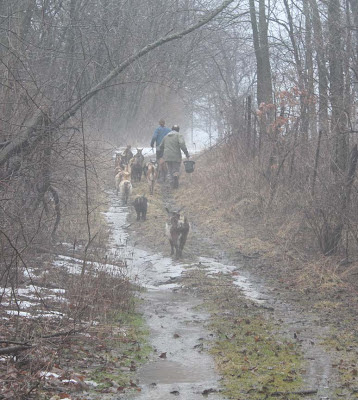
In fact, I'm glad that Mike and Kat are runners, because they got way ahead of me! It's kind of demoralizing to have a 14-year-old goat out-run you! Mike and Kat had the goats completely loaded into the trailer by the time I caught up.

And when we got home, they hopped out of the trailer and followed Kat to their new pasture and dry shelter!
As the day went on, we continued to watch the radar, and we started to worry. The goats across the creek are in a pasture that will flood with enough rain, especially when combined with melting snow. The radar was looking pretty scary, so we decided it was time to get the goats to higher ground. Crossing the creek was out of the question, but luckily we have a neighbor who said we can go through their property to get to the goats when the creek floods.
Mike hooked up the trailer to the pick-up, and because the cab of the pick-up was full of "stuff" he'd recently picked up at his parent's house, Kat and I had to ride in the trailer.

I've never walked that route through the woods, however, and when Mike, Kat, and I were about halfway through the woods, I started to think that this was the craziest idea we'd ever had. How on earth would we get sixteen goats to follow us through the woods with only a couple of them on leads and two buckets of grain? I was imagining a confusing comedy of errors and us chasing wayward goats through the woods for hours.
I always say that goats are smart, and I'm happy to say that this time they came through with flying colors. In fact, I'm pretty sure this proves that they really are psychic. I've been saying for years that they can read my mind because as soon as you walk into the pasture with the intent of doing anything remotely unpleasant, such as trimming hooves, they won't come near me. Well, this time, they seemed to completely understand that we were taking them to a better place. As soon as we got them started on the path through the woods, they actually got ahead of us and started running -- in the right direction.


In fact, I'm glad that Mike and Kat are runners, because they got way ahead of me! It's kind of demoralizing to have a 14-year-old goat out-run you! Mike and Kat had the goats completely loaded into the trailer by the time I caught up.

And when we got home, they hopped out of the trailer and followed Kat to their new pasture and dry shelter!
Thursday, March 7, 2013
Alexandria's quadruplets
by Sarah
Antiquity Oaks apprentice
After Alex gave birth to 4 healthy kids, and with no complications, Deborah asked me to write a blog post about it, so people could get an outside perspective. I was honored and thought it would be a lot of fun. Little did I know what the next few days had in store for me. But I am getting ahead of myself, so let me start at the beginning.

Thursday, February 28, Alex had been a little fussy all day. She had been bleating a lot, not eating very much, and walking around a lot. So we stayed close. I dressed up in my insulated overalls, several layers, and my nice warm work boots, and camped out in the barn office most of the afternoon reading a book. Evening chores came and went, and at 6:00 when I went out to feed Anne (one of the two bottle babies at that time), I thought, “Oh, I will just be outside for a minute, no need to bundle too much.” Never have I been so wrong.
Out I went with two layers on top and two on the bottom, none of it waterproof, no gloves, though luckily I remembered a hat. I make a point to go check on Alex just in case, and what do I see? A big string of mucus hanging out of her, so I quickly call over the monitor to Deborah that Alex is in labor and she needs to come join me.
By 6:30 we were both sitting in the straw waiting for Alex to get serious and talking about what we should have for dinner. Deborah suggests a quiche since we have gotten a decent amount of eggs recently. Between 7 and 7:30 we finally got our wish and her water broke and she began to push. She changed positions several times, eventually laying against Deborah, leaving me to look and see what was coming out. I saw a bubble, but for a minute couldn’t figure out what was inside it. I finally realize it is a tail, hence why Alex was taking so long. But then I see something else, something dark and fluid floating down. I ask Deborah if it is possible that the baby could poop while they were being born, she said yes, but she had never seen it. Suddenly the baby comes shooting out. We break the sack open, start drying the kid's face, and put it in front of Alex to start licking it. We check, and it is a girl! I then recount for Deborah what I saw, “it was like, bubble, tail, tail, tail, poop, baby!” It amazed me how fast the kid came out, and the fact that Deborah said many people freak out when they see breach kids seemed really strange to me. If you give the Mom a chance, they will do just fine, it just takes a little longer.
 Before we know it, out pops the second kid, one hoof and mouth first. We begin to clean it off and it is a boy! The third one then comes shooting out, another boy with very “flashy” markings who was also breach. The fourth is another girl who came out hoof and mouth first. We continue to work on getting everyone dry and warm so that they will hopefully begin to nurse. At this point Deborah says that maybe omelets wound be better since they take less time to cook than a quiche.
 We try without much luck for a while to get any of the kids to nurse. Finally the first girl born, also the littlest, nurses very successfully. The next to nurse is the larger girl, catching on quickly. Now just the boys are left. Boys being boys they were very stubborn and did not like us trying to help them very much, the first one just screamed and screamed when we tried to help. The flashy boy didn’t like it very much, but Deborah helped him through it. As we are sitting there talking about everything that happened, suddenly the first boy gets down on his knees and just latches on and nurses perfectly. Clearly he just wanted to do it on his own.
Since everyone had nursed we finally headed back inside for dinner and to warm up. Checking the clock on the way out of the barn we see it is 8:30. Deborah asks if scrambled eggs would be fine, I said it sounded fantastic.

Once we got inside I made myself a cup of tea, since I could barely move my hands anymore they were so stiff from the cold. Over dinner we talked about everything, the fact that it was not as gross as I thought it would be (this was my first time seeing a birth in real life), what people freak out about when they shouldn’t, everything. I gave the bottle babies their last bottle at 10:00, checked in on the new Mom, and she seemed to be doing fine, so I went to bed happy knowing I had seen my first successful birth. It was simple, and simple seemed good. The only thing we really had to try hard to do was get the kids to nurse, and in the end that wasn’t very hard either. It was an amazing experience, and I am glad her birth was the first one I ever witnessed.
Antiquity Oaks apprentice
After Alex gave birth to 4 healthy kids, and with no complications, Deborah asked me to write a blog post about it, so people could get an outside perspective. I was honored and thought it would be a lot of fun. Little did I know what the next few days had in store for me. But I am getting ahead of myself, so let me start at the beginning.

Thursday, February 28, Alex had been a little fussy all day. She had been bleating a lot, not eating very much, and walking around a lot. So we stayed close. I dressed up in my insulated overalls, several layers, and my nice warm work boots, and camped out in the barn office most of the afternoon reading a book. Evening chores came and went, and at 6:00 when I went out to feed Anne (one of the two bottle babies at that time), I thought, “Oh, I will just be outside for a minute, no need to bundle too much.” Never have I been so wrong.
Out I went with two layers on top and two on the bottom, none of it waterproof, no gloves, though luckily I remembered a hat. I make a point to go check on Alex just in case, and what do I see? A big string of mucus hanging out of her, so I quickly call over the monitor to Deborah that Alex is in labor and she needs to come join me.
By 6:30 we were both sitting in the straw waiting for Alex to get serious and talking about what we should have for dinner. Deborah suggests a quiche since we have gotten a decent amount of eggs recently. Between 7 and 7:30 we finally got our wish and her water broke and she began to push. She changed positions several times, eventually laying against Deborah, leaving me to look and see what was coming out. I saw a bubble, but for a minute couldn’t figure out what was inside it. I finally realize it is a tail, hence why Alex was taking so long. But then I see something else, something dark and fluid floating down. I ask Deborah if it is possible that the baby could poop while they were being born, she said yes, but she had never seen it. Suddenly the baby comes shooting out. We break the sack open, start drying the kid's face, and put it in front of Alex to start licking it. We check, and it is a girl! I then recount for Deborah what I saw, “it was like, bubble, tail, tail, tail, poop, baby!” It amazed me how fast the kid came out, and the fact that Deborah said many people freak out when they see breach kids seemed really strange to me. If you give the Mom a chance, they will do just fine, it just takes a little longer.


Since everyone had nursed we finally headed back inside for dinner and to warm up. Checking the clock on the way out of the barn we see it is 8:30. Deborah asks if scrambled eggs would be fine, I said it sounded fantastic.

Once we got inside I made myself a cup of tea, since I could barely move my hands anymore they were so stiff from the cold. Over dinner we talked about everything, the fact that it was not as gross as I thought it would be (this was my first time seeing a birth in real life), what people freak out about when they shouldn’t, everything. I gave the bottle babies their last bottle at 10:00, checked in on the new Mom, and she seemed to be doing fine, so I went to bed happy knowing I had seen my first successful birth. It was simple, and simple seemed good. The only thing we really had to try hard to do was get the kids to nurse, and in the end that wasn’t very hard either. It was an amazing experience, and I am glad her birth was the first one I ever witnessed.
Subscribe to:
Posts (Atom)
LinkWithin
