This is really hard, but it seems the most logical place to cut back. I briefly mentioned a few posts ago that I was thinking about selling the Shetland sheep, except for my two old ladies, Majik and White Feather, who were my first two ewes. Everyone else is for sale. And until I typed that sentence, I had not even thought about price. Yeah, this is hard to do, but I'm going to keep typing. I've come up with a dozen ways to procrastinate already.
Here are the lambs:
Hmm ... I have eleven lambs, but that's only eight pictures. There are three more just as cute -- one is white and two are brown (or moorit in Shetland speak).
I also have a lovely yearling ewe that I didn't breed:
And here are my three adult wethers:
Lucky was supposed to be lamb chops, but the morning Mike was loading up the wethers, I said, "You know, Majik is my only gray ewe. And I like gray wool. We should keep him." So, I wrote about it on here, and someone said he was Lucky! The name stuck.
This wether also got lucky because someone told me she wanted him for wool, so he didn't go the locker with the rest of the boys that fall. But she never picked him up, so he's still here.
And then there is Latte. My oldest daughter bought him for me as a gift when she was buying a ewe six or seven years ago. If I could find my sheep binder, I would know his age for sure. I'm actually thinking that I might keep him. After all, three sheep isn't any more work than two, right?
And I just realized I don't have pictures of the adult ewes unless they just happened to get into pictures with their lambs. Well, I have six adult ewes for sale -- two white, one black, two spotted black and white, and one brown. I'm not very good at this "selling" thing.
Thursday, June 28, 2012
Monday, June 25, 2012
Cooking with our solar oven
A week ago we attended the Midwest Renewable Energy Fair, and while there were a lot of high tech presentations and exhibitors, there were also some low tech products, such as solar ovens. One in particular caught my eye, and the price was perfect -- only $85! This is another one of those things that has been on my 'to do' list forever.
You can find plans online to make a solar oven, and I even tried to convince Jonathan to make one for us back when we were homeschooling. He turns 22 next week, so that was quite a few years ago. Anyway, you can see how long I've wanted a solar oven. Basically you can use one to cook outside with nothing more than the heat of the sun on those horribly hot summer days.
We've had our oven for a week now, and we've made ...
meatloaf
brownies -- twice
and roast with vegetables, as well as bread. Of course it doesn't work on cloudy days, but then cloudy days are not so hot. Here are a few more pictures, so you can get a better idea of what it looks like.
Our oven was made by this company, but the design is new, and it is not for sale yet on their website.
There is definitely a learning curve when it comes to using it. You can't just set the timer for 30 minutes or whatever the cookbook says because the heat in the oven is based upon the position of the sun and whether or not any clouds happen to come past. The heat is usually between 250 and 300 when it is pointed straight at the sun. After we've used it some more, I'll be posting information on my Homegrown & Handmade blog about how to cook with a solar oven. Overall, however, this is so easy. It is another one of those things that makes us say, "I can't believe we didn't do this sooner!"
Wednesday, June 13, 2012
Raccoon woes
I had hoped to fall asleep early tonight, but that's not going to happen. I was all snug in bed at 10:15 reading about dog aggression in Temple Grandin's book, Animals in Translation, and I heard a chicken squawking outside. I called downstairs and asked Jonathan to see what was happening because chickens go to bed with the sun, and hens like to get a good night's sleep, which means no squawking in the middle of the night unless something serious is happening.
A few seconds after hearing the sliding glass door close, Jonathan is yelling, but I can't understand what he's saying. I run to the window and yell, "What?" He yells for me to come right away and bring the gun. I grab a .22 pistol and run outside. He meets me at the chicken house door and says there is a raccoon that has climbed up to the rafters. I complain about not wanting to put a hole in the roof or the wall but don't see any alternatives. We can't just leave and say, "Have a nice dinner." Chickens are running around, squawking, flapping their wings, and dust is flying. I am incredibly grateful that we have a light in the chicken house.
I point the gun at the raccoon's head, then second guess my shooting ability and aim for the middle of his chest and pull the trigger. He falls, hits the ground, and starts running. I know I've hit him because I see blood. I pull the slide back on the gun and see a bullet fly out. I aim again, pull the trigger, and nothing happens. I realize the slide is stuck in the open position. I can't remember what I'm supposed to do now! I haven't held a gun in two or three years. Every now and then Mike tells me that I need to know what to do in case of an emergency, so I walk out to wherever he is shooting at a target, I take the gun, fire multiple rounds into the center of the target and hand the gun back to him, asking, "You happy now?" I had never realized until tonight how foolish I was to assume that I only needed to know how to shoot straight.
The raccoon is huddled in a corner of the chicken house, and I tell Jonathan to watch him while I run inside the house to call Mike, who is obviously not home. If he were home, he would be the one out here, and I would still be reading my book! He has barely said "hello" into the phone when I blurt out, "There is a coon in the chicken house. I shot him, but I need to shoot him again, and the gun isn't working." I'm still fiddling with the pistol, and at that moment, I realize what I need to do to get the slide to close. I hang up, run out to the chicken house, take aim at the raccoon again, pull the trigger and hear a faint click. Ugh! I try again and hear another faint click! The idea of leaving the raccoon until Mike got home briefly entered my mind, but I didn't want it to suffer for another hour.
I run back to the house to call Mike again. He suggests I grab the .45 pistol, which I don't want to do because that's overkill for a raccoon, and I really have visions of blowing a big hole in the wall of the chicken house. He suggests the rifle, but I haven't fired a rifle in I-don't-know-how-many years. And if I was doing so badly with a .22 pistol, which is what I've used the most, then a rifle sounded like a really bad idea. Somehow we finally come to the conclusion that the pistol was out of bullets. I could not figure out how to get the magazine out of the gun, which was very frustrating because I was sure that I had at least done that much in my infrequent practice sessions. Ultimately I learn that this is a gun that Mike inherited from his father after his Alzheimer's diagnosis. It is obviously different than the one that Mike has had since his days on the Naval Academy pistol team 30+ years ago -- the gun that I had always practiced with. On the bright side, I had never touched this gun before and was happy to know that I was not entirely senile!
Mike explains how to load a single round into the chamber, and I head back to the chicken house. This time, I aim at the raccoon's forehead and pull the trigger.
It is dead.
I walk to the door of the chicken house, never taking my eyes off the raccoon in the corner. I head back to the house and call Mike to tell him that it's over. I head upstairs, thinking about getting some sleep, but that's not happening.
I've learned a couple of really important things tonight. First, I need to know exactly how every part of a gun works if I'm going to use it. And I'm sure this won't be the last time that I need to do that. This was not the first predator that thought our farm looked like a nice buffet, and sometimes we have to put down one of our animals in an emergency situation, like when the lamb was born without an anus and was having seizures.
And second, if I'm going to shoot at a predator, I should shoot at the head. It was pretty terrifying to be in the same room with an injured animal that could have attacked me.
And I suppose there is a third thing that I've learned and that is that I need to have a refresher course every few months. The more you do something, the more it becomes second nature. I know that I don't have to pull the slide back after I fire the first shot, but in a panic, I forgot, pulled back the slide unnecessarily and ejected the second and final bullet. I never want to find myself face to face with a rabid fox or coyote and in a panic.
I often say that there were a lot of things that were not on my radar screen when we moved out here, but I give examples like tapping maple trees and making our own syrup. I certainly never expected to turn into Annie Oakley. I'm still not entirely comfortable with the idea, but you don't find too many people living on farms who don't use guns. And I'm certainly not going to beat an animal to death with a shovel like I heard one man talk about doing a few years ago. It is kind of odd that I was reading Temple Grandin's book when all of this started tonight. In the movie about her life, she says, "Nature is cruel, but we don't have to be," which is true. I can't bear the thought of any type of predator tearing apart one of my chickens or sheep, but I still don't want to be as cruel as the predators.
A few seconds after hearing the sliding glass door close, Jonathan is yelling, but I can't understand what he's saying. I run to the window and yell, "What?" He yells for me to come right away and bring the gun. I grab a .22 pistol and run outside. He meets me at the chicken house door and says there is a raccoon that has climbed up to the rafters. I complain about not wanting to put a hole in the roof or the wall but don't see any alternatives. We can't just leave and say, "Have a nice dinner." Chickens are running around, squawking, flapping their wings, and dust is flying. I am incredibly grateful that we have a light in the chicken house.
I point the gun at the raccoon's head, then second guess my shooting ability and aim for the middle of his chest and pull the trigger. He falls, hits the ground, and starts running. I know I've hit him because I see blood. I pull the slide back on the gun and see a bullet fly out. I aim again, pull the trigger, and nothing happens. I realize the slide is stuck in the open position. I can't remember what I'm supposed to do now! I haven't held a gun in two or three years. Every now and then Mike tells me that I need to know what to do in case of an emergency, so I walk out to wherever he is shooting at a target, I take the gun, fire multiple rounds into the center of the target and hand the gun back to him, asking, "You happy now?" I had never realized until tonight how foolish I was to assume that I only needed to know how to shoot straight.
The raccoon is huddled in a corner of the chicken house, and I tell Jonathan to watch him while I run inside the house to call Mike, who is obviously not home. If he were home, he would be the one out here, and I would still be reading my book! He has barely said "hello" into the phone when I blurt out, "There is a coon in the chicken house. I shot him, but I need to shoot him again, and the gun isn't working." I'm still fiddling with the pistol, and at that moment, I realize what I need to do to get the slide to close. I hang up, run out to the chicken house, take aim at the raccoon again, pull the trigger and hear a faint click. Ugh! I try again and hear another faint click! The idea of leaving the raccoon until Mike got home briefly entered my mind, but I didn't want it to suffer for another hour.
I run back to the house to call Mike again. He suggests I grab the .45 pistol, which I don't want to do because that's overkill for a raccoon, and I really have visions of blowing a big hole in the wall of the chicken house. He suggests the rifle, but I haven't fired a rifle in I-don't-know-how-many years. And if I was doing so badly with a .22 pistol, which is what I've used the most, then a rifle sounded like a really bad idea. Somehow we finally come to the conclusion that the pistol was out of bullets. I could not figure out how to get the magazine out of the gun, which was very frustrating because I was sure that I had at least done that much in my infrequent practice sessions. Ultimately I learn that this is a gun that Mike inherited from his father after his Alzheimer's diagnosis. It is obviously different than the one that Mike has had since his days on the Naval Academy pistol team 30+ years ago -- the gun that I had always practiced with. On the bright side, I had never touched this gun before and was happy to know that I was not entirely senile!
Mike explains how to load a single round into the chamber, and I head back to the chicken house. This time, I aim at the raccoon's forehead and pull the trigger.
It is dead.
I walk to the door of the chicken house, never taking my eyes off the raccoon in the corner. I head back to the house and call Mike to tell him that it's over. I head upstairs, thinking about getting some sleep, but that's not happening.
I've learned a couple of really important things tonight. First, I need to know exactly how every part of a gun works if I'm going to use it. And I'm sure this won't be the last time that I need to do that. This was not the first predator that thought our farm looked like a nice buffet, and sometimes we have to put down one of our animals in an emergency situation, like when the lamb was born without an anus and was having seizures.
And second, if I'm going to shoot at a predator, I should shoot at the head. It was pretty terrifying to be in the same room with an injured animal that could have attacked me.
And I suppose there is a third thing that I've learned and that is that I need to have a refresher course every few months. The more you do something, the more it becomes second nature. I know that I don't have to pull the slide back after I fire the first shot, but in a panic, I forgot, pulled back the slide unnecessarily and ejected the second and final bullet. I never want to find myself face to face with a rabid fox or coyote and in a panic.
I often say that there were a lot of things that were not on my radar screen when we moved out here, but I give examples like tapping maple trees and making our own syrup. I certainly never expected to turn into Annie Oakley. I'm still not entirely comfortable with the idea, but you don't find too many people living on farms who don't use guns. And I'm certainly not going to beat an animal to death with a shovel like I heard one man talk about doing a few years ago. It is kind of odd that I was reading Temple Grandin's book when all of this started tonight. In the movie about her life, she says, "Nature is cruel, but we don't have to be," which is true. I can't bear the thought of any type of predator tearing apart one of my chickens or sheep, but I still don't want to be as cruel as the predators.
Sunday, June 10, 2012
Decision time
Life on the homestead has been fairly quiet lately, although still quite busy. This time of year is always busy. The chaos is in my head though!
Katherine, who was only 9 years old when we moved out here, will be transferring to the University of Illinois as a junior in August. That means big changes on the farm! When people used to say that it takes a lot of work to do what we do, I'd respond, "No, not really. It's only about 30 to 45 minutes of chores in the morning and evening for each of us." I never stopped to do the math until two years ago when Jonathan and Katherine were both gone to the local junior college on Tuesday and Thursdays, and I was home alone to do everything. Multiply 30 or 45 minutes by 5, and I was doing two to three hours of chores every morning and evening, and YES, that IS a lot of work! So for the past two years, I've been telling myself that we needed to cut back, but I could never figure out where to cut.
Right off the bat, I'll say that I will always have chickens and goats. I cannot live without my fresh eggs and dairy. However, we could probably cut back on the goats. We don't need 18 goats in milk, and I certainly don't want to be milking 18 goats every single day come August. Choosing which goats to sell, however, is a challenge. I keep making lists, looking at ages, comparing milking records, and checking pedigrees to make sure I still have a wide genetic base for future breeding.
Eliminating the cows a couple years ago would have been somewhat easier than it is now that I've tasted the amazing grassfed beef that they produce. I have mostly given up on the idea of using them for dairy, but the beef is something really special that I would not be able to buy anywhere.
As much as I love the guinea hogs, I'm not happy about the idea of feeding them over the winter. They are the most amazing homestead hog during the growing season because they eat everything. They love grass and whatever fallen fruit and imperfect vegetables that come from the garden, but during the winter, we are mostly stuck with feeding them grain and hay, which I don't really like doing. Because we haven't butchered any of them yet, I don't really want to make a decision on whether or not to keep them. This fall we'll butcher the August 2011 pigs, as well as those from March, and then I'll make a decision on whether or not to continue raising them.
Then there are the sheep. I love the wool, but in all honesty, I probably have enough to last me the rest of my life. And I don't really need it. The lamb is tasty, but we have so much other meat. I can't think of any really great reasons to keep the sheep. Majik and White Feather are ten years old, so I don't want to send them off to a new farm. But I think I should probably sell the others. Then I could turn the sheep pastures into the retired goat and sheep pastures, and my old milk does could hang out with the two sheep and enjoy their golden years together.
When I asked Mike what animals he would sell first he immediately said the llamas, which surprised me. They are barely on my radar screen as they do not need much personal attention, but I suppose we should be considering everyone.
So, there you have it. I can't believe this is so difficult. I don't want my life to be completely consumed by farm chores when the fall semester begins, but at the same time, all of these animals feel like a part of my extended family. I knew my children would not live here forever, but the reality of them leaving never really sunk into my brain until now. I suppose I need to sell some sheep. It's not much, but it is a step in the right direction.
Katherine, who was only 9 years old when we moved out here, will be transferring to the University of Illinois as a junior in August. That means big changes on the farm! When people used to say that it takes a lot of work to do what we do, I'd respond, "No, not really. It's only about 30 to 45 minutes of chores in the morning and evening for each of us." I never stopped to do the math until two years ago when Jonathan and Katherine were both gone to the local junior college on Tuesday and Thursdays, and I was home alone to do everything. Multiply 30 or 45 minutes by 5, and I was doing two to three hours of chores every morning and evening, and YES, that IS a lot of work! So for the past two years, I've been telling myself that we needed to cut back, but I could never figure out where to cut.
Right off the bat, I'll say that I will always have chickens and goats. I cannot live without my fresh eggs and dairy. However, we could probably cut back on the goats. We don't need 18 goats in milk, and I certainly don't want to be milking 18 goats every single day come August. Choosing which goats to sell, however, is a challenge. I keep making lists, looking at ages, comparing milking records, and checking pedigrees to make sure I still have a wide genetic base for future breeding.
Eliminating the cows a couple years ago would have been somewhat easier than it is now that I've tasted the amazing grassfed beef that they produce. I have mostly given up on the idea of using them for dairy, but the beef is something really special that I would not be able to buy anywhere.
As much as I love the guinea hogs, I'm not happy about the idea of feeding them over the winter. They are the most amazing homestead hog during the growing season because they eat everything. They love grass and whatever fallen fruit and imperfect vegetables that come from the garden, but during the winter, we are mostly stuck with feeding them grain and hay, which I don't really like doing. Because we haven't butchered any of them yet, I don't really want to make a decision on whether or not to keep them. This fall we'll butcher the August 2011 pigs, as well as those from March, and then I'll make a decision on whether or not to continue raising them.
Then there are the sheep. I love the wool, but in all honesty, I probably have enough to last me the rest of my life. And I don't really need it. The lamb is tasty, but we have so much other meat. I can't think of any really great reasons to keep the sheep. Majik and White Feather are ten years old, so I don't want to send them off to a new farm. But I think I should probably sell the others. Then I could turn the sheep pastures into the retired goat and sheep pastures, and my old milk does could hang out with the two sheep and enjoy their golden years together.
When I asked Mike what animals he would sell first he immediately said the llamas, which surprised me. They are barely on my radar screen as they do not need much personal attention, but I suppose we should be considering everyone.
So, there you have it. I can't believe this is so difficult. I don't want my life to be completely consumed by farm chores when the fall semester begins, but at the same time, all of these animals feel like a part of my extended family. I knew my children would not live here forever, but the reality of them leaving never really sunk into my brain until now. I suppose I need to sell some sheep. It's not much, but it is a step in the right direction.
Friday, June 1, 2012
Turkey poults
I'm in Seattle this weekend for the Mother Earth News Fair, and yesterday when I was about halfway to the airport, my son called to say that our baby turkeys had arrived. In case you're wondering why we're buying baby turkeys, check out the last post where I mentioned that one of our turkey hens hatched ducklings, and the others don't appear to be feeling very maternal this spring.
After ten years, I felt pretty sure that my son knew what needed to be done, but there was the issue of finding a box big enough to make a brooder. The whole family was brainstorming face to face and via cell phone, and we finally figured out where he could find a large box. Of course, I should have had all of this ready before I left for the airport, but I was so busy with packing and everything else that it slipped my mind. (And I also forgot to pack a hair brush for myself!)
I ordered these poults last week when I realized the odds of home-hatched poults were rapidly decreasing. Being that it was so late in the game, I had to order "hatchery's choice" of breeds (translation: leftovers) because all of the specific breeds were already reserved. That makes it especially frustrating that I'm not home to help figure out the breeds. "Hatchery's choice" can be fun because it's like Christmas -- you don't know what you're getting until you open the box!
The black ones with yellow head are easiest -- Black Spanish. The chipmunk-striped ones are probably bronze, but they could be standard or broad breasted. The one on the right looks a little wide, whereas the one towards the back of the box definitely looks more like a heritage turkey. The yellow one in the corner is some kind of white turkey. My husband said they feel heavier than the others, and he looks kind of wide, so I'm thinking it might be broad-breasted whites, which I've never raised in the past because they can get enormously huge, and I really don't need any 50-pound turkeys! Although, once you know how to deal with such big turkeys, it isn't so bad. If we get anything over 30 pounds dressed now, it gets turned into ground meat. But we don't need to worry about that for a few months.
As for the rest of the weekend -- I really hope I have time for more blogging. As usual, I'll post personal stuff on here and educational or instructive information over on Homegrown and Handmade. And I really hope I have the chance to sit in on some of the other lectures because there are some awesome speakers here! If you're in the area, drop in if you have the chance!
After ten years, I felt pretty sure that my son knew what needed to be done, but there was the issue of finding a box big enough to make a brooder. The whole family was brainstorming face to face and via cell phone, and we finally figured out where he could find a large box. Of course, I should have had all of this ready before I left for the airport, but I was so busy with packing and everything else that it slipped my mind. (And I also forgot to pack a hair brush for myself!)
I ordered these poults last week when I realized the odds of home-hatched poults were rapidly decreasing. Being that it was so late in the game, I had to order "hatchery's choice" of breeds (translation: leftovers) because all of the specific breeds were already reserved. That makes it especially frustrating that I'm not home to help figure out the breeds. "Hatchery's choice" can be fun because it's like Christmas -- you don't know what you're getting until you open the box!
The black ones with yellow head are easiest -- Black Spanish. The chipmunk-striped ones are probably bronze, but they could be standard or broad breasted. The one on the right looks a little wide, whereas the one towards the back of the box definitely looks more like a heritage turkey. The yellow one in the corner is some kind of white turkey. My husband said they feel heavier than the others, and he looks kind of wide, so I'm thinking it might be broad-breasted whites, which I've never raised in the past because they can get enormously huge, and I really don't need any 50-pound turkeys! Although, once you know how to deal with such big turkeys, it isn't so bad. If we get anything over 30 pounds dressed now, it gets turned into ground meat. But we don't need to worry about that for a few months.
As for the rest of the weekend -- I really hope I have time for more blogging. As usual, I'll post personal stuff on here and educational or instructive information over on Homegrown and Handmade. And I really hope I have the chance to sit in on some of the other lectures because there are some awesome speakers here! If you're in the area, drop in if you have the chance!
Sunday, May 20, 2012
Birth and death and life goes on
The chaos has continued ever since my last post. We've had babies popping up everywhere -- lambs, kids, chicks, and "babies" hatched by a turkey! I took a quick trip to Wisconsin to talk about wool on The Morning Blend, as well as give a "Natural Home Dairy" lecture at University of Wisconsin-Parkside and a bread demonstration at the Chicago Green Festival. I'm also in the home stretch of edits for my next book, and my baby graduated from Joliet Junior College with high honors. And life has not been without its challenges as we had a brutal coyote attack, and two of our milk goats have taken ill. If you ask me anything about what I've done in the past two weeks, I have to look at my planner to tell you!
I am truly hoping I can find time in the next couple weeks to give a proper accounting of all that's been happening, but in the meantime, here's the short version. The funniest thing was when we thought the turkey hen had hatched poults. We saw her standing next to the pond, and the babies were getting into the water and getting wet, which is very bad! Baby turkeys could easily get chilled, so Mike went running out there to get them away from the pond, but the silly things just kept running farther into the water, so he backed off. Turns out the babies were ducklings! We actually thought this might work for us because whenever a duck hatches babies, she takes them into the pond, where they get eaten by turtles or big mouth bass. We hoped that the ducklings would stay close enough to shore that the pond monsters wouldn't be able to eat them, but that has not been the case. Mama Turkey started with three ducklings and is down to only one now.
She really threw a monkey wrench into our plans by sitting on duck eggs. It never occurred to us that we needed to be checking up on her to see that she was actually sitting on turkey eggs. We are not aware of any other turkeys sitting on eggs, and we have not even found any turkey eggs that we could put into the incubator, so I've just ordered some poults from a hatchery. This is especially disappointing because I kept three hens from last year, and none of them appear to be doing anything remotely related to motherhood. The turkey hen that hatched the ducklings is four or five years old, so maybe she's going through eggopause but still had the urge to be a mama and was just lucky enough to find a bunch of duck eggs. I wish I knew!
We are up to eleven lambs so far, although I don't have an exact number on rams and ewes. Since the coyote attack, the sheep have been extremely high strung, so we can't even get within 20 feet of them before they freak out and just start running. And about that coyote attack -- when we were gone to my baby's graduation, a pack attacked Minerva, who was very pregnant and due at any moment. It makes me sick thinking that she might have been in labor when they attacked her, which is why she was vulnerable and couldn't get away. This is the first time we've lost a sheep since we got the llamas in 2008. And if you were reading my blog back then, you know we had a terrible problem! We lost nine of our ten lambs to coyotes in the summer and fall of 2007 and heading into 2008, so we know that once a pack thinks the buffet is open, we have to get very serious. We've moved the sheep into a pasture that is fully enclosed with woven wire. They had been in an area that was open to the creek, which is probably how the coyotes got to them.
The month actually started off with two of our goats giving birth. Jane, a yearling, gave birth to quads, and Pearl gave birth to twins. Our luck with does this year continues as there is only one buckling out of the six. Just remember that we had 29 bucklings last year, so don't think that we're that lucky! I really have to write a separate blog post about the goat births because it was utter chaos with the two of them giving birth only about ten minutes apart, but both screaming and pushing at the same time!
The two ill milk goats are doing okay. On Wednesday, Katherine came in from milking to say that Annie didn't have any milk. Huh? She was making three pounds a day (a quart and a half) the day before. I have only ever had two goats suddenly stop producing milk, and in both cases, they were dead within 12 hours, so I wasn't about to waste time with Annie. I rushed her down to the University of Illinois vet clinic. They ran every blood, poop, milk, and urine test known to veterinary medicine, and then they did an ultrasound and looked at every internal organ in her abdomen. Clearly she had some sort of infection as she had a fever of 104.5, and her white blood cell count was elevated. But beyond that, they had no idea what was really going on. She was starting to head into acidosis, probably due to the diarrhea that she'd developed, so they drenched her with a liter of water with baking soda and other things that were lacking in her blood and gave her antibiotics. Things did not look good for a couple of days as the diarrhea continued and her udder did not fill up.
Then this morning, Katherine came inside to tell me that Cicada has diarrhea and no milk. Ugh! I immediately told her to put Cicada in the other barn with Annie because it looked like whatever Annie had was contagious and now Cicada has it, but hopefully no one else gets it! I was getting really depressed, worrying about losing all of my milkers and thinking the worst. I planned to contact the vet clinic after coming back inside the house. But when we took Cicada into the other barn, Annie appeared to have a full udder! Katherine milked her and she had about two-thirds of a quart of milk, which is almost where she was before she got sick. Then I realized her poop was back to normal. So, we are really excited about her prognosis now and assuming that Cicada will follow suit!
There was one day in the past couple weeks that I thought the mama turkey had lost her babies, and I was worried about her udder filling up with milk. No, I haven't been getting a lot of sleep lately!
That's all the time I have for tonight, but I'm really hoping to post more often and keep you updated on everything that's happening around here! And as I'm typing this, thunder is clapping and lightening is streaking across the sky. The radar looks scary, so I better hit "publish" before the electricity goes out. I think I hear Bette Davis saying, "Fasten your seatbelts. It's going to be a bumpy night."
I am truly hoping I can find time in the next couple weeks to give a proper accounting of all that's been happening, but in the meantime, here's the short version. The funniest thing was when we thought the turkey hen had hatched poults. We saw her standing next to the pond, and the babies were getting into the water and getting wet, which is very bad! Baby turkeys could easily get chilled, so Mike went running out there to get them away from the pond, but the silly things just kept running farther into the water, so he backed off. Turns out the babies were ducklings! We actually thought this might work for us because whenever a duck hatches babies, she takes them into the pond, where they get eaten by turtles or big mouth bass. We hoped that the ducklings would stay close enough to shore that the pond monsters wouldn't be able to eat them, but that has not been the case. Mama Turkey started with three ducklings and is down to only one now.
She really threw a monkey wrench into our plans by sitting on duck eggs. It never occurred to us that we needed to be checking up on her to see that she was actually sitting on turkey eggs. We are not aware of any other turkeys sitting on eggs, and we have not even found any turkey eggs that we could put into the incubator, so I've just ordered some poults from a hatchery. This is especially disappointing because I kept three hens from last year, and none of them appear to be doing anything remotely related to motherhood. The turkey hen that hatched the ducklings is four or five years old, so maybe she's going through eggopause but still had the urge to be a mama and was just lucky enough to find a bunch of duck eggs. I wish I knew!
![]() |
| Cheyenne and two ewe lambs |
The month actually started off with two of our goats giving birth. Jane, a yearling, gave birth to quads, and Pearl gave birth to twins. Our luck with does this year continues as there is only one buckling out of the six. Just remember that we had 29 bucklings last year, so don't think that we're that lucky! I really have to write a separate blog post about the goat births because it was utter chaos with the two of them giving birth only about ten minutes apart, but both screaming and pushing at the same time!
The two ill milk goats are doing okay. On Wednesday, Katherine came in from milking to say that Annie didn't have any milk. Huh? She was making three pounds a day (a quart and a half) the day before. I have only ever had two goats suddenly stop producing milk, and in both cases, they were dead within 12 hours, so I wasn't about to waste time with Annie. I rushed her down to the University of Illinois vet clinic. They ran every blood, poop, milk, and urine test known to veterinary medicine, and then they did an ultrasound and looked at every internal organ in her abdomen. Clearly she had some sort of infection as she had a fever of 104.5, and her white blood cell count was elevated. But beyond that, they had no idea what was really going on. She was starting to head into acidosis, probably due to the diarrhea that she'd developed, so they drenched her with a liter of water with baking soda and other things that were lacking in her blood and gave her antibiotics. Things did not look good for a couple of days as the diarrhea continued and her udder did not fill up.
Then this morning, Katherine came inside to tell me that Cicada has diarrhea and no milk. Ugh! I immediately told her to put Cicada in the other barn with Annie because it looked like whatever Annie had was contagious and now Cicada has it, but hopefully no one else gets it! I was getting really depressed, worrying about losing all of my milkers and thinking the worst. I planned to contact the vet clinic after coming back inside the house. But when we took Cicada into the other barn, Annie appeared to have a full udder! Katherine milked her and she had about two-thirds of a quart of milk, which is almost where she was before she got sick. Then I realized her poop was back to normal. So, we are really excited about her prognosis now and assuming that Cicada will follow suit!
There was one day in the past couple weeks that I thought the mama turkey had lost her babies, and I was worried about her udder filling up with milk. No, I haven't been getting a lot of sleep lately!
That's all the time I have for tonight, but I'm really hoping to post more often and keep you updated on everything that's happening around here! And as I'm typing this, thunder is clapping and lightening is streaking across the sky. The radar looks scary, so I better hit "publish" before the electricity goes out. I think I hear Bette Davis saying, "Fasten your seatbelts. It's going to be a bumpy night."
Sunday, May 13, 2012
Flood
This past week has been an absolute blur. Things have calmed down for the moment, so I'm hoping to get you updated on what's been happening. They say a picture is worth a thousand words, so here you go!
Last Sunday (a week ago), only two days after the "hurricane" we had a flood --
And when we flood water receded, we had a mess --
All of the pastures that were flooded in the above pictures were fenced, either with electric fencing or temporary electric netting. We already learned our lesson with woven wire. Still, this was a big mess to deal with.
We were not even done cleaning up from the storm a couple days earlier, which cracked seven trees and laid them down on fences, and then we had to deal with this.
At least the goats were happy -- they had a new bridge for crossing the creek!
That was last Monday, and life just got more interesting all week!
Last Sunday (a week ago), only two days after the "hurricane" we had a flood --
No, we don't own lakefront property.
And when we flood water receded, we had a mess --
All of the pastures that were flooded in the above pictures were fenced, either with electric fencing or temporary electric netting. We already learned our lesson with woven wire. Still, this was a big mess to deal with.
We were not even done cleaning up from the storm a couple days earlier, which cracked seven trees and laid them down on fences, and then we had to deal with this.
At least the goats were happy -- they had a new bridge for crossing the creek!
That was last Monday, and life just got more interesting all week!
Friday, May 4, 2012
Hurricane in Illinois?
![]() |
| Clare enjoying the new buffet of leaves and branches! |
![]() |
| Hickory trees in front yard -- most of the branches on the right side are ripped off and hanging down to the ground. |
After half an hour, the noise finally died down, and the radar confirmed that the storm had passed. It was 2 a.m., and Mike and I foolishly thought we could get an hour of sleep before heading to the airport. I did sleep, but it might have been a mistake. It was really tough to drag myself out of bed. Walking across the yard in the darkness to the barn, I couldn't really see much. There were a couple of small branches in my path, so I tossed them aside. By the time we got the kids all loaded into their respective crates and onto the pickup, it was about ten minute to four. I wondered what we'd see when we came home after sun-up.
![]() |
| This branch is laying on an electric fence. |
The man doing our check in briefly scared me. "You got a reservation on this flight?" he asked. I said, yes. He didn't look happy. Apparently the computer was telling him that the goats could not go on the flight on which they were scheduled because the transfer time in Atlanta wasn't long enough. But he double-checked the times manually and said there was plenty of time for the goats to get from one terminal to another.
I wasn't exactly happy that they took all three crates to a back room after the TSA inspection. He came out and asked me which one was going to Arkansas, and thank goodness, I had labeled the crates with their destinations. I told him about the labels, but I really should have just asked to see the goats again to be double sure. I worried all morning that the wrong goats were jetting down to Arkansas.
![]() |
| That is not a bush in front of the shelter. It's part of a tree and is about 8 feet high. The goats will only be able to reach about a fourth of it. |
We saw the sheep walking around happily in their pasture, and then we noticed a huge tree that had been ripped up by the roots and was laying horizontally on the ground. We saw a large tree with huge branches ripped off and laying on the ground -- and then we saw another and another, including one that was laying across an electric fence, which meant the fence was shorted out and worthless. Beyond our driveway, a tree was in the road. As soon as we pulled in front of the house, I decided to walk around to get an idea of the damage.
So far we haven't found any property damage other than fences. Mike's gas-powered chainsaw is broken, so he'll have to haul a generator out to the pastures to do some of the fence work with an electric chainsaw. It took him about an hour to get the limb off the electric fence with a hand saw, but another one is too big for that. It's good that it isn't going across an electric fence though. He spent a couple more hours cleaning off other fences. At least the goats are happy with their windfall. They are stuffing themselves with all of the leaves that are now at buffet level. Although it's a pain to deal with all of this, I am extremely grateful that none of the animals were hurt, and we didn't have any expensive damage.
Mike has a busy weekend ahead as I take off for a book signing in Wisconsin tomorrow and a speaking engagement at the Green Festival in Chicago on Sunday.
Monday, April 30, 2012
The trouble with rams
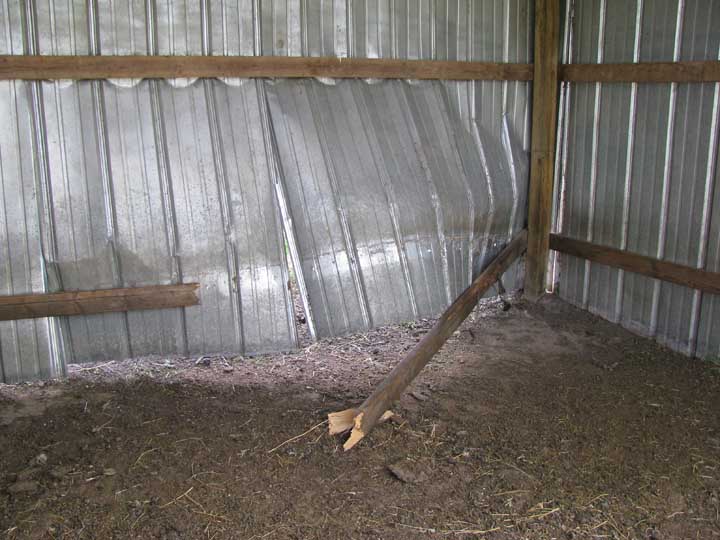
No, a car did not go through our fence and hit the sheep shelter. That bit of damage was done by Storm the ram. The shelter separates the ram pen from the pasture where the ewes were running. And he busted through the corrugated metal and 2X4 framing so he could rejoin the ewes.
I suppose he was mad that we took him away from the girls and put him in his own pen. For the winter -- a.k.a. breeding season -- we had him with most of the flock except for my two ten-year-old ewes and Storm's yearling daughter. We decided to let the three ewes go back with the rest of the flock, and put Storm by himself, so he wouldn't get those last three ewes pregnant. Although sheep are seasonal breeders, I'm not quite sure when their season ends because we have had September lambs in the past, so I know they can still get pregnant in April.
Storm was okay being separated from the girls last year, but he was younger then. Rams can get to be a problem as they get older. They seem to get bossier. He has also broken several fence posts. He is getting to be quite expensive, as well as dangerous. We all know better than to go into the pasture alone. His modus operandi is usually the same. First he runs up as if to say hi, then after checking you out, he backs up, puts his head down, and charges right at you. So, whenever something needs to be done in the pasture, two people need to go in there -- one to do what needs to be done and one to keep an eye on Storm and fend off his attacks.I'm starting to feel like some evil emperor executing too many subjects, but I don't think there are many people out there who would volunteer to give Storm a nice home. If by chance, you want this lovely boy to join your farm, contact me soon because sadly his days are numbered.
Since this is not the first time we've had a ram like this -- and I've heard plenty of other people talk about ram temperament -- I am starting to think that I may stop breeding sheep. I have plenty of wool, and if I run out, I know plenty of people who sell it. And my ewes will still be around for a lot of years. But seriously, I should probably sell some of them anyway. And here we are about to enter another lambing season!
Saturday, April 21, 2012
Bulls will be bulls
It's been a crazy day, and it's only noon. We started out with sheep shearing, and before that was done, we heard honking at the front gate. I went out there to find a neighbor telling me that our bull was flirting with his cows about a mile away. Mike and Katherine took a pan of alfalfa cubes and a lead rope, assuming they could just lead him home the way we did last summer when he got out.
Things didn't exactly go as planned. About twenty minutes later Mike called to say that Jaxon had sort of lost his mind, and they needed help. The sheep shearer had just finished, so I told Margaret and Jonathan to head over. I paid the shearer and decided to head out and see if they needed my help also. When I turned down the road I saw our truck slowly creeping towards me with a bull tied to a cattle chute that the truck was pulling.
According to Mike, this is what happened -- They walked right up to Jaxon when they arrived, and Jaxon started munching on the alfalfa cubes. Katherine snapped the lead rope onto his collar, and Mike started leading him down the road. When Jaxon realized that the goal was to take him away from the sexy cows, he got a little upset and took off. You don't have to have any experience with cattle to know that a man cannot stop a bull from running off if he really wants to run. That's when Mike called for reinforcements. They trapped Jaxon in a corner next to the chute, and Mike tied the end of the lead rope to the chute, then asked the neighbor if he could return it after bringing Jaxon home. He didn't want to risk trying to lead Jaxon to the pick-up and tying him to the bumper because they were thinking that Jaxon would just take off again.
When we got Jaxon home, I was taking pictures of him, saying that we needed to sell him. But then the obvious question arose -- where are we going to keep him so that he can't go visiting the neighbor's cows again? We had no idea. Obviously none of our fences are good enough. Our barn was originally built for racehorses, so that should hold him. But I am not feeding him hay and mucking out stalls forever. The option of turning him into beef was discussed, but we decided to just put him in the barn for now. I had the brilliant idea of putting a second lead rope on him so that two people could lead him into the barn. Do you think that worked?
Of course not. Obviously a bull is stronger than two men, and Jaxon knew it. I was really glad we have our entire property fenced, and as we watched him running around our front yard, we again started talking about butchering him. About twenty minutes passed as we tried to move him back to the barn, and then I told Mike to go inside and call the locker to find out how soon we could bring him in. Shortly after he went inside, Jaxon got close to the fence that separates the front and backyard, and our herding dog Porter started to run along the other side of the fence. That pushed Jaxon to start running in the direction of the barn. And he kept running. After all of the drama of the past hour, could this really end so easily?
Yes! Well, almost. Jaxon ran into the barn, and we closed the door behind him. He ran all the way to the other end, and we opened the door of a stall. Jonathan picked up the lead rope, and I suppose since Jaxon realized he didn't have anywhere to run, he walked back towards the front of the barn. When he saw the open stall door, he went inside, and Jonathan slammed the stall door behind him.
As the four of us came walking out of the barn, Mike came out of the house and yelled across the yard, asking us where Jaxon was. We were all incredibly happy that the bull was finally locked up. And Jaxon has an appointment with destiny for Monday morning.
There is a part of me that feels guilty for butchering him, as if we've failed. But he is a meat animal, and it simply is not practical for him to stay here. There is a lot of liability involved in having a bull, especially if he escaped and ran into the road, causing an accident. And it probably isn't even practical to have him with only two cows, although we've been sharing him with someone else who has two cows. He is a nice bull, as far as bulls go, but they have a lot of testosterone running through their bodies, and that makes them a challenge to handle and to house.
I've been planning a blog post on testosterone and rams, which I hope to get posted in the next few days!
Subscribe to:
Posts (Atom)


