Monday, April 30, 2012

The trouble with rams


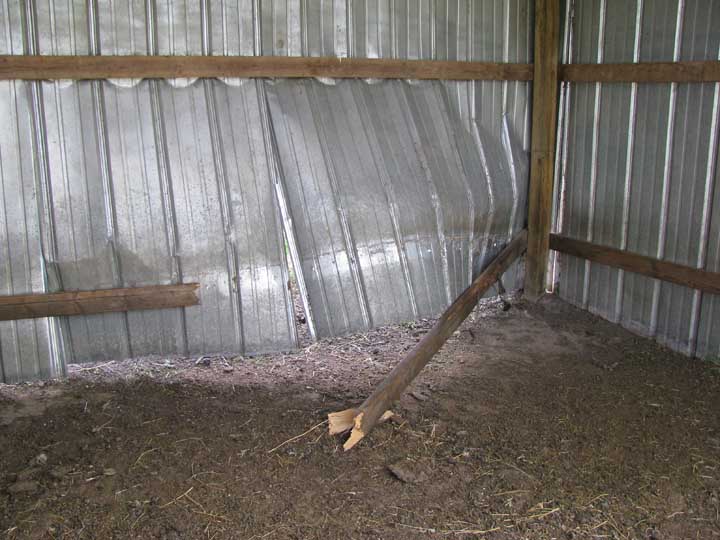
No, a car did not go through our fence and hit the sheep shelter. That bit of damage was done by Storm the ram. The shelter separates the ram pen from the pasture where the ewes were running. And he busted through the corrugated metal and 2X4 framing so he could rejoin the ewes.

I suppose he was mad that we took him away from the girls and put him in his own pen. For the winter -- a.k.a. breeding season -- we had him with most of the flock except for my two ten-year-old ewes and Storm's yearling daughter. We decided to let the three ewes go back with the rest of the flock, and put Storm by himself, so he wouldn't get those last three ewes pregnant. Although sheep are seasonal breeders, I'm not quite sure when their season ends because we have had September lambs in the past, so I know they can still get pregnant in April.

Storm was okay being separated from the girls last year, but he was younger then. Rams can get to be a problem as they get older. They seem to get bossier. He has also broken several fence posts. He is getting to be quite expensive, as well as dangerous. We all know better than to go into the pasture alone. His modus operandi is usually the same. First he runs up as if to say hi, then after checking you out, he backs up, puts his head down, and charges right at you. So, whenever something needs to be done in the pasture, two people need to go in there -- one to do what needs to be done and one to keep an eye on Storm and fend off his attacks.

I'm starting to feel like some evil emperor executing too many subjects, but I don't think there are many people out there who would volunteer to give Storm a nice home. If by chance, you want this lovely boy to join your farm, contact me soon because sadly his days are numbered.

Since this is not the first time we've had a ram like this -- and I've heard plenty of other people talk about ram temperament -- I am starting to think that I may stop breeding sheep. I have plenty of wool, and if I run out, I know plenty of people who sell it. And my ewes will still be around for a lot of years. But seriously, I should probably sell some of them anyway. And here we are about to enter another lambing season!

Saturday, April 21, 2012

Bulls will be bulls


It's been a crazy day, and it's only noon. We started out with sheep shearing, and before that was done, we heard honking at the front gate. I went out there to find a neighbor telling me that our bull was flirting with his cows about a mile away. Mike and Katherine took a pan of alfalfa cubes and a lead rope, assuming they could just lead him home the way we did last summer when he got out.

Things didn't exactly go as planned. About twenty minutes later Mike called to say that Jaxon had sort of lost his mind, and they needed help. The sheep shearer had just finished, so I told Margaret and Jonathan to head over. I paid the shearer and decided to head out and see if they needed my help also. When I turned down the road I saw our truck slowly creeping towards me with a bull tied to a cattle chute that the truck was pulling.


According to Mike, this is what happened -- They walked right up to Jaxon when they arrived, and Jaxon started munching on the alfalfa cubes. Katherine snapped the lead rope onto his collar, and Mike started leading him down the road. When Jaxon realized that the goal was to take him away from the sexy cows, he got a little upset and took off. You don't have to have any experience with cattle to know that a man cannot stop a bull from running off if he really wants to run. That's when Mike called for reinforcements. They trapped Jaxon in a corner next to the chute, and Mike tied the end of the lead rope to the chute, then asked the neighbor if he could return it after bringing Jaxon home. He didn't want to risk trying to lead Jaxon to the pick-up and tying him to the bumper because they were thinking that Jaxon would just take off again.

When we got Jaxon home, I was taking pictures of him, saying that we needed to sell him. But then the obvious question arose -- where are we going to keep him so that he can't go visiting the neighbor's cows again? We had no idea. Obviously none of our fences are good enough. Our barn was originally built for racehorses, so that should hold him. But I am not feeding him hay and mucking out stalls forever. The option of turning him into beef was discussed, but we decided to just put him in the barn for now. I had the brilliant idea of putting a second lead rope on him so that two people could lead him into the barn. Do you think that worked?

Of course not. Obviously a bull is stronger than two men, and Jaxon knew it. I was really glad we have our entire property fenced, and as we watched him running around our front yard, we again started talking about butchering him. About twenty minutes passed as we tried to move him back to the barn, and then I told Mike to go inside and call the locker to find out how soon we could bring him in.  Shortly after he went inside, Jaxon got close to the fence that separates the front and backyard, and our herding dog Porter started to run along the other side of the fence. That pushed Jaxon to start running in the direction of the barn. And he kept running. After all of the drama of the past hour, could this really end so easily?


Yes! Well, almost. Jaxon ran into the barn, and we closed the door behind him. He ran all the way to the other end, and we opened the door of a stall. Jonathan picked up the lead rope, and I suppose since Jaxon realized he didn't have anywhere to run, he walked back towards the front of the barn. When he saw the open stall door, he went inside, and Jonathan slammed the stall door behind him.


As the four of us came walking out of the barn, Mike came out of the house and yelled across the yard, asking us where Jaxon was. We were all incredibly happy that the bull was finally locked up. And Jaxon has an appointment with destiny for Monday morning.

There is a part of me that feels guilty for butchering him, as if we've failed. But he is a meat animal, and it simply is not practical for him to stay here. There is a lot of liability involved in having a bull, especially if he escaped and ran into the road, causing an accident. And it probably isn't even practical to have him with only two cows, although we've been sharing him with someone else who has two cows. He is a nice bull, as far as bulls go, but they have a lot of testosterone running through their bodies, and that makes them a challenge to handle and to house.

I've been planning a blog post on testosterone and rams, which I hope to get posted in the next few days!

Wednesday, April 11, 2012

Ten years!


It seems like it's only been a few years since I started my first chicks in the basement of our suburban Chicago home as we were waiting to close on the property that would become Antiquity Oaks, but as of yesterday, it's been ten years since we moved out here!

Back then, everyone thought we were crazy. When I told friends about our plans, they looked at me with scrunched up eyebrows and said, "Did you grow up on farm?" When I said, "No," they started to pepper me with questions like "Why are you doing this?" and "How are you going to know what to do?"

My father, who was still alive in 2002 said, "What do you want to do that for?" He clearly thought I'd lost my mind. He and my mother had left their farm and moved us to town when I was three years old. It's what smart, modern people did.

The above photo was taken in 2003. We had not made many changes at that point. We lived in the mobile home that was on the property when we bought it. We had put in a garden and a few fruit trees, but there was no chicken house and no picket fence across the front or buck pens in the pasture to the right of the barns.

"Bear"
We had four milk goats and a buck. We'd get our second buck in 2003, and he would turn out to be the best buck we've had to date, siring three of our best milkers. Unfortunately he'd only be with us for three years because we'd lose him to a copper deficiency that we didn't know was being caused by the sulfur in our well water.

We had two cows and our first two calves in 2003. There were no pigs or sheep yet, but we already had a nice poultry collection.

Although we never bought an egg again after we moved out here, it took a little longer to become self-reliant in the dairy department. Although we had four milk goats, I could only milk two of them, which gave us enough milk for our fluid milk needs and some chévre, yogurt, and goat milk soap. Today we make 17 different kinds of cheese.

We became vegetarians in 1989, and we had no intention of starting to eat meat when we came out here. Although today we eat the meat we grow, I am more committed than ever to not eating factory-farmed meat, so I still choose vegetarian options when eating in restaurants. Sometimes the more things change, the more they stay the same.

In 2002, people thought we were crazy. Today, they think we're cool. Even people who are content living in the city and eating conventional food can understand why we do what we do. That represents a huge shift in the mindset of society.

Has it really been ten years . . .
. . . since I learned to milk a goat?
. . . since my children came running into the house with a shiny, wet egg that they joyfully proclaimed was "fresh from the butt!"
. . . since I learned to make chévre and yogurt and kefir?
. . . since I started the most amazing journey of my life!

It has been an incredible decade! We've done everything we set out to do and more. We learned to grow our own food and make things I never dreamed of, like gjetost. And it never crossed my mind that we would someday be making our own maple syrup. I didn't even know there were any maple trees on this property when we bought it. When someone asked ten years ago if I had any plans to raise pigs, I laughed and said no.

New picket fence on Antiquity Oaks in 2009;
we built the house in 2005.
Yes, it's a lot of work. Yes, it can be really dirty. And yes, there are days when you feel your heart breaking. But there are also those delicious times -- like eating the first fresh asparagus a moment after snapping its stem while still standing in the garden. And there are joyful times -- like watching a mama hen with her chicks or seeing a fuzzy lamb bounce across the pasture. And there are those times that are simply too miraculous and wonderful for our language to be able to express -- like watching a baby goat come into the world, take its first breaths, and lift itself up on wobbly legs to find its first meal with its mother.

We've learned so much! We've lived so much! And I'm looking forward to the next ten years on Antiquity Oaks!

Monday, April 2, 2012

Girlfriend's triplets


This kidding season has been filled with more surprises than any other in recent memory. The triplets were not a surprise, but the way that Girlfriend did things was very unusual, to say the least.

Girlfriend, a first generation mini la mancha, has been quite large for at least a month, so I've been saying that I wouldn't be surprised if she had triplets, even though she's a yearling, and they usually only have one or two. Saturday night, her udder was quite large for a first freshener, but her tail ligaments were still very easy to find. The udder convinced me that she could kid pretty soon, so I put her in a kidding pen during evening chores.

A mini mancha doe with elf ears
Katherine was doing chores Sunday morning when she walked into the kidding barn to find Girlfriend standing in her pen munching away on hay with a kid nursing -- a fluffy, dry kid nursing! Katherine thought to herself, Well, isn't Mom going to be surprised that Girlfriend only had one kid!

She went to milk the goats and when she came back about half an hour later, there was a kid in the straw, still half covered with an amniotic sac, and Girlfriend was in the process of pushing out a third kid! It had to have been at least two or three hours since the first kid was born because it was completely dry and fluffy.

So the final count is one buck with erect ears and two does that are marked just like mama, but one has big ears. I definitely lost the ear lottery big time with the second generation mini manchas this year. Odd are that 25% will have erect ears, but three of the five mini kids this year actually have erect ears! Well, that lovely little doe will make a great family milker for someone who isn't interested in registered goats. But I digress . . . back to their entry into the world . . .

A mini mancha doe with erect ears,
which happens 25% of the time with second generation.
For the first time ever in the history of this farm, I have to say that I'm glad I wasn't present for a birth. Even though no one was there, we learned a lot. My "let nature take its course" attitude might have been tested severely if I'd been there. I am a lot more "hands off" than a lot of people with goats. As long as a doe is not in obvious distress, I let her handle things, and it works quite well. So many people are afraid that kids will be born dead if they don't intervene after a certain number of minutes, even when the doe seems perfectly fine. I could make guesses all day long about what I'd have done with Girlfriend, but I'll save myself the time and simply file away this information under "lessons learned."

Saturday, March 31, 2012

Miss Kitty's big surprise

If you're thinking that the title of this blog post looks familiar, you're right! We've had a lot of surprises this year. At last week's goat class, everyone was saying, "She's pregnant?" when they saw Miss Kitty. It's true, she didn't really look pregnant. But she had an udder, so I figured she was indeed pregnant. I was thinking she would have a single kid, which is not that uncommon for yearlings.

The first annoying thing about Kitty is that day 150 of her pregnancy came and went with no kids or sign of impending birth. I only recall two other births on this farm that happened after day 150, and both of them were Kitty's mom, so I told myself they just take a little longer to cook 'em before they're done. On the morning of day 151, which was Thursday, the baby monitor was acting up, so I figured I should personally check on her. Margaret was heading out to milk, so I walked out with her. When we walked into the kidding barn, Kitty was laying there as quiet as a mouse -- pushing! Margaret and I chatted for a minute or so, and then she headed to the next barn to milk the goats. I turned around, and Kitty gave a good push -- still completely quiet -- and a big blob of mucous came out. Obviously we were going to have kids sooner rather than later, so I went into the office and grabbed a stack of clean towels. When I got back, Kitty gave another big push, and there was a hoof. A couple more pushes, and there was a nose. And she was still as quiet as could be!

As soon as the head was out, I started cleaning off the nose, and -- whoosh! -- there was the whole kid. Kitty popped up, turned around and starting cleaning it up. I have never been so impressed with a first freshener. Most of them scream as if they're being tortured, and I don't think I've ever seen one pop up like she did and start cleaning up the kid. After I stick the kid in front of their face, they start licking it, but they don't usually realize they need to do anything about that huge thing that just exited their body. Talk about a natural mom!

It was a doeling, and she was quite the noisy one. She was big and strong and loud! After about fifteen minutes, Kitty plopped down and gave a push, but the doeling started crawling across the straw screaming, and Kitty jumped up again to follow her. I pulled the little doeling back towards her mama, so Kitty could concentrate on pushing out the second kid, which she did just as easily as the first. It was a buck, and as soon as I got him dried off, I put him under the heat lamp and decided to do the morning chores with the other goats in the kidding pen. Kitty didn't look like she even had twins in there, so I was pretty sure she was done. Plus there were a bunch of membranes and a bag of water hanging out of her back end, which you don't usually see unless you only have the placenta left.

I was adding clean straw to the other kidding pens and giving the does grain when I saw Kitty plop down and push out a bag of water about the size of a grapefruit. "No way!" I said as I rushed over to her. I picked up the bag of water, which looked like a pearly black water balloon and definitely contained a kid. I dug my fingernails into the membranes and broke them to find the tiniest little kid inside. I wiped off its nose and put it under the heat lamp. It sneezed and shook its head like most newborns. It seemed perfectly normal in spite of its small size.  Once I got over the shock of a third kid -- a tiny kid -- I checked the gender. It was another doe.

In the meantime, big sister is screaming non-stop unless she has a teat in her mouth. I try to hold her back so her brother can get a chance to nurse, which he figured out quickly. Margaret comes in when she's done milking, and when she sees the tiny doe, she knows what it means, even though we both try to avoid stating the obvious. Kids that size are usually house babies. I am not a fan of house babies because they get so attached to people. They make for very challenging adolescents because they don't usually like goats much and spend their life trying to figure out how to get back into the house.

I weigh the kids. Miss Piggy, as I've started calling the biggest one, weighs 2 pounds, 9 ounces. The buckling is 2 pounds. And the tiny one is 1 pound, 4 ounces.

A half hour after the tiny doe is born, she is still laying under the heat lamp where I placed her, and I notice that she's shivering. I put my finger in her mouth, and it's cold. Great! I know she's heading into hypothermia and will be dead soon if I do nothing. I wrap a towel around her and bring her into the house. I put her into a laundry basket with a heating pad and pull some colostrum out of the freezer to thaw. I put my finger into her mouth again to see if she has a sucking reflex because there is one thing I hate worse than house kids and that is having to tube feed. Thankfully, she starts sucking on my finger, which means she will be able to take a bottle!

After a few hours in the house, she is warm and fed -- although she can't consume more than about half an ounce at a time -- so Margaret decides to see how she will be with her siblings in the barn. Although she can stand now, she can't walk, so she never moves from the spot under the heat lamp. We bring her back into the house because it is simply easier. We have to feed her about every three hours until she is able to consume more than half an ounce at a time. And I am worried about her maintaining her body temperature in the barn overnight when the temperatures were predicted to get down into the 40s again.

She is two days old now and finally took an ounce this morning! And an hour later, she was sucking on Katherine's chin, which was the first time she had done that -- a classic sign that she wanted more milk. To our surprise, she drank another ounce! I was never terribly worried about her surviving after the first few minutes, but it will be interesting to see if she grows up to be a big, strong doe. Most tiny goats do. My first experience with a kid like this was seven years ago with Carmen, who was half the size of her two brothers when she was born, but she thrived in the house and grew up to become a master champion and earn milk stars in two registries. As much as house babies annoy me when they get older, you can't help but love 'em when they're so tiny!

Wednesday, March 28, 2012

Piglets!

Poor Julia finally farrowed. If you think she looks big now, look at where her feet are in relation to her belly -- much better than it was a couple days ago when her belly was dragging on the ground and the poor girl could barely walk! She gave birth sometime between Monday night and Tuesday morning. When Mike and I went into the barn for Tuesday morning chores, there were nine piglets all wiggling around, dry, and nursing.

 It is very hard to keep track of nine black piglets -- "did I already count that one?" -- but I think there are five gilts (females) and four boars (males). Sadly, one of the little girls was about half the size of everyone else, and I didn't have a lot of hope that she'd make it. And by this evening, she'd passed away. She seemed happy and healthy, but sometimes runts just don't have what it takes to survive.

I'm really surprised that Julia had nine piglets again. She sure looked bigger than last year! But I suppose she lost her girlish figure and just looked bigger this time.

The boars will mostly likely become pork, and the gilts will be offered for sale as breeding animals. They are American Guinea Hogs, which is an endangered farm animal, unique to the United States. There are only a few hundred in existence because they're small, which makes them undesirable for factory hog farming. However, that makes them perfect for homesteaders!

We are still waiting on Miss Kitty to have her kids (or kid). She is at day 150 now, so really she should give birth today! I've only had one goat go past 150 days, and she did it twice, AND it was Miss Kitty's mama. I suppose I shouldn't be holding my breath today.

Tuesday, March 27, 2012

Skippy's twins

As I said in Sunday night's post, the most logical time for anyone to give birth would be Monday because I had an out-of-town meeting. So, of course, that's when Skippy decided to kid. When Katherine did morning chores, she told us that Skippy's tail ligaments were quite soft, so Mike went out and put her in a clean kidding pen. I left for my meeting, assuming everything was under control. I mentioned that he and Jonathan should check on Skippy every couple of hours even though they had a baby monitor in the barn. Fast forward to my arrival home at 5:00.

"Skippy kidded!" someone said when I walked in.

"When?" I asked.

"We don't know. She has two kids, but she never made any noise over the monitor. It's a buck and a doe."

Turns out the monitor was on the wrong channel, but luckily, Skippy, who is only a yearling, is a great mom. Both kids were cleaned up and nursing when they were discovered. And it was still unseasonably warm, even though temperatures were in the 50s, so there was no problem with hypothermia because they were in the barn, out of the wind.

Doeling with elf ears
The buck has erect ears like a Nigerian. Skippy is a first generation mini mancha. Her dam is a la mancha, and her sire is a Nigerian. I'm one of those people who thinks the no-ear thing is cute, but I like smaller goats, which is why I'm experimenting with mini manchas. Anyway, first generation minis have one gene for erect ears and one gene for gopher ears, so they wind up with elf ears, which are extremely short ears. When two first generations are bred, you wind up with 25% gopher ears (almost nothing), 50% elf ears (really short ones), and 25% erect ears like a Nigerian or Swiss goat. The doeling has elf ears.

It's really funny that the kids are the same color as mom because that rarely happens with Nigerians or la manchas. Mom and her two kids would look like a perfect set of matched goats except for the erect ears on the buckling! Unfortunately for him, those ears mean he'll be castrated and sold as a pet.


Sunday, March 25, 2012

Ladies in waiting

Who will kid or farrow first?

Julia the pig, whose due date was Saturday, according to an online pig gestation calculator that I used almost four months ago --

Or Skippy the mini mancha who is at day 147?

She's got such a tiny baby bump, I'm glad she has an udder, or I wouldn't necessarily know she's pregnant. I'll be surprised if she has more than one, but then she is a yearling.

Or Miss Kitty the Nigerian dwarf yearling who is also at day 147?

Miss Kitty is really not looking like she is pregnant, but she also has an udder, so I have my hopes up. I've never had a ND with a precocious udder, and I hope she isn't the first.

And then there is Girlfriend the mini mancha, who isn't due until Thursday at the earliest, but she's bigger than either of the other goats, so I'm hoping she has twins doelings with gopher ears! Yes, I know, I want everything!

The only day that I have anything planned is Monday, so of course, that would be the logical time for everyone to go into labor, but everyone's tail ligaments still are as solid as steel, so I can't imagine they'll kid that soon.

As for Julia, the poor pig is so huge and miserable. The only time she stands up is if you bring food, and then she flails like a turtle that's stuck on its back. It's kind of scary, but so far she has always managed to get herself up. Her belly is dragging in the straw when she does attempt walking. Last year, she had nine, so I'm thinking she'll have more this year.

It's going to be an exciting week!

Sunday, March 18, 2012

What's wrong with these beautiful pictures?


 Daffodils blooming


 Rose bush leafing out

 Pear tree ready to bloom
Cherry blossoms
It's March 18! In case you're wondering why that's a problem, it's because we have NEVER had daffodils blooming in mid-March in Illinois! Last year, the daffodils were blooming at the end of April. In 2010, the fruit trees had blossoms, and the daffodils were blooming in mid-April. Looking through my blog over the years, it appears that my memory has not failed me. Daffodils do appear in mid-April -- normally -- not mid-March. Rose bushes do not have green leaves on them, nor do pear trees or cherry bushes bloom in March.

Everything is coming out of hibernation. The bees are buzzing around pollinating the blossoms. The dayliles are coming up, as well as the irises and the tulips. We have made a temporary pen in the front yard for the goats so that they can get out of the barn, which is too hot for them.

I don't see any positive end to this. If we go back to normal temperatures, all of the buds will freeze, so we won't have any fruit this year. If these record-breaking temperatures continue, I can hardly imagine what that will mean for us this summer. We've been having temperatures well above normal since October. And the temperatures have been in the 80s for several days now, and they're predicting they will continue for several more days before falling into the 70s. Normal high for March is 50s with freezing temperatures overnight. The low tonight is supposed to be 62.

Friday, March 16, 2012

Out of the frying pan and into the fire?

I totally understand the people living in the cities around me who are celebrating this beautiful weather that we're having. We don't normally see 80 degrees in Illinois until May. Our normal highs this time of year are somewhere in the 50s with freezing temperatures overnight. But then our weather has not been normal for a long time. It has been way above normal ever since October. All winter long we didn't go more than about three days without the temperature going above freezing during the day, which is not good. I was watching it, hoping and praying to have a good, long freeze of at least a couple of weeks to kill the bugs and parasites that plague the garden and the livestock. But it never happened.

It was lovely to wake up this morning with a cool breeze blowing across my face from the open window. It's my favorite way to wake up, so there is a part of me that's loving this weather too. But there's the other part of me that is torn between letting my baby goats out onto pasture and keeping them in the barn. It usually isn't a tough decision this time of year. If the pasture is still frozen, let the goats out; if it's wet, leave them in the barn which is a comfortable temperature.

But the past few days, I've been choosing between a barn so hot the goats are panting and a pasture that is probably covered with larvae from haemonchus contortus just waiting to be eaten by a goat host. The wetter the pasture, the more likely the larvae is still alive, and I keep walking through the pastures trying to find one that's dry enough to convince me that the larvae has died and the eggs have dried out with no hope of hatching. It feels like a lose-lose situation. And it's supposed to rain again tomorrow.

I am contemplating some non-conventional ideas, like putting the mamas and babies in the front yard, where goats have not grazed in the past year, so there are no parasite eggs or larvae on the ground. The down side is that we need some type of enclosure so that they don't eat my evergreens. And it would take a few people to get them to and from the barn daily, but I'll have a lot of help for the next week because it's the beginning of spring break. The other issue is that there is no shade where the ground is dry, which is why the ground is dry! Hopefully we can figure out something that will work. Just when you think you've got everything figured out, everything changes!

LinkWithin

Related Posts with Thumbnails