Tuesday, November 19, 2013

Foul fowl weather

The last few days have certainly been interesting. It all started on Saturday when things got really windy. We lost electricity in the late afternoon. We've learned over the years that if it isn't back in a few seconds, it won't be back for awhile, so Mike tried to start the generator. Key word: tried. It wouldn't start, so he spent the next couple hours working on it. The sun went down, and he kept working with the help of a flashlight, then the barn lights came on.

Good news: Electricity is back.

Bad news: We knew that Sunday's weather was predicted to be worse, and we still did not have a working generator.


Sunday morning, we were lounging in bed, sipping coffee. Mike was texting our daughter who now lives in Ft. Worth, and I was gazing out the window. Suddenly one of the turkey's moveable pens lifted off the ground, flew high into the air, and came down on top of a 12-foot tall pine tree. Mike's head immediately popped up from his cell phone, and as soon as he saw that I was staring out the window with my mouth wide open and spewing expletives, such as "Holy cow!" he whipped his head around in time to see the pen landing on top of the pine tree. He flew out of bed, and as we exited the bedroom, we met Jane, who was also running out of her bedroom. Because I was still in my gown, I was glad to see that Jane was dressed.

She and Mike ran out to the front yard as I ran for my camera. It seemed like it would be entirely inappropriate for me to yell after them, asking them to wait to remove the pen from the top of the tree while I switched to my zoom lens, which is why I didn't manage to get a picture of it. Those pens are not at all heavy, which was good for the tree and good for Mike and Jane, as it was easy to get down, and it had not broken any branches on the tree.


Once they had the pen down, they had to herd the turkeys back in there. Interestingly enough, the other turkey pen did not get blown away at all. We think it's because it was positioned at a 90 degree angle to the one that did get blown. As long as the wind could blow straight through the pen and under the tarp like a tunnel, it didn't get any lift. Unfortunately, the forecast was calling for the wind to shift in the afternoon from the south to the west.


The forecast was also calling for even stronger winds in the afternoon. Ultimately we decided to slide the pens up against the wooden fence, sticking the skids until the fence and tying the pen to the fence. Jane and Mike piled cinder blocks on the two corners of the skids that were not under the fence.


Mike went back to work on the generator, while Jane and I started chores. When we were feeding the sheep, we saw a ram lamb mount a ewe, which should not really have happened because the ram lambs were supposed to be castrated. Jane grabbed the little guy when he wasn't looking, and I checked for the presence of the family jewels. I thought that I felt two testicles that were very uneven in size. Since I had used a Burdizzo to castrate the little guy, I assumed that I had somehow missed the cord on one, so I was heading to the barn to grab the Burdizzo and try again. At that moment Jonathan was hurrying into the pasture to tell us that we were under a tornado alert.

"Well, we have a testicle alert here!" Jane shot back, as she was holding the little ram. I know tornadoes are nothing to play with, but we already had the little guy, so it should only take a minute to redo the job. I grabbed the Burdizzo from the barn and brought it out to the pasture. As soon as we were done and let the lamb go, I heard the roaring that was unmistakeably the sound of a tornado. I told Jane, who is from Baltimore and knows nothing about tornadoes, and we both started rushing to the house. Once we were close to the house, however, she wanted to stay outside and see everything. Amazingly enough, we were getting zero rain -- not even a drop! -- even though the radar showed purple and magenta over us, so we should have been getting buckets of rain. Later we learned that the tornado was only a couple of miles away.

We wound up losing Internet because the tornado knocked out electricity where our service provider's tower is located, but considering all of the people killed and houses damaged, we were extremely lucky. We are only an hour from Washington, IL, which made national news as it had some of the worst damage, and we have a friend closer to Chicago whose neighbor's barn was completely blown to bits. We've also seen a video of a twister touching down near Pontiac, which is only 12 miles from us. So, all things considered, we really can't complain.


Monday, November 11, 2013

Sheep debacle, part 2

Sorry it's taken me so long to finish the story about moving the sheep, but you know ... it's been a busy week. And I really wanted to have a picture to go with the story, and that just isn't happening, so here's the story!

Wednesday (the day after the original sheep debacle) is a day when Mike doesn't go to work until the afternoon, so we decided that we would simply set up a lane using our Electronet to move the sheep from their summer pasture to the winter pasture. After all, we have moved them from that pasture to the barn for shearing in the spring, and it worked just fine.

So, Mike set up the Electronet lanes, and no one even told me that they were going to move the sheep. They thought it would work so well. Then they came inside and told me what happened -- and it wasn't exactly what they had planned. Yes, the sheep did run right through the lanes of Electronet just like they do every spring for shearing. Then they ran between the barns (rather than into the barn) and they ran into the winter pasture ... and they ran through the pasture and didn't even bother to stop when they reached the traditional electric fence on the opposite end of the pasture. They went right through those five strands of electric wire and just kept running!

Mike and Jonathan and Jane assumed that the sheep ran around the south side of the pond and right back to their summer pasture, so they had come inside to ask for my help in keeping the sheep from running through the electric fence again after they herded them back the next time. So, I went down to the opposite end of the pasture and was hanging out when I heard screaming from the south, which is the opposite of the direction they were supposed to be coming from. As it turns out, the sheep had not run all the way back to their summer pasture. They had stopped once they were out of sight just south of the pond. So, we opened the gate on the south side of the winter pasture, and the sheep were herded into the pasture! Yay! No ... not so fast!

They ran into the winter pasture heading west, and they kept running ... and running. Everyone (except middle-aged me) ran after them and tried to get ahead of them so they could cut them off before they reached the electric fence on the west side of the pasture and went through it. And believe it or not, they actually succeeded! Yay! Yes, really! Bravo! Okay, not really, bravo ... not yet anyway.

Even though the sheep were in the pasture where we wanted them, it was quite obvious to everyone that they would not stay in there because they have zero respect for traditional electric fencing. Oh, yeah, that's why we moved them to the eastern pastures four years ago! (Those pastures are fenced with woven wire.) Funny how you forget little details like that. I had thought that it was merely because we had been keeping the cattle in the western pastures, and since we sold the cattle in July, we could now put the sheep in there for the winter, which would make winter feeding so much easier. But no, there was a real logistical reason that we had not been keeping sheep in there.

I suggested that we just fence in the sheep exactly where they were. By now, they had stopped running near the northern section of the pasture, and they were eying us suspiciously. I told Jonathan to go get the Electronet that had been used to create the lanes and bring it back and start setting it up to fence in the sheep in the area where they were currently standing. And that is what we did. They happened to be standing in an area where there was woven wire to the north and Electronet already set up on the east and west, so all we had to do was set up Electronet along the south, and they would be secure. It wasn't a huge area, but this was not meant to be permanent -- just to keep them in this area until they calmed down and realized that this was an okay place to spend the next few months.

So, we finally got the sheep where we wanted them, and they stayed put. This weekend, Mike and Jane put up Electronet around the entire perimeter of the western pasture so the sheep would have a larger area to graze and more grass to eat -- at least for a couple more weeks. We have started feeding hay already, and the sheep have calmed down, so this should be the end of the sheep drama ... at least for a few months.

Sunday, November 3, 2013

Sheep debacle


On Tuesday, we were going to move the sheep to a pasture near the barn to make it easier for us to feed them over the winter. We had been gradually rotating them from one pasture to another in that direction, so it didn't seem like it was going to be a big deal to move them the last leg into the correct pasture.


In addition to myself, there was apprentice Jane, son Jonathan, and a volunteer who's been helping out every Tuesday lately. Since he had zero experience with sheep, we told him to stand in the middle of the ford of the dried-up creek bed so that the sheep couldn't run across there when they reached the pasture. It seemed simple enough. We'd drive the sheep west, and they'd only have two choices -- run into the pasture or into the creek. Simple, right?


We opened up the temporary electric fencing that had been keeping them in their current area, and they were eager to run out.


Things were going splendidly! They ran straight north and then west to exactly where we wanted them to be. Jonathan and Jane were following close behind, and I was way behind because I'm middle-aged and slow.


There were a lot of trees between point A and point B, so I was only getting an occasional glimpse of the sheep, but I could see that they were moving perfectly.

Then suddenly, I see them moving east! What? East? They were coming back! I ran towards the area where I knew they'd be coming through, and when they got near me, I started screaming, "No! No! No!" And they all turned around and started running west again. I was so proud of myself. Then a few sheep ran across the creek before getting to the ford. Jonathan ran across the creek to try and turn them around again.

From this point, it all gets very fuzzy, and there was no more time for picture taking. Apparently the volunteer had walked up out of the middle of the dried up creek bed and was standing much too close to the pasture gate, so the sheep saw him, and they turned around again and came running back to where I was -- and this time they didn't stop when I yelled and jumped up and down, trying to look scary. Half of them ran to one side and half to the other side, zooming right past me! And they kept running ... and running ... and running.

They ran all the way back to their old pastures where they had spent most of the summer. Jonathan and Jane were in hot pursuit. About two-thirds of the sheep stopped in their old pasture, but the other third just kept going and went through the hayfield and then through the fence on the other side of the hayfield and into the woods. Jonathan and Jane disappeared.

Somehow Porter our English shepherd, who has zero herding training, had gotten himself into the pasture and was determined to move two spring lambs into the old pasture with the other sheep. That was not going well at all, and he was completely deaf to all of my commands to "come" and "sit" and "stay." Finally, he did come to me -- probably because he was just too exhausted to keep trying to herd the sheep -- so I took him back to the house. I told the volunteer that he could leave because a bunch of the sheep were gone, as well as Jonathan and Jane, and I didn't know when they were going to be back.

I went back out there, and eventually Jonathan and Jane came back through the woods. They said the sheep were completely lost, but within a few minutes, we heard them. They were across the creek. Everyone split up to go look for them, and at one point, I heard Jane scream. It turns out that the sound she was following was a rabbit that decided to turn around and run straight at her, which startled her.

We eventually got the sheep back into their old pasture. No, we did not try to move them back to the new pasture, which is on the other side of our property. The sun was going down, and we had not even started on evening chores. What we had expected would take about 15 minutes had occupied us for more than an hour.

Check back in a couple of days for the exciting conclusion!

Tuesday, October 29, 2013

Sheep rescue


After living on a farm for a few years, you feel like you've seen it all, but then you know that you will always have new challenges. But you can't imagine what they will be. And you assume that they will probably just be variations on a theme. Right?

Well, after last night's adventure, I'm actually kind of surprised that we haven't had this happen before. We do have a ridiculous number of thorny trees and bushes on our property, and I've picked out my share of thorns from wool after shearing. But I certainly never expected to have to rescue a sheep from a thorny bush!

Yesterday afternoon as Jane and I were about to head out to do evening chores, Jonathan came inside and told us that a ewe lamb was stuck in a bush. He said he tried to get her out, but it was impossible. We grabbed a pair of scissors and headed out to the sheep pasture. Jonathan sat down with the ewe in his lap while Jane started cutting the ewe's wool to get her free. It became obvious fairly quickly that this was not going to be an easy job. Notice in that top picture how there is wool all over the branches in every square inch of that photo? Well, that little ewe had apparently panicked herself to such a degree that her wool was severely twisted up with the thorny branches!


I headed back to the house to get another pair of scissors and a pair of pruning shears so that I could help Jane. Once I got back with the pruning shears, I was able to cut off the branches, so that at least we were not all being poked while we were trying to rescue her.


It looks like she has a bush growing out of her back, doesn't it!


We finally realized that it would have taken hours to get all of those branches cut out of her wool if we just continued using scissors -- and dusk was rapidly approaching. Jonathan and Jane agreed to carry the ewe back to the barn so that we could use sheep shears.


And that's what we did! Sheep shears are big, scary, and loud, and I was really nervous about accidentally cutting the little ewe, but I didn't, which made all of us very happy. Obviously I couldn't take a picture of the shearing because I was the one running the shears, but here is the big wad of wool and sticks that was ultimately cut off! Notice my little hand in the lower left corner of the above photo.


Then Jane continued picking out the last few little sticks that were left.


Unfortunately the thorns had damaged her skin and ripped out some wool by the roots. Ouch! We sprayed iodine on her injuries before putting her back in the pasture with the other sheep.


And we were all very surprised that she didn't actually look that bad after her very bad haircut!


Thursday, October 24, 2013

Interns, apprentices, and volunteers

If you've been around for awhile, you may remember my post about The challenge with apprentices last year. Thankfully, I've learned a few things in the past year, and we've had some new experiences. As Joel Salatin says in his latest book, Field of Farmers: Interning, Mentoring, Partnering, Germinating,
This is my best advice right now. I'm sure I'll learn something more tomorrow, but this is what I think today.
We've had three excellent apprentices this year, so I am ready to officially start looking for interns and apprentices for next year. I had completely stopped advertising last year, but didn't actually delete the apprentice page from our website, and three very motivated young ladies found the application and applied. And the rest (as they say) is history. We've had a really excellent time getting to know them, and it's been fun watching them learn and grow. If you want to know more about our apprentice program, click on the link to visit our website.

On the other hand, we've had two less-than-stellar experiences with people volunteering on an intermittent basis. I've come to the conclusion (which was reinforced by reading Joel's book) that people really do need to be on the farm day after day to learn farming skills. The hardest thing about people who volunteer for a day occasionally is that it is challenging to give them meaningful things to do. Usually the first time you do something with a new person, it takes far longer than it would if you were doing it alone because you are doing lots of explaining. And they don't know how to do it after doing it only once, which means you have to continue to help them with each new chore multiple times. This doesn't seem like such a big deal when someone is staying on the farm and will be there for several months.

The things that don't take a lot of extra time are things that are not fun -- like mucking out the barn or turning the compost pile. We've had a few conversations with our current apprentice about how we could utilize volunteers in a meaningful way, but we haven't come up with a great idea. I get quite a few requests from people who live within 100 miles and would like an internship experience but can't commit to staying on the farm due to their own life commitments, so I wish I could figure out how to provide an educational experience for them. I'm afraid that the best thing for them would be a program where they pay for a one-week crash course in farming, but that isn't something I'm ready to develop. But as Joel says, "I'm sure I'll learn something more tomorrow, but this is what I think today."

If you're interested in being a mentor or an intern -- on any farm -- I highly recommend Joel's book, Fields of Farmers. I'm not quite done with it, but when I finish, I'll be posting a review on my Thrifty Homesteader blog.

Sunday, October 20, 2013

Visit with future farmers


We had a visit on Wednesday from an agricultural marketing club at Illinois State University. Their project this year is to create a marketing plan for the American Guinea Hog, and they were referred to me by the Livestock Conservancy as being a breeder near them. Since I am very interested in educating future farmers, as well as promoting rare breeds, I was more than happy to have them come over to meet our hogs and see our farm.


We had a great visit! Not only was it the first time they had seen guinea hogs in person, it was also the first time most of them had seen pigs on pasture, as well as pigs that were being raised naturally, meaning they had never been injected with anything and they still had their tails. Supermarket hogs in this country are raised in big buildings and have their teeth and tails clipped at birth. They are also given iron injections and a number of routine vaccines, as well as antibiotics in their feed. Our pigs get none of that -- and thrive.


Although some of the students were quiet and reserved, a few seemed really excited about the guinea hogs and our way of raising them. The students will be putting together their marketing plan towards the end of this semester, which I am really excited about! It will be interesting to see how people with backgrounds in conventional agriculture promote virtues in a hog that is the polar opposite of everything in commercial ag today. And of course, it would be really exciting if even one of these students decided to raise guineas hogs someday!

Wednesday, October 16, 2013

Mother Earth News Fair in their own backyard

The past couple weeks have been crazy. Early last week I was getting ready for the Mother Earth News Fair, and then I headed out on Friday. This year the Mother Earth News Fair folks decided to stage an event in their own community -- Lawrence, KS -- and it was great. It was smaller than the events held in Pennsylvania and Washington State, and it was held in a park. It felt smaller than it was because the park was smaller than the other two venues, but the attendance wasn't that much smaller 10,000 versus the 12-14,000 that the other events draw.


One nice thing about having the event in the MEN backyard is that Mother Earth News Publisher Bryan Welch invited the speakers to his ranch for a party on Friday night. And of course, several of us asked for a tour of Rancho Cappuccino. Forget the fancy party tent and the band! We want to see livestock! And Bryan was happy to oblige.


Unfortunately most of his goats and sheep were not so cooperative, as they were way far off in the pasture, so we didn't get a great view of them. However, these are some ram lambs (above) that will soon become lamb chops.


And his breeding rams were more than happy to pose for pictures. It was almost dark, and I was using my phone's camera, so these pictures came out looking really artsy -- more like a painting than a photograph.


And I was also excited to see solar panels on Bryan's barn roof. He said that the panels produce enough electricity to pretty much meet their needs, although their system is tied into the local grid so that they have electricity even when the sun hasn't been shining for a few days. We've talked about putting solar panels on our barn roof, so it's good to see someone else has already tried it, and it's working fine. My husband was worried that the panels might be too heavy for our barn roof, so he'll probably want to talk to Bryan when he sees this post.

The Fair was great! I spoke about Ecothrifty Bread, Ecothrifty Living, and Raising Goats Naturally. It sure is interesting trying to condense a whole book into a one-hour talk of the most important points. My goat talk was at the same time that Temple Grandin was presenting, so I was worried that no one would show up -- but I figured that I would know that everyone at my talk really loved goats. To my surprise, the seats in the tent quickly filled up until there was standing room only.

Ecothrifty and Raising Goats Naturally both sold out in the bookstore, and the local public library had a copy of Ecothrifty sitting on their table. They asked if they could take a picture of me holding the book. It hasn't shown up on their Facebook page yet, so maybe they'll be using it for something else. Too bad I didn't get contact info for the woman there because I forgot to get any pictures of myself doing anything all weekend.

Overall, it was a great event. I arrived home late Monday night and was back in the barn Tuesday morning milking the goats.

Sunday, October 6, 2013

My television debut


by Agnes the goat


Those of you who follow me on Twitter already know that on Friday we taped my first television appearance. The show will air tomorrow afternoon on Paula Sands Live in Davenport, Iowa and the Quad Cities area.  My daughter Marie and I went with my milk maid Deborah, who wrote a book about goats recently. The other goats and I taught her everything she knows, so of course, she had to bring us along to publicly thank me and the other does back home for all of our assistance.

First of all, I have to say that I was really disappointed in the travel accommodations. I was shocked and horrified to discover that we were expected to travel to the TV studio in dog crates! Oh, yes, we each got our own private crate, and they were big enough for us to stand up and turn around, and they were filled with fluffy straw, and we were even given some hay for snacking, but really -- dog crates! We are caprines not canines!


When we arrived at the studio, the farm apprentice Jane escorted us into the building. We were taken in the back entrance -- the one that only the most famous people use! First they took us into the studio, and Marie started to poop on the floor. They asked us to go into a room called the "garage," which I assume is their term for the green room. Being my first time on television, I've never seen a green room before, but I sure expected it to look a lot nicer than it did. It reminded me of the front of the barn at home where the goatherd stores his tools and stuff.


A couple of people walked through the green room and asked what we were doing in there. I suppose this is the most special green room that only gets used for the biggest celebrities, and they wanted to be sure that we were important enough to be in there. Then more people came through and asked if they could pet me and Marie. Before we knew it, there were people having their pictures taken with us, including Greg the weatherman. I overheard my milk maid say that she never received that kind of attention when she's been at TV stations in the past. Obviously, the people in Iowa know true greatness when they see it.

When we went into the studio for the promo shot -- that's when they videotape us as Paula is doing a voice-over saying that goats will be in the next segment -- they asked us to stand on a rug in front of some beautiful plants that didn't smell good enough to eat. In fact, I've never smelled plants like those before. They didn't make me the least bit hungry. How strange! Marie and I both squatted to pee on the pretty rug, and people started gasping. You would think they'd never seen a goat pee before! Come to think of it, I've never seen a human pee, so maybe it isn't something they're capable of doing, which is why there were so impressed. Then we stood up and started to poop, and I heard more gasps and cries of, "Oh, no!" I really did not see the big deal. No one ever cared when we peed or pooped before!

Then they started talking about having us stay on the pretty rug. Earlier they said we would be with Deborah on the main set during the interview. There was a lot of talk about cleaning carpets. What does that have to do with our interview? We're here to talk about the greatness of goats and our wonderful milk, which we share with the barn servants so they can make cheese and soap.

So, Paula sat down with my milk maid, and the cameras were rolling. They talked about the book and our awesome milk. Paula tasted the chévre and showed off the soap that the barn servants made with our milk. Then Paula asked my milk maid about us, and Deborah introduced us but completely forgot to tell everyone how we helped her write the book! I was disappointed, but I suppose I should not have been surprised. After all, humans think they are so smart. Silly people even think they are smarter than us caprines. The simple truth is that my milk maid could not have written that book without us!


As we were getting ready to leave, Paula said she wanted to get her picture taken with us, so of course we obliged.

When my milk maid and the apprentice put us back into the dog crates (ugh!) for the ride home, they told us we were good goats (well, duh!) and gave us something called corn "chips," which didn't look like any corn that I'd ever seen before, although it smelled similar. I tried to resist eating them, thinking they might have been poisonous, but the humans left a few in the crate with me, and after a little while, I finally nibbled on one, and it tasted okay, so I ate all of them. I heard the humans talking about another television appearance in a few weeks. I do hope I get a luxurious travel trailer next time.

Marie and I were exhausted by the time we got home, and we spent the rest of the day lounging under a hickory tree while the rest of the herd was browsing around the pond.

Thursday, October 3, 2013

Castration day


For the first time since 2008, I castrated lambs. It was in 2009 that I discovered that I could get just as much meat from an intact lamb at six months as I could with a castrated lamb at a year or more, which was after feeding him through the winter. So, why put the little guys through castration and buy hay for them when they can grow so much faster with the aid of their own testosterone?

I am not entirely sure what happened this year, but only about a third of the ram lambs are big enough to be worth the cost to butcher, so we decided to castrate the little guys and let them stick around a little longer. About a third of the boys were only a little smaller than normal sized, but the last third were tiny little things. Maybe they were inbred? It was a bit of a free for all last fall, so it would have been a miracle if there wasn't at least some inbreeding.

These are the three rams that have their date with destiny next week. I got a little carried away taking pictures of them. They are handsome boys!


The others will be spending the winter with us and be sent to the locker sometime next year, probably depending upon when the grass slows down.

Tuesday, October 1, 2013

Acorn harvest


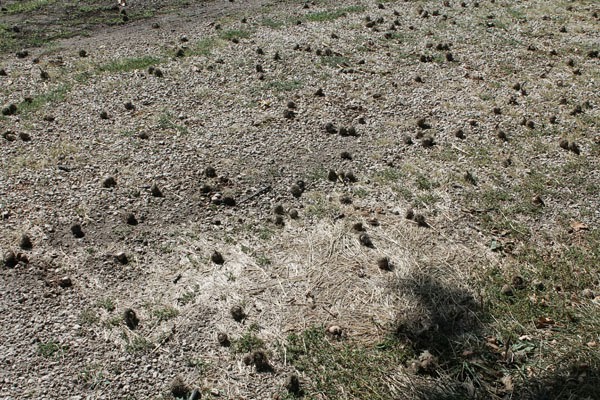
It's that time of year again -- the time that we used to hate, before we had the American Guinea Hogs. Acorns are falling from the trees. During our pre-hog years, it was a time of great danger, when simply walking across the driveway could result in a twisted ankle or bruised bum due to the "walking on marbles" situation provided by Mother Nature.


One of the reasons that I wanted Guinea Hogs is because they are friendly enough that we can easily lead them wherever we want them to go. We simply hold a bucket of whey or other yummy food in front of them, and they will follow us to the ends of the earth. In this case, they only had to follow us as far as the driveway. As soon as they realized they were surrounded by acorns, they went to work eating them. I didn't see a single hog laying down on the job the first day. The second day I did see some of them taking a nap mid-day.


The first year we just let them into the front yard and that was a mistake. When they got bored with the acorns, they went exploring and got into the barn to eat the chicken grain. They also destroyed a welded wire fence that separated them from the chicken yard.


So, now we use a single hot wire about eight inches off the ground charged by this nifty solar charger. Only eight inches off the ground, you say? Yep, pigs don't jump, so that works just fine to keep them inside the area under the big oak tree. That's right at nose level, and if they touch it, they let out a little squeal and run away. And it is really easy for us to step over the wire "fence" when walking through the yard.


LinkWithin

Related Posts with Thumbnails